

4.3 Green’s Spatial Functions
39
4.2 Green Function
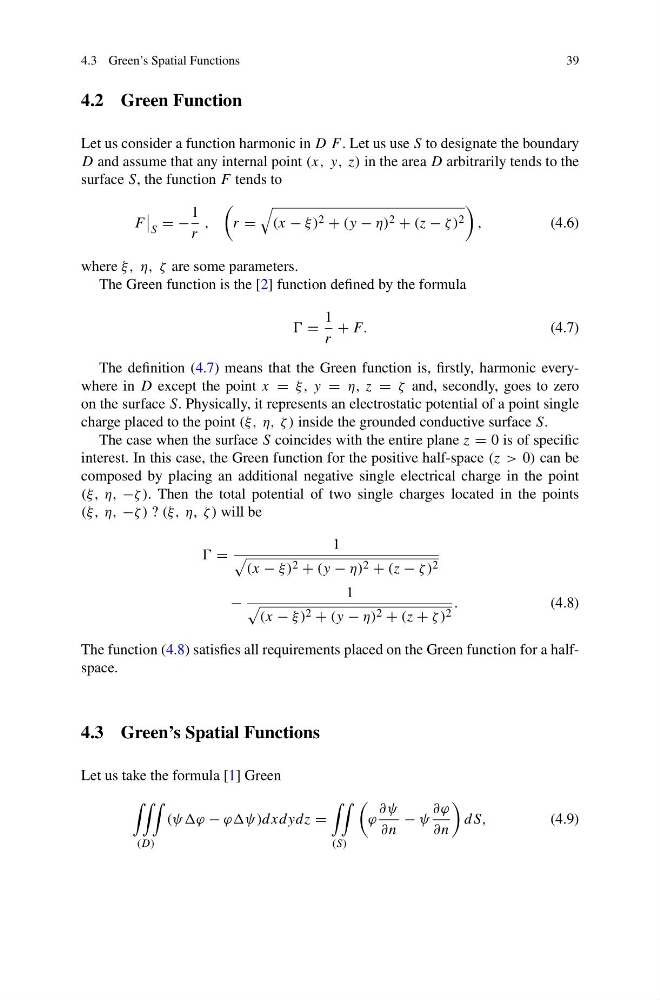
Let us consider a function harmonic in D F . Let us use S to designate the boundary
D and assume that any internal point (x, y, z) in the area D arbitrarily tends to the
surface S, the function F tends to
F
S
= −
1
r
,
r =
(x − ξ) 2 + (y − η) 2 + (z − ζ ) 2
,
(4.6)
where ξ, η, ζ are some parameters.
The Green function is the [2] function defined by the formula
=
1
r
+ F.
(4.7)
The definition (4.7) means that the Green function is, firstly, harmonic everywhere in D except the point x = ξ, y = η, z = ζ and, secondly, goes to zero
on the surface S. Physically, it represents an electrostatic potential of a point single
charge placed to the point (ξ, η, ζ) inside the grounded conductive surface S.
The case when the surface S coincides with the entire plane z = 0 is of specific
interest. In this case, the Green function for the positive half-space (z > 0) can be
composed by placing an additional negative single electrical charge in the point
(ξ, η, −ζ ). Then the total potential of two single charges located in the points
(ξ, η, −ζ ) ? (ξ, η, ζ) will be
=
1
(x − ξ) 2 + (y − η) 2 + (z − ζ ) 2
−
1
(x − ξ) 2 + (y − η) 2 + (z + ζ ) 2
.
(4.8)
The function (4.8) satisfies all requirements placed on the Green function for a halfspace.
4.3 Green’s Spatial Functions
Let us take the formula [1] Green
(D)
(ψψϕ − ϕϕψ)dxdydz =
(S)
ϕ
∂ψ
∂n
− ψ
∂ϕ
∂n
dS,
(4.9)
39
4.2 Green Function
Let us consider a function harmonic in D F . Let us use S to designate the boundary
D and assume that any internal point (x, y, z) in the area D arbitrarily tends to the
surface S, the function F tends to
F
S
= −
1
r
,
r =
(x − ξ) 2 + (y − η) 2 + (z − ζ ) 2
,
(4.6)
where ξ, η, ζ are some parameters.
The Green function is the [2] function defined by the formula
=
1
r
+ F.
(4.7)
The definition (4.7) means that the Green function is, firstly, harmonic everywhere in D except the point x = ξ, y = η, z = ζ and, secondly, goes to zero
on the surface S. Physically, it represents an electrostatic potential of a point single
charge placed to the point (ξ, η, ζ) inside the grounded conductive surface S.
The case when the surface S coincides with the entire plane z = 0 is of specific
interest. In this case, the Green function for the positive half-space (z > 0) can be
composed by placing an additional negative single electrical charge in the point
(ξ, η, −ζ ). Then the total potential of two single charges located in the points
(ξ, η, −ζ ) ? (ξ, η, ζ) will be
=
1
(x − ξ) 2 + (y − η) 2 + (z − ζ ) 2
−
1
(x − ξ) 2 + (y − η) 2 + (z + ζ ) 2
.
(4.8)
The function (4.8) satisfies all requirements placed on the Green function for a halfspace.
4.3 Green’s Spatial Functions
Let us take the formula [1] Green
(D)
(ψψϕ − ϕϕψ)dxdydz =
(S)
ϕ
∂ψ
∂n
− ψ
∂ϕ
∂n
dS,
(4.9)