

40
4 Three-Dimensional Harmonic Function
where D is some three-dimensional area confined by the surface S, n is the internal
normal line S, and ϕ and ψ are scalar functions having derivatives up to the second
order, inclusively.
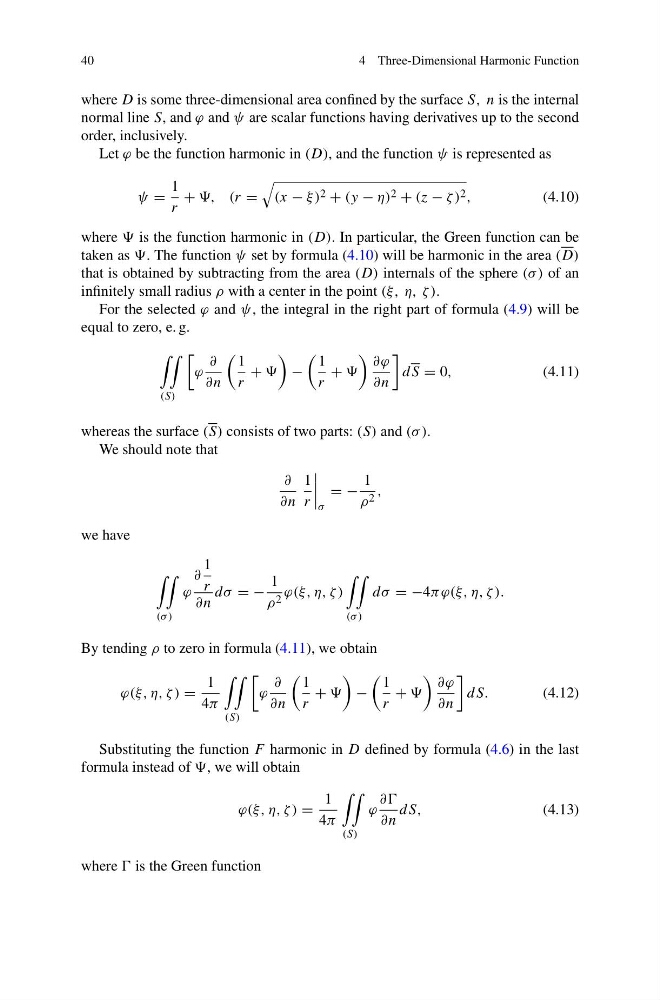
Let ϕ be the function harmonic in (D), and the function ψ is represented as
ψ =
1
r
+ , (r =
(x − ξ) 2 + (y − η) 2 + (z − ζ ) 2 ,
(4.10)
where is the function harmonic in (D). In particular, the Green function can be
taken as . The function ψ set by formula (4.10) will be harmonic in the area (D)
that is obtained by subtracting from the area (D) internals of the sphere (σ ) of an
infinitely small radius ρ with a center in the point (ξ, η, ζ ).
For the selected ϕ and ψ, the integral in the right part of formula (4.9) will be
equal to zero, e. g.
(S)
ϕ
∂
∂n
1
r
+
−
1
r
+
∂ϕ
∂n
dS = 0,
(4.11)
whereas the surface (S) consists of two parts: (S) and (σ ).
We should note that
∂
∂n
1
r
σ
= −
1
ρ 2 ,
we have
(σ )
ϕ
∂
1
r
∂n
dσ = −
1
ρ 2 ϕ(ξ, η, ζ )
(σ )
dσ = −4πϕ(ξ, η, ζ ).
By tending ρ to zero in formula (4.11), we obtain
ϕ(ξ, η, ζ ) =
1
4π
(S)
ϕ
∂
∂n
1
r
+
−
1
r
+
∂ϕ
∂n
dS.
(4.12)
Substituting the function F harmonic in D defined by formula (4.6) in the last
formula instead of , we will obtain
ϕ(ξ, η, ζ ) =
1
4π
(S)
ϕ
∂∂
∂n
dS,
(4.13)
where is the Green function
4 Three-Dimensional Harmonic Function
where D is some three-dimensional area confined by the surface S, n is the internal
normal line S, and ϕ and ψ are scalar functions having derivatives up to the second
order, inclusively.
Let ϕ be the function harmonic in (D), and the function ψ is represented as
ψ =
1
r
+ , (r =
(x − ξ) 2 + (y − η) 2 + (z − ζ ) 2 ,
(4.10)
where is the function harmonic in (D). In particular, the Green function can be
taken as . The function ψ set by formula (4.10) will be harmonic in the area (D)
that is obtained by subtracting from the area (D) internals of the sphere (σ ) of an
infinitely small radius ρ with a center in the point (ξ, η, ζ ).
For the selected ϕ and ψ, the integral in the right part of formula (4.9) will be
equal to zero, e. g.
(S)
ϕ
∂
∂n
1
r
+
−
1
r
+
∂ϕ
∂n
dS = 0,
(4.11)
whereas the surface (S) consists of two parts: (S) and (σ ).
We should note that
∂
∂n
1
r
σ
= −
1
ρ 2 ,
we have
(σ )
ϕ
∂
1
r
∂n
dσ = −
1
ρ 2 ϕ(ξ, η, ζ )
(σ )
dσ = −4πϕ(ξ, η, ζ ).
By tending ρ to zero in formula (4.11), we obtain
ϕ(ξ, η, ζ ) =
1
4π
(S)
ϕ
∂
∂n
1
r
+
−
1
r
+
∂ϕ
∂n
dS.
(4.12)
Substituting the function F harmonic in D defined by formula (4.6) in the last
formula instead of , we will obtain
ϕ(ξ, η, ζ ) =
1
4π
(S)
ϕ
∂∂
∂n
dS,
(4.13)
where is the Green function