

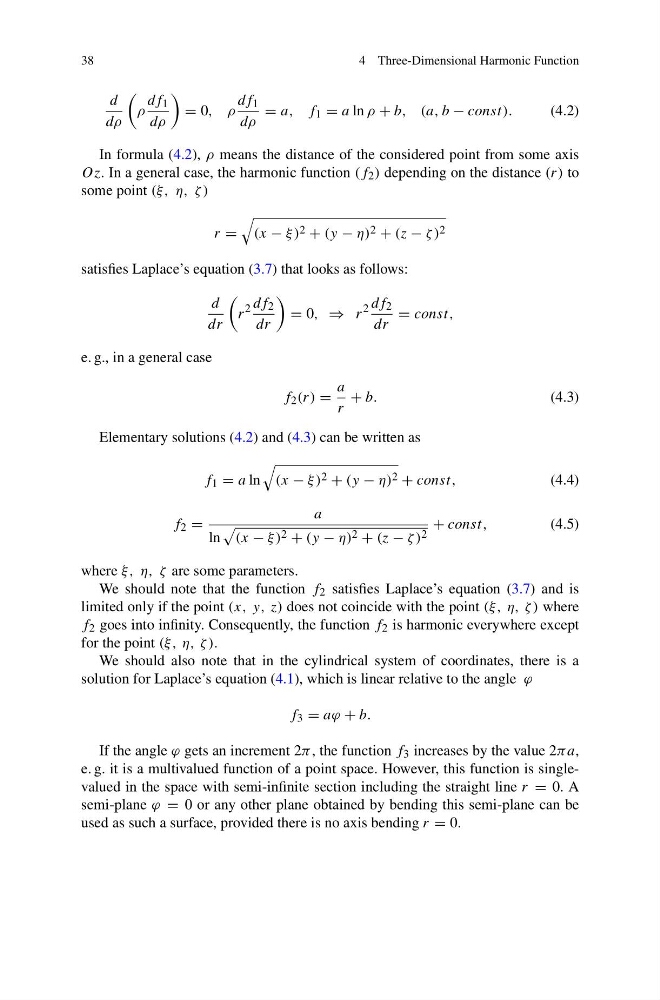
38
4 Three-Dimensional Harmonic Function
d
dρ
ρ
df 1
dρ
= 0, ρ
df 1
dρ
= a, f 1 = a ln ρ + b, (a, b − const).
(4.2)
In formula (4.2), ρ means the distance of the considered point from some axis
Oz. In a general case, the harmonic function (f 2 ) depending on the distance (r) to
some point (ξ, η, ζ )
r =
(x − ξ) 2 + (y − η) 2 + (z − ζ ) 2
satisfies Laplace’s equation (3.7) that looks as follows:
d
dr
r
2 df 2
dr
= 0, ⇒ r
2 df 2
dr
= const,
e. g., in a general case
f 2 (r) =
a
r
+ b.
(4.3)
Elementary solutions (4.2) and (4.3) can be written as
f 1 = a ln
(x − ξ) 2 + (y − η) 2 + const,
(4.4)
f 2 =
a
ln
(x − ξ) 2 + (y − η) 2 + (z − ζ ) 2
+ const,
(4.5)
where ξ, η, ζ are some parameters.
We should note that the function f 2 satisfies Laplace’s equation (3.7) and is
limited only if the point (x, y, z) does not coincide with the point (ξ, η, ζ) where
f 2 goes into infinity. Consequently, the function f 2 is harmonic everywhere except
for the point (ξ, η, ζ).
We should also note that in the cylindrical system of coordinates, there is a
solution for Laplace’s equation (4.1), which is linear relative to the angle ϕ
f 3 = aϕ + b.
If the angle ϕ gets an increment 2π , the function f 3 increases by the value 2πa,
e. g. it is a multivalued function of a point space. However, this function is singlevalued in the space with semi-infinite section including the straight line r = 0. A
semi-plane ϕ = 0 or any other plane obtained by bending this semi-plane can be
used as such a surface, provided there is no axis bending r = 0.
4 Three-Dimensional Harmonic Function
d
dρ
ρ
df 1
dρ
= 0, ρ
df 1
dρ
= a, f 1 = a ln ρ + b, (a, b − const).
(4.2)
In formula (4.2), ρ means the distance of the considered point from some axis
Oz. In a general case, the harmonic function (f 2 ) depending on the distance (r) to
some point (ξ, η, ζ )
r =
(x − ξ) 2 + (y − η) 2 + (z − ζ ) 2
satisfies Laplace’s equation (3.7) that looks as follows:
d
dr
r
2 df 2
dr
= 0, ⇒ r
2 df 2
dr
= const,
e. g., in a general case
f 2 (r) =
a
r
+ b.
(4.3)
Elementary solutions (4.2) and (4.3) can be written as
f 1 = a ln
(x − ξ) 2 + (y − η) 2 + const,
(4.4)
f 2 =
a
ln
(x − ξ) 2 + (y − η) 2 + (z − ζ ) 2
+ const,
(4.5)
where ξ, η, ζ are some parameters.
We should note that the function f 2 satisfies Laplace’s equation (3.7) and is
limited only if the point (x, y, z) does not coincide with the point (ξ, η, ζ) where
f 2 goes into infinity. Consequently, the function f 2 is harmonic everywhere except
for the point (ξ, η, ζ).
We should also note that in the cylindrical system of coordinates, there is a
solution for Laplace’s equation (4.1), which is linear relative to the angle ϕ
f 3 = aϕ + b.
If the angle ϕ gets an increment 2π , the function f 3 increases by the value 2πa,
e. g. it is a multivalued function of a point space. However, this function is singlevalued in the space with semi-infinite section including the straight line r = 0. A
semi-plane ϕ = 0 or any other plane obtained by bending this semi-plane can be
used as such a surface, provided there is no axis bending r = 0.