

32.8 The Application of Kröner’s Method to the Brazilian Test
435
σ 2 − p =
q
π
−
(1 − 2ν)(θ − θ 0 )
3
−
2(1 − ρ 2 ) sin 2θ 0
√ w 1 w 2
,
where it is indicated
w 1 = (1 + ρ
2 )
2
− 4ρ
2 cos
2 (θ 0 + ϕ); w 2 = (1 + ρ
2 )
2
− 4ρ
2 cos
2 (θ 0 − ϕ).
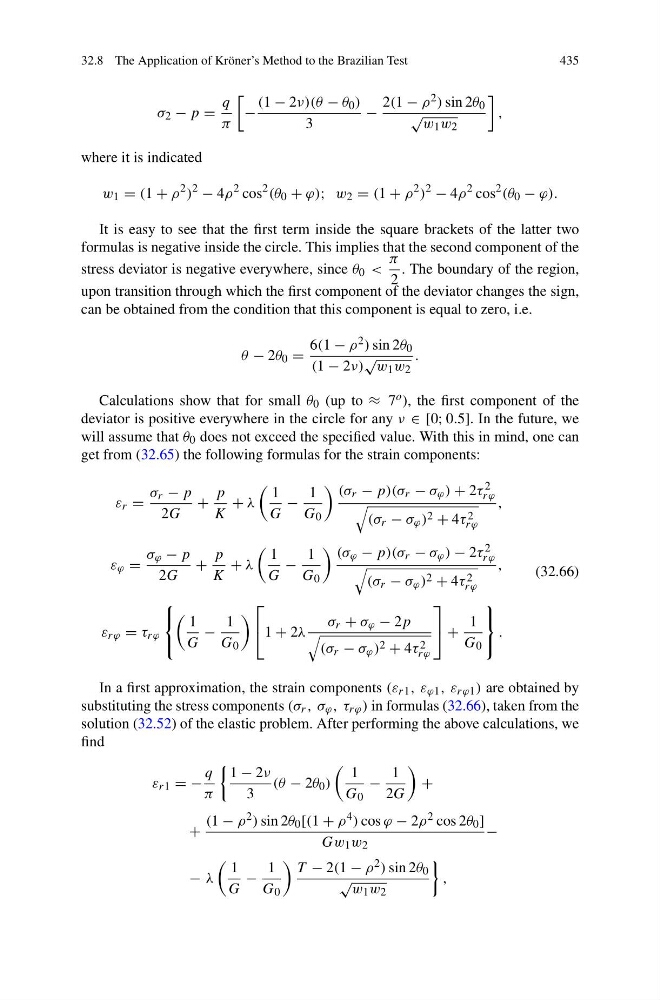
It is easy to see that the first term inside the square brackets of the latter two
formulas is negative inside the circle. This implies that the second component of the
stress deviator is negative everywhere, since θ 0 <
π
2
. The boundary of the region,
upon transition through which the first component of the deviator changes the sign,
can be obtained from the condition that this component is equal to zero, i.e.
θ − 2θ 0 =
6(1 − ρ 2 ) sin 2θ 0
(1 − 2ν)
√ w 1 w 2
.
Calculations show that for small θ 0 (up to ≈ 7 o ), the first component of the
deviator is positive everywhere in the circle for any ν ∈ [0; 0.5]. In the future, we
will assume that θ 0 does not exceed the specified value. With this in mind, one can
get from (32.65) the following formulas for the strain components:
ε r =
σ r − p
2G
+
p
K
+ λ
1
G
−
1
G 0
(σ r − p)(σ r − σ ϕ ) + 2τ 2
rϕ
(σ r − σ ϕ ) 2 + 4τ 2
rϕ
,
ε ϕ =
σ ϕ − p
2G
+
p
K
+ λ
1
G
−
1
G 0
(σ ϕ − p)(σ r − σ ϕ ) − 2τ 2
rϕ
(σ r − σ ϕ ) 2 + 4τ 2
rϕ
,
ε rϕ = τ rϕ
⎧
⎨
⎩
1
G
−
1
G 0
⎡
⎣ 1 + 2λ
σ r + σ ϕ − 2p
(σ r − σ ϕ ) 2 + 4τ 2
rϕ
⎤
⎦ +
1
G 0
⎫
⎬
⎭
.
(32.66)
In a first approximation, the strain components (ε r1 , ε ϕ1 , ε rϕ1 ) are obtained by
substituting the stress components (σ r , σ ϕ , τ rϕ ) in formulas (32.66), taken from the
solution (32.52) of the elastic problem. After performing the above calculations, we
find
ε r1 = −
q
π
1 − 2ν
3
(θ − 2θ 0 )
1
G 0
−
1
2G
+
+
(1 − ρ 2 ) sin 2θ 0 [(1 + ρ 4 ) cos ϕ − 2ρ 2 cos 2θ 0 ]
Gw 1 w 2
−
− λ
1
G
−
1
G 0
T − 2(1 − ρ 2 ) sin 2θ 0
√ w 1 w 2
,
435
σ 2 − p =
q
π
−
(1 − 2ν)(θ − θ 0 )
3
−
2(1 − ρ 2 ) sin 2θ 0
√ w 1 w 2
,
where it is indicated
w 1 = (1 + ρ
2 )
2
− 4ρ
2 cos
2 (θ 0 + ϕ); w 2 = (1 + ρ
2 )
2
− 4ρ
2 cos
2 (θ 0 − ϕ).
It is easy to see that the first term inside the square brackets of the latter two
formulas is negative inside the circle. This implies that the second component of the
stress deviator is negative everywhere, since θ 0 <
π
2
. The boundary of the region,
upon transition through which the first component of the deviator changes the sign,
can be obtained from the condition that this component is equal to zero, i.e.
θ − 2θ 0 =
6(1 − ρ 2 ) sin 2θ 0
(1 − 2ν)
√ w 1 w 2
.
Calculations show that for small θ 0 (up to ≈ 7 o ), the first component of the
deviator is positive everywhere in the circle for any ν ∈ [0; 0.5]. In the future, we
will assume that θ 0 does not exceed the specified value. With this in mind, one can
get from (32.65) the following formulas for the strain components:
ε r =
σ r − p
2G
+
p
K
+ λ
1
G
−
1
G 0
(σ r − p)(σ r − σ ϕ ) + 2τ 2
rϕ
(σ r − σ ϕ ) 2 + 4τ 2
rϕ
,
ε ϕ =
σ ϕ − p
2G
+
p
K
+ λ
1
G
−
1
G 0
(σ ϕ − p)(σ r − σ ϕ ) − 2τ 2
rϕ
(σ r − σ ϕ ) 2 + 4τ 2
rϕ
,
ε rϕ = τ rϕ
⎧
⎨
⎩
1
G
−
1
G 0
⎡
⎣ 1 + 2λ
σ r + σ ϕ − 2p
(σ r − σ ϕ ) 2 + 4τ 2
rϕ
⎤
⎦ +
1
G 0
⎫
⎬
⎭
.
(32.66)
In a first approximation, the strain components (ε r1 , ε ϕ1 , ε rϕ1 ) are obtained by
substituting the stress components (σ r , σ ϕ , τ rϕ ) in formulas (32.66), taken from the
solution (32.52) of the elastic problem. After performing the above calculations, we
find
ε r1 = −
q
π
1 − 2ν
3
(θ − 2θ 0 )
1
G 0
−
1
2G
+
+
(1 − ρ 2 ) sin 2θ 0 [(1 + ρ 4 ) cos ϕ − 2ρ 2 cos 2θ 0 ]
Gw 1 w 2
−
− λ
1
G
−
1
G 0
T − 2(1 − ρ 2 ) sin 2θ 0
√ w 1 w 2
,