

436
32 On Boundary Value Problems of Inelastic Body Mechanics
ε ϕ1 = −
q
π
1 − 2ν
3
(θ − 2θ 0 )
−
1
2G
−
1
G 0
−
−
(1 − ρ 2 ) sin 2θ 0 [(1 + ρ 4 ) cos ϕ − 2ρ 2 cos 2θ 0 ]
Gw 1 w 2
+
+ λ
1
G
−
1
G 0
T + 2(1 − ρ 2 ) sin 2θ 0
√ w 1 w 2
,
(32.67)
ε rϕ1 =
2q(1 − ρ 4 )(1 − ρ 2 ) sin 2θ 0 sin 2ϕ
πw 1 w 2
1
G
−
1
G 0
×
×
1 −
λ(1 − 2ν)(θ − 2θ 0 )
3(1 − ρ 2 ) sin 2θ 0
√
w 1 w 2
+
1
G 0
,
where indicated
T = (1 − 2ν)(θ − θ 0 )[(1 + ρ
4 ) cos 2ϕ − 2ρ
2 cos 2θ 0 ]/3.
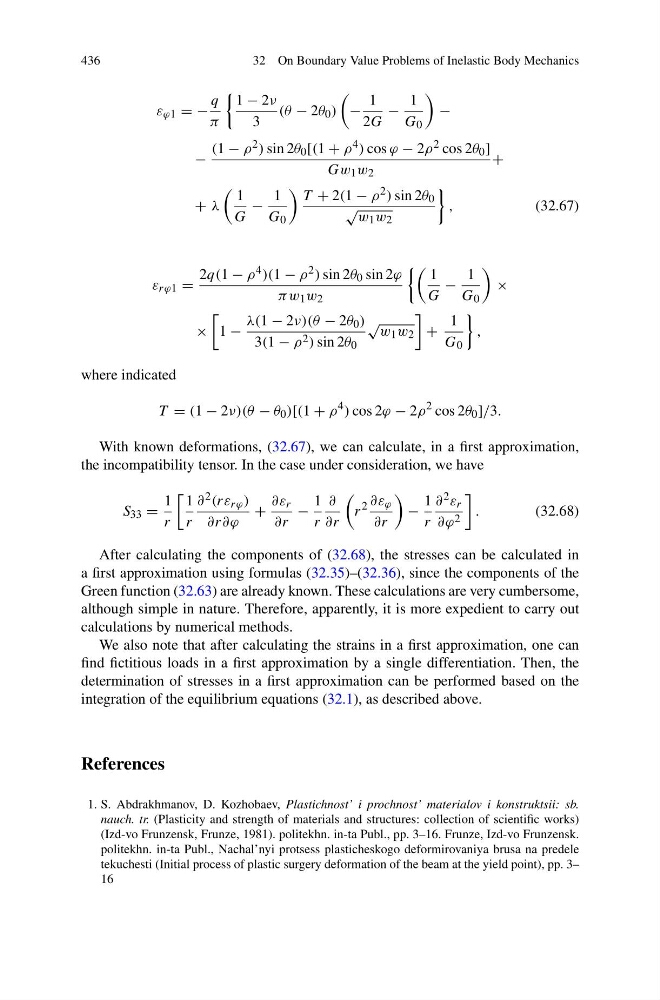
With known deformations, (32.67), we can calculate, in a first approximation,
the incompatibility tensor. In the case under consideration, we have
S 33 =
1
r
1
r
∂ 2 (rε rϕ )
∂r∂ϕ
+
∂ε r
∂r
−
1
r
∂
∂r
r
2 ∂ε ϕ
∂r
−
1
r
∂ 2 ε r
∂ϕ 2
.
(32.68)
After calculating the components of (32.68), the stresses can be calculated in
a first approximation using formulas (32.35)–(32.36), since the components of the
Green function (32.63) are already known. These calculations are very cumbersome,
although simple in nature. Therefore, apparently, it is more expedient to carry out
calculations by numerical methods.
We also note that after calculating the strains in a first approximation, one can
find fictitious loads in a first approximation by a single differentiation. Then, the
determination of stresses in a first approximation can be performed based on the
integration of the equilibrium equations (32.1), as described above.
References
1. S. Abdrakhmanov, D. Kozhobaev, Plastichnost’ i prochnost’ materialov i konstruktsii: sb.
nauch. tr. (Plasticity and strength of materials and structures: collection of scientific works)
(Izd-vo Frunzensk, Frunze, 1981). politekhn. in-ta Publ., pp. 3–16. Frunze, Izd-vo Frunzensk.
politekhn. in-ta Publ., Nachal’nyi protsess plasticheskogo deformirovaniya brusa na predele
tekuchesti (Initial process of plastic surgery deformation of the beam at the yield point), pp. 3–
16
32 On Boundary Value Problems of Inelastic Body Mechanics
ε ϕ1 = −
q
π
1 − 2ν
3
(θ − 2θ 0 )
−
1
2G
−
1
G 0
−
−
(1 − ρ 2 ) sin 2θ 0 [(1 + ρ 4 ) cos ϕ − 2ρ 2 cos 2θ 0 ]
Gw 1 w 2
+
+ λ
1
G
−
1
G 0
T + 2(1 − ρ 2 ) sin 2θ 0
√ w 1 w 2
,
(32.67)
ε rϕ1 =
2q(1 − ρ 4 )(1 − ρ 2 ) sin 2θ 0 sin 2ϕ
πw 1 w 2
1
G
−
1
G 0
×
×
1 −
λ(1 − 2ν)(θ − 2θ 0 )
3(1 − ρ 2 ) sin 2θ 0
√
w 1 w 2
+
1
G 0
,
where indicated
T = (1 − 2ν)(θ − θ 0 )[(1 + ρ
4 ) cos 2ϕ − 2ρ
2 cos 2θ 0 ]/3.
With known deformations, (32.67), we can calculate, in a first approximation,
the incompatibility tensor. In the case under consideration, we have
S 33 =
1
r
1
r
∂ 2 (rε rϕ )
∂r∂ϕ
+
∂ε r
∂r
−
1
r
∂
∂r
r
2 ∂ε ϕ
∂r
−
1
r
∂ 2 ε r
∂ϕ 2
.
(32.68)
After calculating the components of (32.68), the stresses can be calculated in
a first approximation using formulas (32.35)–(32.36), since the components of the
Green function (32.63) are already known. These calculations are very cumbersome,
although simple in nature. Therefore, apparently, it is more expedient to carry out
calculations by numerical methods.
We also note that after calculating the strains in a first approximation, one can
find fictitious loads in a first approximation by a single differentiation. Then, the
determination of stresses in a first approximation can be performed based on the
integration of the equilibrium equations (32.1), as described above.
References
1. S. Abdrakhmanov, D. Kozhobaev, Plastichnost’ i prochnost’ materialov i konstruktsii: sb.
nauch. tr. (Plasticity and strength of materials and structures: collection of scientific works)
(Izd-vo Frunzensk, Frunze, 1981). politekhn. in-ta Publ., pp. 3–16. Frunze, Izd-vo Frunzensk.
politekhn. in-ta Publ., Nachal’nyi protsess plasticheskogo deformirovaniya brusa na predele
tekuchesti (Initial process of plastic surgery deformation of the beam at the yield point), pp. 3–
16