

434
32 On Boundary Value Problems of Inelastic Body Mechanics
1
c
σ ϕ = ρ
2
0 − 1 + ln
V 3
V 4
+
2(1 − ρ 2
0 )V 5
V 4
+
(1 − ρ 2
0 )(V 2
6 − ρ 2
0 V 2
1 )
V 3 V 4
,
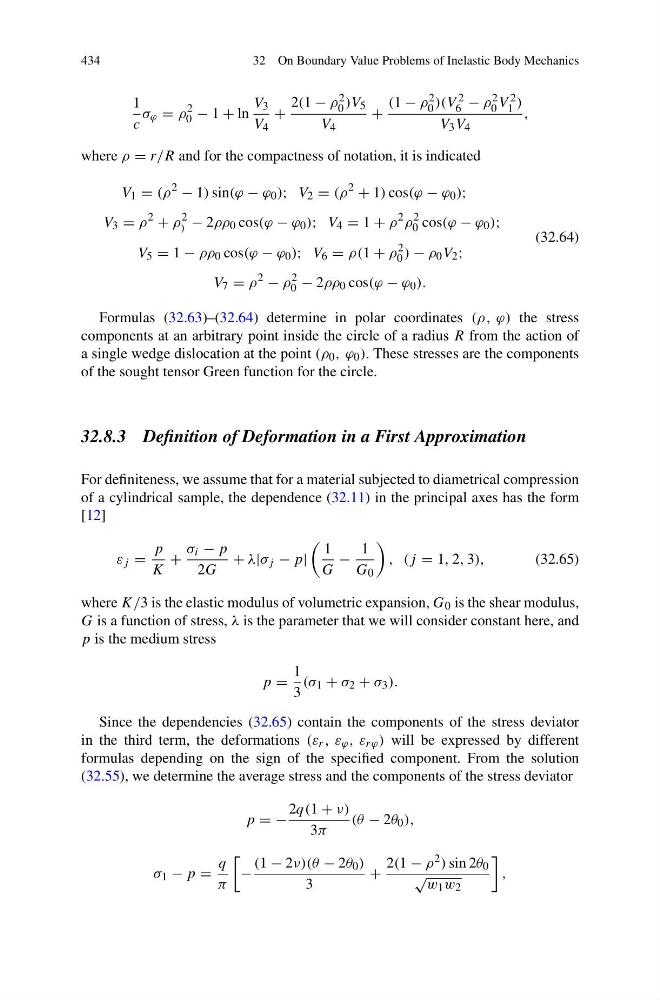
where ρ = r/R and for the compactness of notation, it is indicated
V 1 = (ρ
2
− 1) sin(ϕ − ϕ 0 ); V 2 = (ρ
2
+ 1) cos(ϕ − ϕ 0 );
V 3 = ρ
2
+ ρ
2
) − 2ρρ 0 cos(ϕ − ϕ 0 ); V 4 = 1 + ρ
2 ρ
2
0 cos(ϕ − ϕ 0 );
V 5 = 1 − ρρ 0 cos(ϕ − ϕ 0 ); V 6 = ρ(1 + ρ
2
0 ) − ρ 0 V 2 ;
V 7 = ρ
2
− ρ
2
0 − 2ρρ 0 cos(ϕ − ϕ 0 ).
(32.64)
Formulas (32.63)–(32.64) determine in polar coordinates (ρ, ϕ) the stress
components at an arbitrary point inside the circle of a radius R from the action of
a single wedge dislocation at the point (ρ 0 , ϕ 0 ). These stresses are the components
of the sought tensor Green function for the circle.
32.8.3 Definition of Deformation in a First Approximation
For definiteness, we assume that for a material subjected to diametrical compression
of a cylindrical sample, the dependence (32.11) in the principal axes has the form
[12]
ε j =
p
K
+
σ i − p
2G
+ λ|σ j − p|
1
G
−
1
G 0
, (j = 1, 2, 3),
(32.65)
where K/3 is the elastic modulus of volumetric expansion, G 0 is the shear modulus,
G is a function of stress, λ is the parameter that we will consider constant here, and
p is the medium stress
p =
1
3
(σ 1 + σ 2 + σ 3 ).
Since the dependencies (32.65) contain the components of the stress deviator
in the third term, the deformations (ε r , ε ϕ , ε rϕ ) will be expressed by different
formulas depending on the sign of the specified component. From the solution
(32.55), we determine the average stress and the components of the stress deviator
p = −
2q(1 + ν)
3π
(θ − 2θ 0 ),
σ 1 − p =
q
π
−
(1 − 2ν)(θ − 2θ 0 )
3
+
2(1 − ρ 2 ) sin 2θ 0
√ w 1 w 2
,
32 On Boundary Value Problems of Inelastic Body Mechanics
1
c
σ ϕ = ρ
2
0 − 1 + ln
V 3
V 4
+
2(1 − ρ 2
0 )V 5
V 4
+
(1 − ρ 2
0 )(V 2
6 − ρ 2
0 V 2
1 )
V 3 V 4
,
where ρ = r/R and for the compactness of notation, it is indicated
V 1 = (ρ
2
− 1) sin(ϕ − ϕ 0 ); V 2 = (ρ
2
+ 1) cos(ϕ − ϕ 0 );
V 3 = ρ
2
+ ρ
2
) − 2ρρ 0 cos(ϕ − ϕ 0 ); V 4 = 1 + ρ
2 ρ
2
0 cos(ϕ − ϕ 0 );
V 5 = 1 − ρρ 0 cos(ϕ − ϕ 0 ); V 6 = ρ(1 + ρ
2
0 ) − ρ 0 V 2 ;
V 7 = ρ
2
− ρ
2
0 − 2ρρ 0 cos(ϕ − ϕ 0 ).
(32.64)
Formulas (32.63)–(32.64) determine in polar coordinates (ρ, ϕ) the stress
components at an arbitrary point inside the circle of a radius R from the action of
a single wedge dislocation at the point (ρ 0 , ϕ 0 ). These stresses are the components
of the sought tensor Green function for the circle.
32.8.3 Definition of Deformation in a First Approximation
For definiteness, we assume that for a material subjected to diametrical compression
of a cylindrical sample, the dependence (32.11) in the principal axes has the form
[12]
ε j =
p
K
+
σ i − p
2G
+ λ|σ j − p|
1
G
−
1
G 0
, (j = 1, 2, 3),
(32.65)
where K/3 is the elastic modulus of volumetric expansion, G 0 is the shear modulus,
G is a function of stress, λ is the parameter that we will consider constant here, and
p is the medium stress
p =
1
3
(σ 1 + σ 2 + σ 3 ).
Since the dependencies (32.65) contain the components of the stress deviator
in the third term, the deformations (ε r , ε ϕ , ε rϕ ) will be expressed by different
formulas depending on the sign of the specified component. From the solution
(32.55), we determine the average stress and the components of the stress deviator
p = −
2q(1 + ν)
3π
(θ − 2θ 0 ),
σ 1 − p =
q
π
−
(1 − 2ν)(θ − 2θ 0 )
3
+
2(1 − ρ 2 ) sin 2θ 0
√ w 1 w 2
,