

426
32 On Boundary Value Problems of Inelastic Body Mechanics
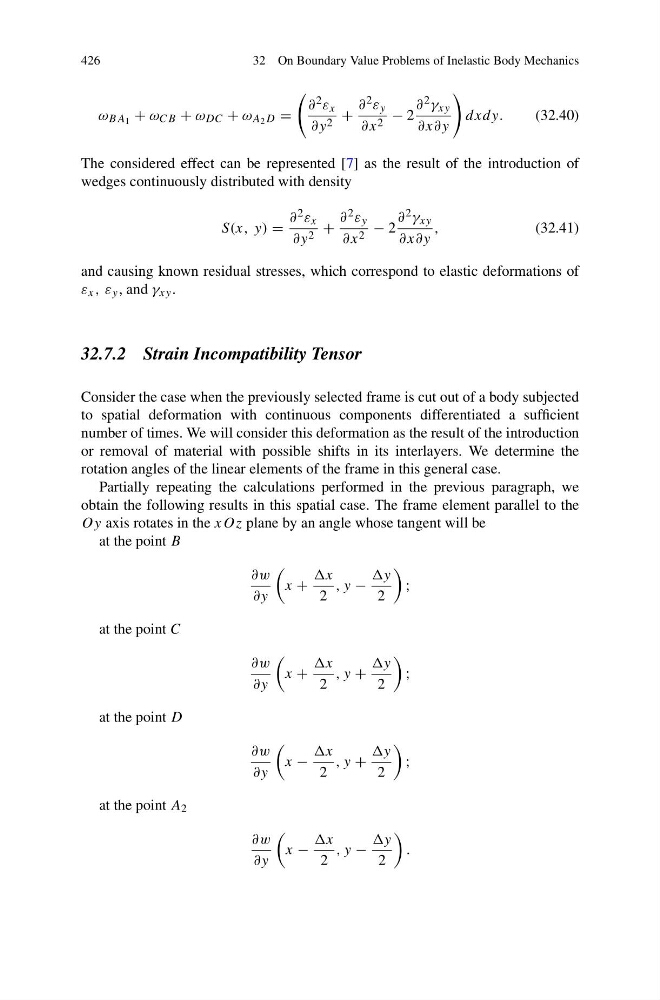
ω BA 1 + ω CB + ω DC + ω A 2 D =
∂ 2 ε x
∂y 2 +
∂ 2 ε y
∂x 2 − 2
∂ 2 γ xy
∂x∂y
dxdy.
(32.40)
The considered effect can be represented [7] as the result of the introduction of
wedges continuously distributed with density
S(x, y) =
∂ 2 ε x
∂y 2 +
∂ 2 ε y
∂x 2 − 2
∂ 2 γ xy
∂x∂y
,
(32.41)
and causing known residual stresses, which correspond to elastic deformations of
ε x , ε y , and γ xy .
32.7.2 Strain Incompatibility Tensor
Consider the case when the previously selected frame is cut out of a body subjected
to spatial deformation with continuous components differentiated a sufficient
number of times. We will consider this deformation as the result of the introduction
or removal of material with possible shifts in its interlayers. We determine the
rotation angles of the linear elements of the frame in this general case.
Partially repeating the calculations performed in the previous paragraph, we
obtain the following results in this spatial case. The frame element parallel to the
Oy axis rotates in the xOz plane by an angle whose tangent will be
at the point B
∂w
∂y
x +
x
2
, y −
y
2
;
at the point C
∂w
∂y
x +
x
2
, y +
y
2
;
at the point D
∂w
∂y
x −
x
2
, y +
y
2
;
at the point A 2
∂w
∂y
x −
x
2
, y −
y
2
.
32 On Boundary Value Problems of Inelastic Body Mechanics
ω BA 1 + ω CB + ω DC + ω A 2 D =
∂ 2 ε x
∂y 2 +
∂ 2 ε y
∂x 2 − 2
∂ 2 γ xy
∂x∂y
dxdy.
(32.40)
The considered effect can be represented [7] as the result of the introduction of
wedges continuously distributed with density
S(x, y) =
∂ 2 ε x
∂y 2 +
∂ 2 ε y
∂x 2 − 2
∂ 2 γ xy
∂x∂y
,
(32.41)
and causing known residual stresses, which correspond to elastic deformations of
ε x , ε y , and γ xy .
32.7.2 Strain Incompatibility Tensor
Consider the case when the previously selected frame is cut out of a body subjected
to spatial deformation with continuous components differentiated a sufficient
number of times. We will consider this deformation as the result of the introduction
or removal of material with possible shifts in its interlayers. We determine the
rotation angles of the linear elements of the frame in this general case.
Partially repeating the calculations performed in the previous paragraph, we
obtain the following results in this spatial case. The frame element parallel to the
Oy axis rotates in the xOz plane by an angle whose tangent will be
at the point B
∂w
∂y
x +
x
2
, y −
y
2
;
at the point C
∂w
∂y
x +
x
2
, y +
y
2
;
at the point D
∂w
∂y
x −
x
2
, y +
y
2
;
at the point A 2
∂w
∂y
x −
x
2
, y −
y
2
.