

32.3 An Example of Using the Birger Method
415
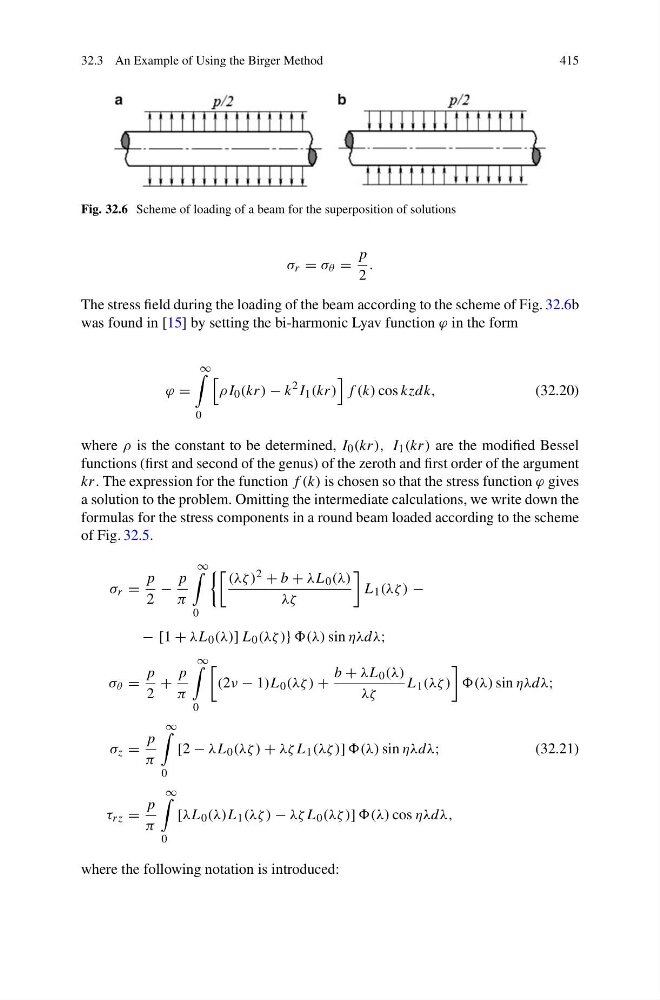
Fig. 32.6 Scheme of loading of a beam for the superposition of solutions
σ r = σ θ =
p
2
.
The stress field during the loading of the beam according to the scheme of Fig. 32.6b
was found in [15] by setting the bi-harmonic Lyav function ϕ in the form
ϕ =
∞
0
ρI 0 (kr) − k
2 I 1 (kr)
f (k) cos kzdk,
(32.20)
where ρ is the constant to be determined, I 0 (kr), I 1 (kr) are the modified Bessel
functions (first and second of the genus) of the zeroth and first order of the argument
kr. The expression for the function f (k) is chosen so that the stress function ϕ gives
a solution to the problem. Omitting the intermediate calculations, we write down the
formulas for the stress components in a round beam loaded according to the scheme
of Fig. 32.5.
σ r =
p
2
−
p
π
∞
0
(λζ ) 2 + b + λL 0 (λ)
λζ
L 1 (λζ ) −
− [1 + λL 0 (λ)] L 0 (λζ )} (λ) sin ηλdλ;
σ θ =
p
2
+
p
π
∞
0
(2ν − 1)L 0 (λζ ) +
b + λL 0 (λ)
λζ
L 1 (λζ )
(λ) sin ηλdλ;
σ z =
p
π
∞
0
[2 − λL 0 (λζ ) + λζ L 1 (λζ )] (λ) sin ηλdλ;
(32.21)
τ rz =
p
π
∞
0
[λL 0 (λ)L 1 (λζ ) − λζ L 0 (λζ )] (λ) cos ηλdλ,
where the following notation is introduced:
415
Fig. 32.6 Scheme of loading of a beam for the superposition of solutions
σ r = σ θ =
p
2
.
The stress field during the loading of the beam according to the scheme of Fig. 32.6b
was found in [15] by setting the bi-harmonic Lyav function ϕ in the form
ϕ =
∞
0
ρI 0 (kr) − k
2 I 1 (kr)
f (k) cos kzdk,
(32.20)
where ρ is the constant to be determined, I 0 (kr), I 1 (kr) are the modified Bessel
functions (first and second of the genus) of the zeroth and first order of the argument
kr. The expression for the function f (k) is chosen so that the stress function ϕ gives
a solution to the problem. Omitting the intermediate calculations, we write down the
formulas for the stress components in a round beam loaded according to the scheme
of Fig. 32.5.
σ r =
p
2
−
p
π
∞
0
(λζ ) 2 + b + λL 0 (λ)
λζ
L 1 (λζ ) −
− [1 + λL 0 (λ)] L 0 (λζ )} (λ) sin ηλdλ;
σ θ =
p
2
+
p
π
∞
0
(2ν − 1)L 0 (λζ ) +
b + λL 0 (λ)
λζ
L 1 (λζ )
(λ) sin ηλdλ;
σ z =
p
π
∞
0
[2 − λL 0 (λζ ) + λζ L 1 (λζ )] (λ) sin ηλdλ;
(32.21)
τ rz =
p
π
∞
0
[λL 0 (λ)L 1 (λζ ) − λζ L 0 (λζ )] (λ) cos ηλdλ,
where the following notation is introduced: