

414
32 On Boundary Value Problems of Inelastic Body Mechanics
Subtracting the plastic components (32.17) from elastic radial displacements (32.14), we obtain the value of the incompatibility of the strains at the
interface between the two zones
= u
p
− u
y
=
(σ s − σ 0 )(E − E 1 )
2EE 1
r.
(32.18)
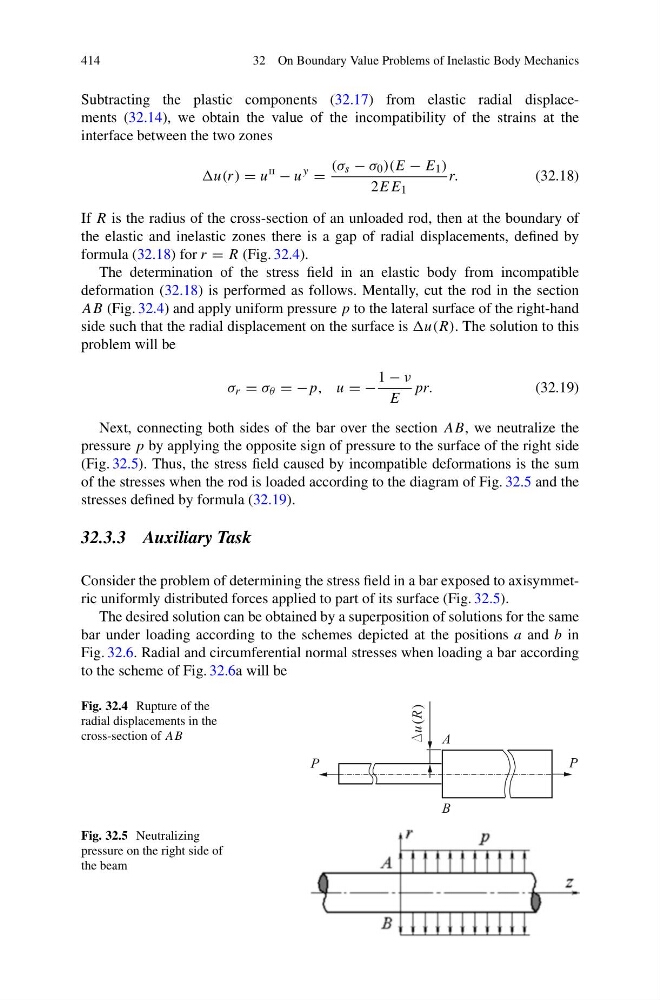
If R is the radius of the cross-section of an unloaded rod, then at the boundary of
the elastic and inelastic zones there is a gap of radial displacements, defined by
formula (32.18) for r = R (Fig. 32.4).
The determination of the stress field in an elastic body from incompatible
deformation (32.18) is performed as follows. Mentally, cut the rod in the section
AB (Fig. 32.4) and apply uniform pressure p to the lateral surface of the right-hand
side such that the radial displacement on the surface is u(R). The solution to this
problem will be
σ r = σ θ = −p, u = −
1 − ν
E
pr.
(32.19)
Next, connecting both sides of the bar over the section AB, we neutralize the
pressure p by applying the opposite sign of pressure to the surface of the right side
(Fig. 32.5). Thus, the stress field caused by incompatible deformations is the sum
of the stresses when the rod is loaded according to the diagram of Fig. 32.5 and the
stresses defined by formula (32.19).
32.3.3 Auxiliary Task
Consider the problem of determining the stress field in a bar exposed to axisymmetric uniformly distributed forces applied to part of its surface (Fig. 32.5).
The desired solution can be obtained by a superposition of solutions for the same
bar under loading according to the schemes depicted at the positions a and b in
Fig. 32.6. Radial and circumferential normal stresses when loading a bar according
to the scheme of Fig. 32.6a will be
Fig. 32.4 Rupture of the
radial displacements in the
cross-section of AB
Fig. 32.5 Neutralizing
pressure on the right side of
the beam
32 On Boundary Value Problems of Inelastic Body Mechanics
Subtracting the plastic components (32.17) from elastic radial displacements (32.14), we obtain the value of the incompatibility of the strains at the
interface between the two zones
= u
p
− u
y
=
(σ s − σ 0 )(E − E 1 )
2EE 1
r.
(32.18)
If R is the radius of the cross-section of an unloaded rod, then at the boundary of
the elastic and inelastic zones there is a gap of radial displacements, defined by
formula (32.18) for r = R (Fig. 32.4).
The determination of the stress field in an elastic body from incompatible
deformation (32.18) is performed as follows. Mentally, cut the rod in the section
AB (Fig. 32.4) and apply uniform pressure p to the lateral surface of the right-hand
side such that the radial displacement on the surface is u(R). The solution to this
problem will be
σ r = σ θ = −p, u = −
1 − ν
E
pr.
(32.19)
Next, connecting both sides of the bar over the section AB, we neutralize the
pressure p by applying the opposite sign of pressure to the surface of the right side
(Fig. 32.5). Thus, the stress field caused by incompatible deformations is the sum
of the stresses when the rod is loaded according to the diagram of Fig. 32.5 and the
stresses defined by formula (32.19).
32.3.3 Auxiliary Task
Consider the problem of determining the stress field in a bar exposed to axisymmetric uniformly distributed forces applied to part of its surface (Fig. 32.5).
The desired solution can be obtained by a superposition of solutions for the same
bar under loading according to the schemes depicted at the positions a and b in
Fig. 32.6. Radial and circumferential normal stresses when loading a bar according
to the scheme of Fig. 32.6a will be
Fig. 32.4 Rupture of the
radial displacements in the
cross-section of AB
Fig. 32.5 Neutralizing
pressure on the right side of
the beam