

32.3 An Example of Using the Birger Method
413
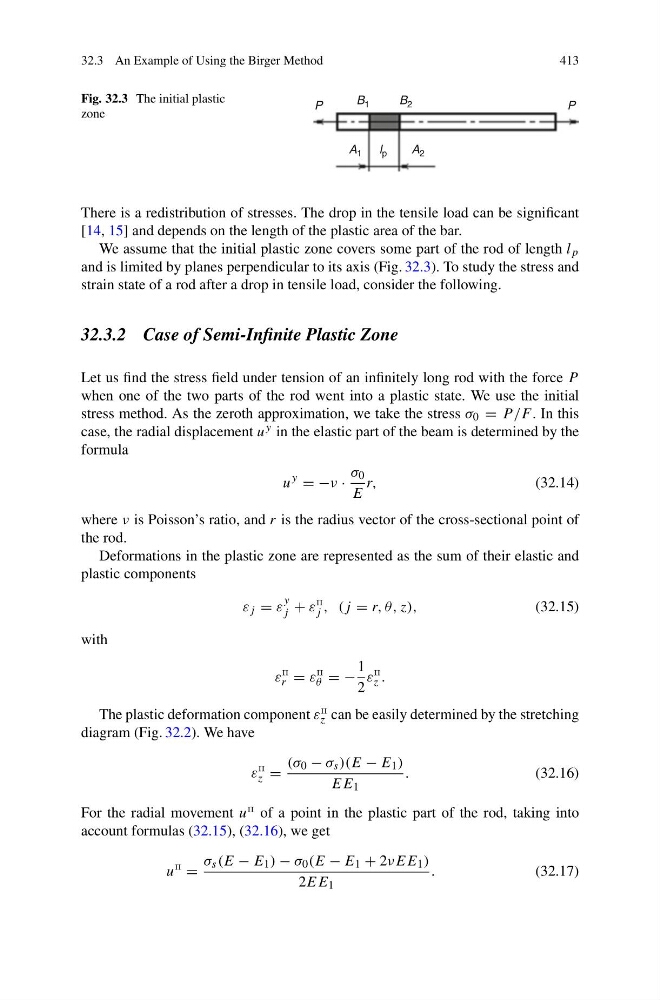
Fig. 32.3 The initial plastic
zone
P
B 1
B 2
P
A 2
l p
A 1
There is a redistribution of stresses. The drop in the tensile load can be significant
[14, 15] and depends on the length of the plastic area of the bar.
We assume that the initial plastic zone covers some part of the rod of length l p
and is limited by planes perpendicular to its axis (Fig. 32.3). To study the stress and
strain state of a rod after a drop in tensile load, consider the following.
32.3.2 Case of Semi-Infinite Plastic Zone
Let us find the stress field under tension of an infinitely long rod with the force P
when one of the two parts of the rod went into a plastic state. We use the initial
stress method. As the zeroth approximation, we take the stress σ 0 = P /F . In this
case, the radial displacement u y in the elastic part of the beam is determined by the
formula
u
y
= −ν ·
σ 0
E
r,
(32.14)
where ν is Poisson’s ratio, and r is the radius vector of the cross-sectional point of
the rod.
Deformations in the plastic zone are represented as the sum of their elastic and
plastic components
ε j = ε
y
j + ε
p
j , (j = r, θ, z),
(32.15)
with
ε
p
r = ε
p
θ = −
1
2
ε
p
z .
The plastic deformation component ε p
z can be easily determined by the stretching
diagram (Fig. 32.2). We have
ε
p
z =
(σ 0 − σ s )(E − E 1 )
EE 1
.
(32.16)
For the radial movement u p of a point in the plastic part of the rod, taking into
account formulas (32.15), (32.16), we get
u
p
=
σ s (E − E 1 ) − σ 0 (E − E 1 + 2νEE 1 )
2EE 1
.
(32.17)
413
Fig. 32.3 The initial plastic
zone
P
B 1
B 2
P
A 2
l p
A 1
There is a redistribution of stresses. The drop in the tensile load can be significant
[14, 15] and depends on the length of the plastic area of the bar.
We assume that the initial plastic zone covers some part of the rod of length l p
and is limited by planes perpendicular to its axis (Fig. 32.3). To study the stress and
strain state of a rod after a drop in tensile load, consider the following.
32.3.2 Case of Semi-Infinite Plastic Zone
Let us find the stress field under tension of an infinitely long rod with the force P
when one of the two parts of the rod went into a plastic state. We use the initial
stress method. As the zeroth approximation, we take the stress σ 0 = P /F . In this
case, the radial displacement u y in the elastic part of the beam is determined by the
formula
u
y
= −ν ·
σ 0
E
r,
(32.14)
where ν is Poisson’s ratio, and r is the radius vector of the cross-sectional point of
the rod.
Deformations in the plastic zone are represented as the sum of their elastic and
plastic components
ε j = ε
y
j + ε
p
j , (j = r, θ, z),
(32.15)
with
ε
p
r = ε
p
θ = −
1
2
ε
p
z .
The plastic deformation component ε p
z can be easily determined by the stretching
diagram (Fig. 32.2). We have
ε
p
z =
(σ 0 − σ s )(E − E 1 )
EE 1
.
(32.16)
For the radial movement u p of a point in the plastic part of the rod, taking into
account formulas (32.15), (32.16), we get
u
p
=
σ s (E − E 1 ) − σ 0 (E − E 1 + 2νEE 1 )
2EE 1
.
(32.17)