

396
30 Complex Strain of Soils
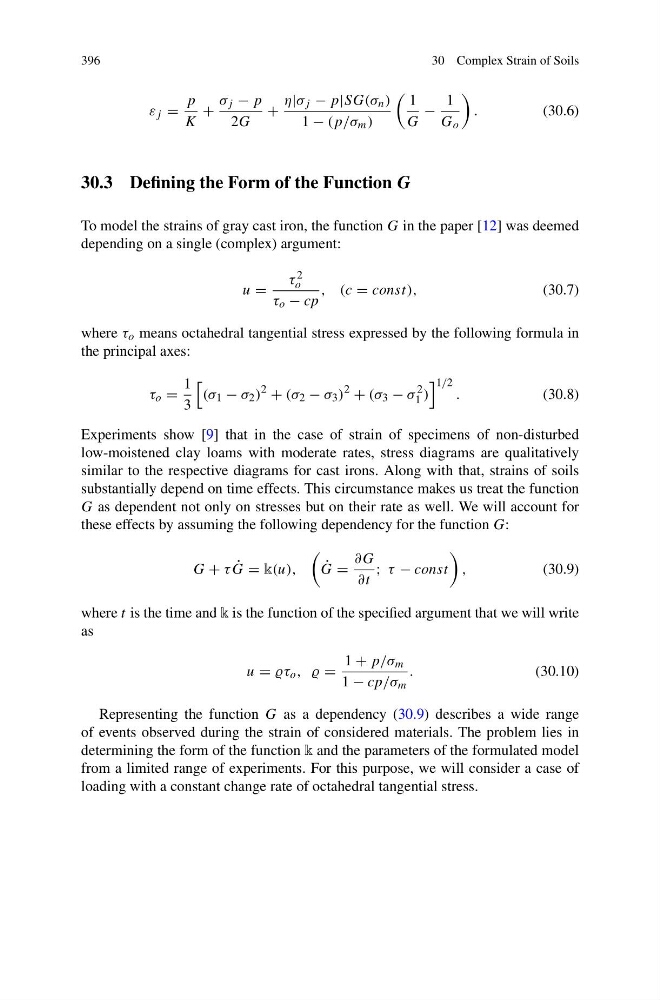
ε j =
p
K
+
σ j − p
2G
+
η|σ j − p|SG(σ n )
1 − (p/σ m )
1
G
−
1
G o
.
(30.6)
30.3 Defining the Form of the Function G
To model the strains of gray cast iron, the function G in the paper [12] was deemed
depending on a single (complex) argument:
u =
τ 2
o
τ o − cp
, (c = const),
(30.7)
where τ o means octahedral tangential stress expressed by the following formula in
the principal axes:
τ o =
1
3
(σ 1 − σ 2 )
2
+ (σ 2 − σ 3 )
2
+ (σ 3 − σ
2
1 )
1/2
.
(30.8)
Experiments show [9] that in the case of strain of specimens of non-disturbed
low-moistened clay loams with moderate rates, stress diagrams are qualitatively
similar to the respective diagrams for cast irons. Along with that, strains of soils
substantially depend on time effects. This circumstance makes us treat the function
G as dependent not only on stresses but on their rate as well. We will account for
these effects by assuming the following dependency for the function G:
G + τ ˙
G = k(u),
˙
G =
∂G
∂t
; τ − const
,
(30.9)
where t is the time and k is the function of the specified argument that we will write
as
u = τ o , , =
1 + p/σ m
1 − cp/σ m
.
(30.10)
Representing the function G as a dependency (30.9) describes a wide range
of events observed during the strain of considered materials. The problem lies in
determining the form of the function k and the parameters of the formulated model
from a limited range of experiments. For this purpose, we will consider a case of
loading with a constant change rate of octahedral tangential stress.
30 Complex Strain of Soils
ε j =
p
K
+
σ j − p
2G
+
η|σ j − p|SG(σ n )
1 − (p/σ m )
1
G
−
1
G o
.
(30.6)
30.3 Defining the Form of the Function G
To model the strains of gray cast iron, the function G in the paper [12] was deemed
depending on a single (complex) argument:
u =
τ 2
o
τ o − cp
, (c = const),
(30.7)
where τ o means octahedral tangential stress expressed by the following formula in
the principal axes:
τ o =
1
3
(σ 1 − σ 2 )
2
+ (σ 2 − σ 3 )
2
+ (σ 3 − σ
2
1 )
1/2
.
(30.8)
Experiments show [9] that in the case of strain of specimens of non-disturbed
low-moistened clay loams with moderate rates, stress diagrams are qualitatively
similar to the respective diagrams for cast irons. Along with that, strains of soils
substantially depend on time effects. This circumstance makes us treat the function
G as dependent not only on stresses but on their rate as well. We will account for
these effects by assuming the following dependency for the function G:
G + τ ˙
G = k(u),
˙
G =
∂G
∂t
; τ − const
,
(30.9)
where t is the time and k is the function of the specified argument that we will write
as
u = τ o , , =
1 + p/σ m
1 − cp/σ m
.
(30.10)
Representing the function G as a dependency (30.9) describes a wide range
of events observed during the strain of considered materials. The problem lies in
determining the form of the function k and the parameters of the formulated model
from a limited range of experiments. For this purpose, we will consider a case of
loading with a constant change rate of octahedral tangential stress.