

30.3 Defining the Form of the Function G
397
30.3.1 Building the G Function for a Material with High
Hardening
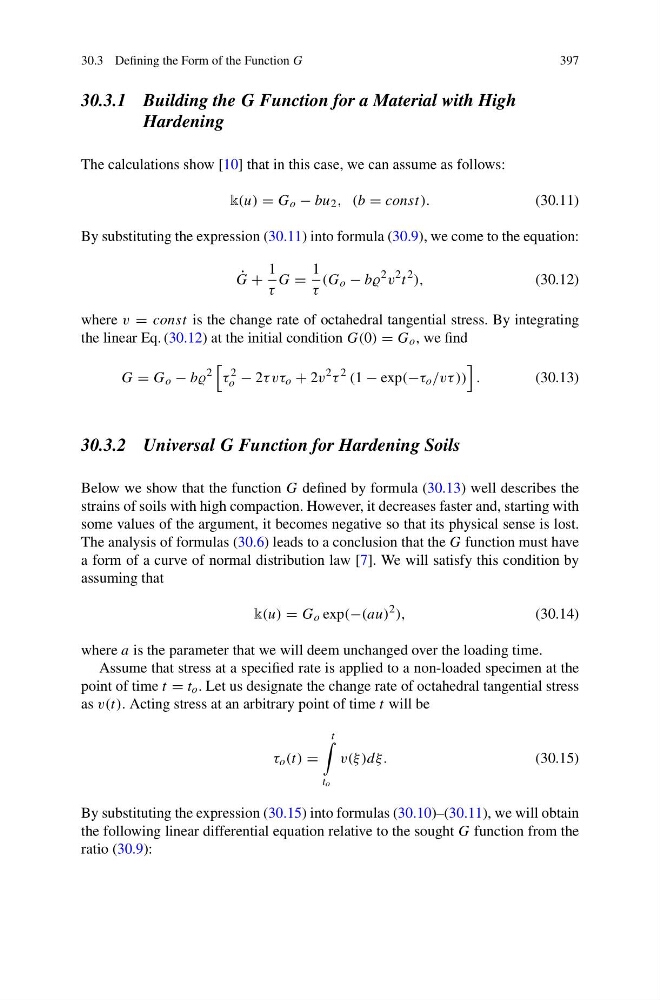
The calculations show [10] that in this case, we can assume as follows:
k(u) = G o − bu 2 , (b = const).
(30.11)
By substituting the expression (30.11) into formula (30.9), we come to the equation:
˙
G +
1
τ
G =
1
τ
(G o − bb
2 v
2 t
2 ),
(30.12)
where v = const is the change rate of octahedral tangential stress. By integrating
the linear Eq. (30.12) at the initial condition G(0) = G o , we find
G = G o − bb
2
τ
2
o − 2τ vτ o + 2v
2 τ
2 (1 − exp(−τ o /vτ ))
.
(30.13)
30.3.2 Universal G Function for Hardening Soils
Below we show that the function G defined by formula (30.13) well describes the
strains of soils with high compaction. However, it decreases faster and, starting with
some values of the argument, it becomes negative so that its physical sense is lost.
The analysis of formulas (30.6) leads to a conclusion that the G function must have
a form of a curve of normal distribution law [7]. We will satisfy this condition by
assuming that
k(u) = G o exp(−(au)
2 ),
(30.14)
where a is the parameter that we will deem unchanged over the loading time.
Assume that stress at a specified rate is applied to a non-loaded specimen at the
point of time t = t o . Let us designate the change rate of octahedral tangential stress
as v(t). Acting stress at an arbitrary point of time t will be
τ o (t) =
t
t o
v(ξ )dξ.
(30.15)
By substituting the expression (30.15) into formulas (30.10)–(30.11), we will obtain
the following linear differential equation relative to the sought G function from the
ratio (30.9):
397
30.3.1 Building the G Function for a Material with High
Hardening
The calculations show [10] that in this case, we can assume as follows:
k(u) = G o − bu 2 , (b = const).
(30.11)
By substituting the expression (30.11) into formula (30.9), we come to the equation:
˙
G +
1
τ
G =
1
τ
(G o − bb
2 v
2 t
2 ),
(30.12)
where v = const is the change rate of octahedral tangential stress. By integrating
the linear Eq. (30.12) at the initial condition G(0) = G o , we find
G = G o − bb
2
τ
2
o − 2τ vτ o + 2v
2 τ
2 (1 − exp(−τ o /vτ ))
.
(30.13)
30.3.2 Universal G Function for Hardening Soils
Below we show that the function G defined by formula (30.13) well describes the
strains of soils with high compaction. However, it decreases faster and, starting with
some values of the argument, it becomes negative so that its physical sense is lost.
The analysis of formulas (30.6) leads to a conclusion that the G function must have
a form of a curve of normal distribution law [7]. We will satisfy this condition by
assuming that
k(u) = G o exp(−(au)
2 ),
(30.14)
where a is the parameter that we will deem unchanged over the loading time.
Assume that stress at a specified rate is applied to a non-loaded specimen at the
point of time t = t o . Let us designate the change rate of octahedral tangential stress
as v(t). Acting stress at an arbitrary point of time t will be
τ o (t) =
t
t o
v(ξ )dξ.
(30.15)
By substituting the expression (30.15) into formulas (30.10)–(30.11), we will obtain
the following linear differential equation relative to the sought G function from the
ratio (30.9):