

29.3 Monotonous Plane-Plastic Strain
381
where
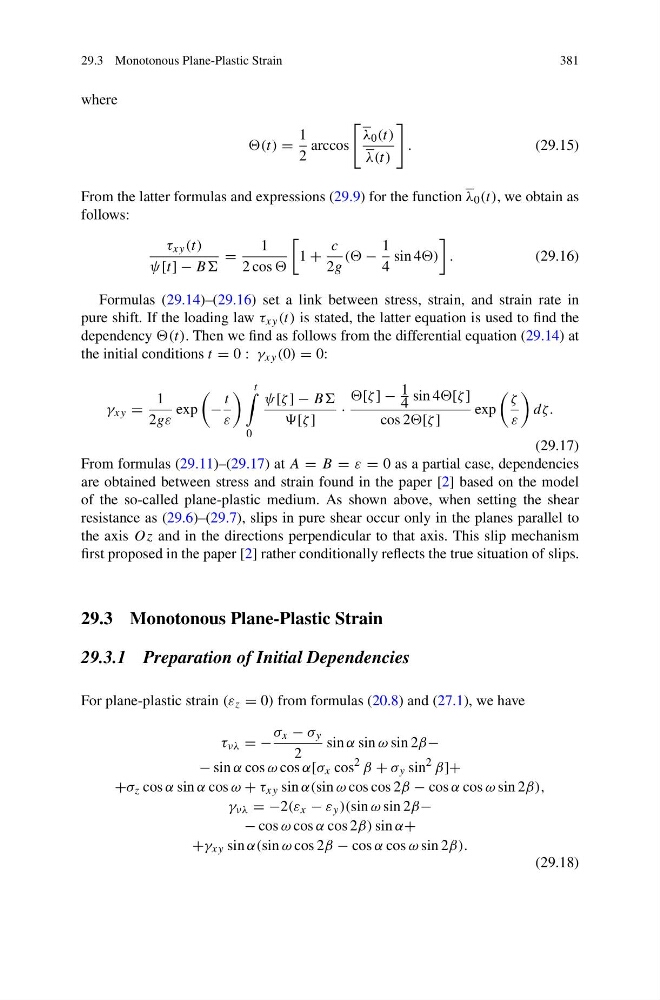
=
1
2
arccos
λ 0 (t)
λ(t)
.
(29.15)
From the latter formulas and expressions (29.9) for the function λ 0 (t), we obtain as
follows:
τ xy (t)
ψ[t] − BB
=
1
2 cos
1 +
c
2g
(( −
1
4
sin 4)
.
(29.16)
Formulas (29.14)–(29.16) set a link between stress, strain, and strain rate in
pure shift. If the loading law τ xy (t) is stated, the latter equation is used to find the
dependency Then we find as follows from the differential equation (29.14) at
the initial conditions t = 0 : γ xy (0) = 0:
γ xy =
1
2gε
exp
−
t
ε
t
0
ψ[ζ ] − BB
[ζ ]
·
[ζ ] − 1
4 sin 4[ζ ]
cos 2[ζ ]
exp
ζ
ε
dζ.
(29.17)
From formulas (29.11)–(29.17) at A = B = ε = 0 as a partial case, dependencies
are obtained between stress and strain found in the paper [2] based on the model
of the so-called plane-plastic medium. As shown above, when setting the shear
resistance as (29.6)–(29.7), slips in pure shear occur only in the planes parallel to
the axis Oz and in the directions perpendicular to that axis. This slip mechanism
first proposed in the paper [2] rather conditionally reflects the true situation of slips.
29.3 Monotonous Plane-Plastic Strain
29.3.1 Preparation of Initial Dependencies
For plane-plastic strain (ε z = 0) from formulas (20.8) and (27.1), we have
τ νλ = −
σ x − σ y
2
sin α sin ω sin 2β−
− sin α cos ω cos α[σ x cos
2 β + σ y sin
2 β]+
+σ z cos α sin α cos ω + τ xy sin α(sin ω cos cos 2β − cos α cos ω sin 2β),
γ νλ = −2(ε x − ε y )(sin ω sin 2β−
− cos ω cos α cos 2β) sin α+
+γ xy sin α(sin ω cos 2β − cos α cos ω sin 2β).
(29.18)
381
where
=
1
2
arccos
λ 0 (t)
λ(t)
.
(29.15)
From the latter formulas and expressions (29.9) for the function λ 0 (t), we obtain as
follows:
τ xy (t)
ψ[t] − BB
=
1
2 cos
1 +
c
2g
(( −
1
4
sin 4)
.
(29.16)
Formulas (29.14)–(29.16) set a link between stress, strain, and strain rate in
pure shift. If the loading law τ xy (t) is stated, the latter equation is used to find the
dependency Then we find as follows from the differential equation (29.14) at
the initial conditions t = 0 : γ xy (0) = 0:
γ xy =
1
2gε
exp
−
t
ε
t
0
ψ[ζ ] − BB
[ζ ]
·
[ζ ] − 1
4 sin 4[ζ ]
cos 2[ζ ]
exp
ζ
ε
dζ.
(29.17)
From formulas (29.11)–(29.17) at A = B = ε = 0 as a partial case, dependencies
are obtained between stress and strain found in the paper [2] based on the model
of the so-called plane-plastic medium. As shown above, when setting the shear
resistance as (29.6)–(29.7), slips in pure shear occur only in the planes parallel to
the axis Oz and in the directions perpendicular to that axis. This slip mechanism
first proposed in the paper [2] rather conditionally reflects the true situation of slips.
29.3 Monotonous Plane-Plastic Strain
29.3.1 Preparation of Initial Dependencies
For plane-plastic strain (ε z = 0) from formulas (20.8) and (27.1), we have
τ νλ = −
σ x − σ y
2
sin α sin ω sin 2β−
− sin α cos ω cos α[σ x cos
2 β + σ y sin
2 β]+
+σ z cos α sin α cos ω + τ xy sin α(sin ω cos cos 2β − cos α cos ω sin 2β),
γ νλ = −2(ε x − ε y )(sin ω sin 2β−
− cos ω cos α cos 2β) sin α+
+γ xy sin α(sin ω cos 2β − cos α cos ω sin 2β).
(29.18)