

380
29 Plane-Plastic Strain
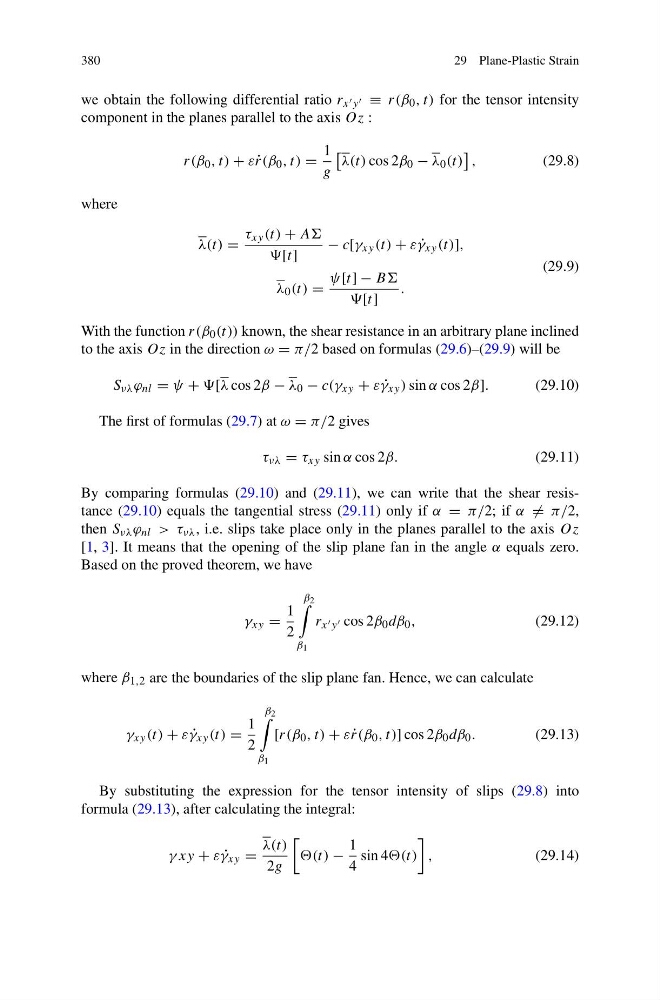
we obtain the following differential ratio r x y ≡ r(β 0 , t) for the tensor intensity
component in the planes parallel to the axis Oz :
r(β 0 , t) + ε ˙
r(β 0 , t) =
1
g
λ(t) cos 2β 0 − λ 0 (t)
,
(29.8)
where
λ(t) =
τ xy (t) + AA
[t]
− c[γ xy (t) + ε ˙
γ xy (t)],
λ 0 (t) =
ψ[t] − BB
[t]
.
(29.9)
With the function r(β 0 (t)) known, the shear resistance in an arbitrary plane inclined
to the axis Oz in the direction ω = π/2 based on formulas (29.6)–(29.9) will be
S νλ ϕ nl = ψ + [λ cos 2β − λ 0 − c(γ xy + ε ˙
γ xy ) sin α cos 2β].
(29.10)
The first of formulas (29.7) at ω = π/2 gives
τ νλ = τ xy sin α cos 2β.
(29.11)
By comparing formulas (29.10) and (29.11), we can write that the shear resistance (29.10) equals the tangential stress (29.11) only if α = π/2; if α = π/2,
then S νλ ϕ nl > τ νλ , i.e. slips take place only in the planes parallel to the axis Oz
[1, 3]. It means that the opening of the slip plane fan in the angle α equals zero.
Based on the proved theorem, we have
γ xy =
1
2
β 2
β 1
r x y cos 2β 0 dβ 0 ,
(29.12)
where β 1,2 are the boundaries of the slip plane fan. Hence, we can calculate
γ xy (t) + ε ˙
γ xy (t) =
1
2
β 2
β 1
[r(β 0 , t) + ε ˙
r(β 0 , t)] cos 2β 0 dβ 0 .
(29.13)
By substituting the expression for the tensor intensity of slips (29.8) into
formula (29.13), after calculating the integral:
γ xy + ε ˙
γ xy =
λ(t)
2g
(t) −
1
4
sin 4(t)
,
(29.14)
29 Plane-Plastic Strain
we obtain the following differential ratio r x y ≡ r(β 0 , t) for the tensor intensity
component in the planes parallel to the axis Oz :
r(β 0 , t) + ε ˙
r(β 0 , t) =
1
g
λ(t) cos 2β 0 − λ 0 (t)
,
(29.8)
where
λ(t) =
τ xy (t) + AA
[t]
− c[γ xy (t) + ε ˙
γ xy (t)],
λ 0 (t) =
ψ[t] − BB
[t]
.
(29.9)
With the function r(β 0 (t)) known, the shear resistance in an arbitrary plane inclined
to the axis Oz in the direction ω = π/2 based on formulas (29.6)–(29.9) will be
S νλ ϕ nl = ψ + [λ cos 2β − λ 0 − c(γ xy + ε ˙
γ xy ) sin α cos 2β].
(29.10)
The first of formulas (29.7) at ω = π/2 gives
τ νλ = τ xy sin α cos 2β.
(29.11)
By comparing formulas (29.10) and (29.11), we can write that the shear resistance (29.10) equals the tangential stress (29.11) only if α = π/2; if α = π/2,
then S νλ ϕ nl > τ νλ , i.e. slips take place only in the planes parallel to the axis Oz
[1, 3]. It means that the opening of the slip plane fan in the angle α equals zero.
Based on the proved theorem, we have
γ xy =
1
2
β 2
β 1
r x y cos 2β 0 dβ 0 ,
(29.12)
where β 1,2 are the boundaries of the slip plane fan. Hence, we can calculate
γ xy (t) + ε ˙
γ xy (t) =
1
2
β 2
β 1
[r(β 0 , t) + ε ˙
r(β 0 , t)] cos 2β 0 dβ 0 .
(29.13)
By substituting the expression for the tensor intensity of slips (29.8) into
formula (29.13), after calculating the integral:
γ xy + ε ˙
γ xy =
λ(t)
2g
(t) −
1
4
sin 4(t)
,
(29.14)