

382
29 Plane-Plastic Strain
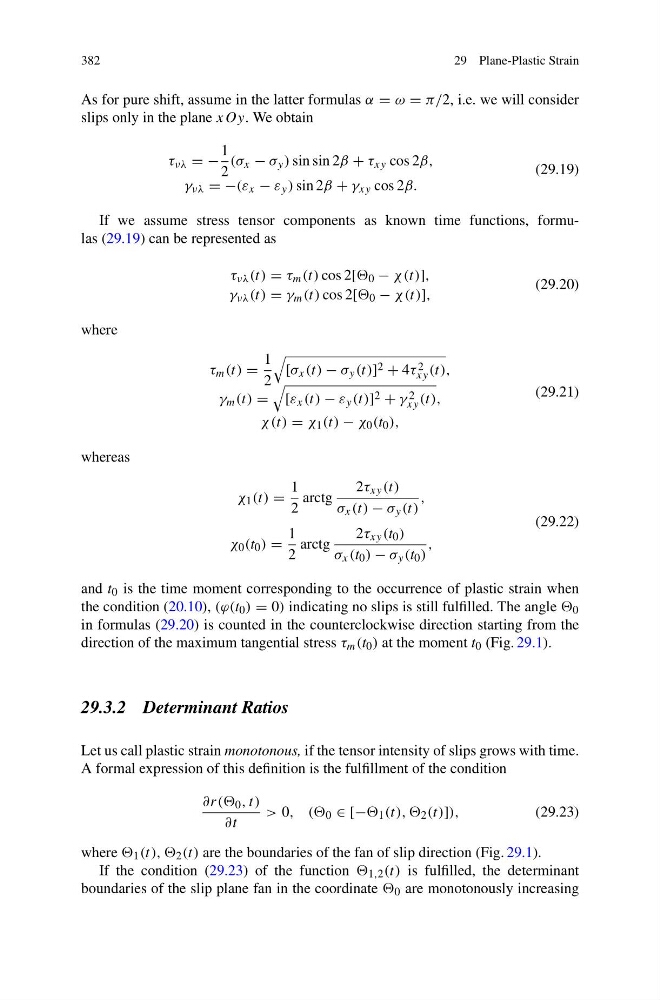
As for pure shift, assume in the latter formulas α = ω = π/2, i.e. we will consider
slips only in the plane xOy. We obtain
τ νλ = −
1
2
(σ x − σ y ) sin sin 2β + τ xy cos 2β,
γ νλ = −(ε x − ε y ) sin 2β + γ xy cos 2β.
(29.19)
If we assume stress tensor components as known time functions, formulas (29.19) can be represented as
τ νλ (t) = τ m (t) cos 2[ 0 − χ (t)],
γ νλ (t) = γ m (t) cos 2[ 0 − χ (t)],
(29.20)
where
τ m (t) =
1
2
[σ x (t) − σ y (t)] 2 + 4τ 2
xy (t),
γ m (t) =
[ε x (t) − ε y (t)] 2 + γ 2
xy (t),
χ (t) = χ 1 (t) − χ 0 (t 0 ),
(29.21)
whereas
χ 1 (t) =
1
2
arctg
2τ xy (t)
σ x (t) − σ y (t)
,
χ 0 (t 0 ) =
1
2
arctg
2τ xy (t 0 )
σ x (t 0 ) − σ y (t 0 )
,
(29.22)
and t 0 is the time moment corresponding to the occurrence of plastic strain when
the condition (20.10), (ϕ(t 0 ) = 0) indicating no slips is still fulfilled. The angle 0
in formulas (29.20) is counted in the counterclockwise direction starting from the
direction of the maximum tangential stress τ m (t 0 ) at the moment t 0 (Fig. 29.1).
29.3.2 Determinant Ratios
Let us call plastic strain monotonous, if the tensor intensity of slips grows with time.
A formal expression of this definition is the fulfillment of the condition
∂r(( 0 , t)
∂t
> 0, (( 0 ∈ [− 1 (t), , 2 (t)]),
(29.23)
where 1 (t), , 2 (t) are the boundaries of the fan of slip direction (Fig. 29.1).
If the condition (29.23) of the function 1,2 (t) is fulfilled, the determinant
boundaries of the slip plane fan in the coordinate 0 are monotonously increasing
29 Plane-Plastic Strain
As for pure shift, assume in the latter formulas α = ω = π/2, i.e. we will consider
slips only in the plane xOy. We obtain
τ νλ = −
1
2
(σ x − σ y ) sin sin 2β + τ xy cos 2β,
γ νλ = −(ε x − ε y ) sin 2β + γ xy cos 2β.
(29.19)
If we assume stress tensor components as known time functions, formulas (29.19) can be represented as
τ νλ (t) = τ m (t) cos 2[ 0 − χ (t)],
γ νλ (t) = γ m (t) cos 2[ 0 − χ (t)],
(29.20)
where
τ m (t) =
1
2
[σ x (t) − σ y (t)] 2 + 4τ 2
xy (t),
γ m (t) =
[ε x (t) − ε y (t)] 2 + γ 2
xy (t),
χ (t) = χ 1 (t) − χ 0 (t 0 ),
(29.21)
whereas
χ 1 (t) =
1
2
arctg
2τ xy (t)
σ x (t) − σ y (t)
,
χ 0 (t 0 ) =
1
2
arctg
2τ xy (t 0 )
σ x (t 0 ) − σ y (t 0 )
,
(29.22)
and t 0 is the time moment corresponding to the occurrence of plastic strain when
the condition (20.10), (ϕ(t 0 ) = 0) indicating no slips is still fulfilled. The angle 0
in formulas (29.20) is counted in the counterclockwise direction starting from the
direction of the maximum tangential stress τ m (t 0 ) at the moment t 0 (Fig. 29.1).
29.3.2 Determinant Ratios
Let us call plastic strain monotonous, if the tensor intensity of slips grows with time.
A formal expression of this definition is the fulfillment of the condition
∂r(( 0 , t)
∂t
> 0, (( 0 ∈ [− 1 (t), , 2 (t)]),
(29.23)
where 1 (t), , 2 (t) are the boundaries of the fan of slip direction (Fig. 29.1).
If the condition (29.23) of the function 1,2 (t) is fulfilled, the determinant
boundaries of the slip plane fan in the coordinate 0 are monotonously increasing