

28.4 Analysis of Results and Conclusions
373
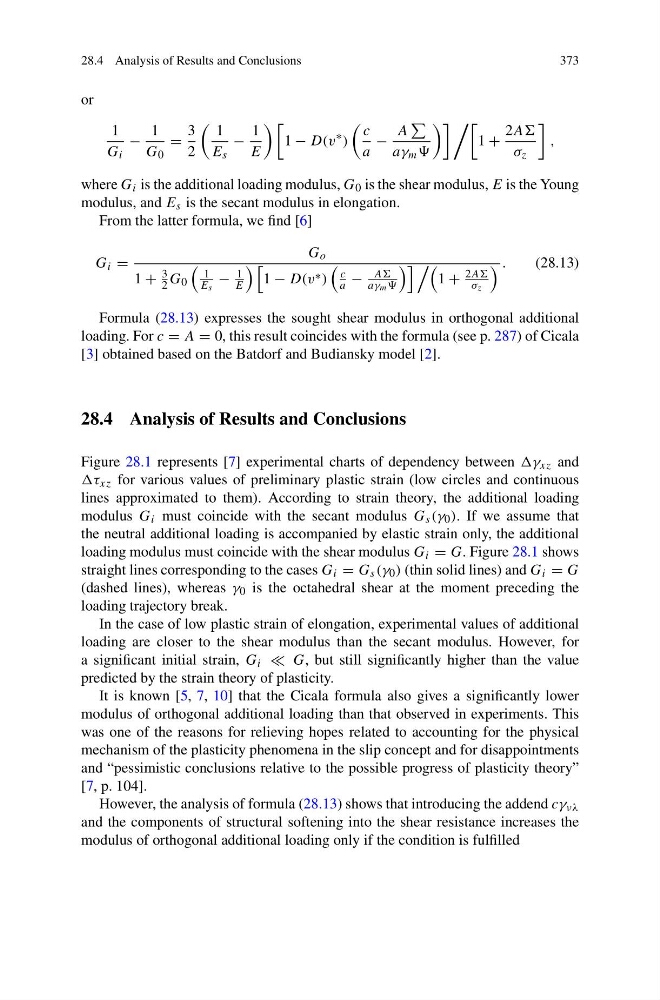
or
1
G i
−
1
G 0
=
3
2
1
E s
−
1
E
1 − D(v
∗ )
c
a
−
A
aγ m
1 +
2AA
σ z
,
where G i is the additional loading modulus, G 0 is the shear modulus, E is the Young
modulus, and E s is the secant modulus in elongation.
From the latter formula, we find [6]
G i =
G o
1 +
3
2 G 0
1
E s
−
1
E
1 − D(v ∗ )
c
a −
AA
aγ m
1 +
2AA
σ z
.
(28.13)
Formula (28.13) expresses the sought shear modulus in orthogonal additional
loading. For c = A = 0, this result coincides with the formula (see p. 287) of Cicala
[3] obtained based on the Batdorf and Budiansky model [2].
28.4 Analysis of Results and Conclusions
Figure 28.1 represents [7] experimental charts of dependency between γ xz and
τ xz for various values of preliminary plastic strain (low circles and continuous
lines approximated to them). According to strain theory, the additional loading
modulus G i must coincide with the secant modulus G s (γ 0 ). If we assume that
the neutral additional loading is accompanied by elastic strain only, the additional
loading modulus must coincide with the shear modulus G i = G. Figure 28.1 shows
straight lines corresponding to the cases G i = G s (γ 0 ) (thin solid lines) and G i = G
(dashed lines), whereas γ 0 is the octahedral shear at the moment preceding the
loading trajectory break.
In the case of low plastic strain of elongation, experimental values of additional
loading are closer to the shear modulus than the secant modulus. However, for
a significant initial strain, G i G, but still significantly higher than the value
predicted by the strain theory of plasticity.
It is known [5, 7, 10] that the Cicala formula also gives a significantly lower
modulus of orthogonal additional loading than that observed in experiments. This
was one of the reasons for relieving hopes related to accounting for the physical
mechanism of the plasticity phenomena in the slip concept and for disappointments
and “pessimistic conclusions relative to the possible progress of plasticity theory”
[7, p. 104].
However, the analysis of formula (28.13) shows that introducing the addend cγ νλ
and the components of structural softening into the shear resistance increases the
modulus of orthogonal additional loading only if the condition is fulfilled
373
or
1
G i
−
1
G 0
=
3
2
1
E s
−
1
E
1 − D(v
∗ )
c
a
−
A
aγ m
1 +
2AA
σ z
,
where G i is the additional loading modulus, G 0 is the shear modulus, E is the Young
modulus, and E s is the secant modulus in elongation.
From the latter formula, we find [6]
G i =
G o
1 +
3
2 G 0
1
E s
−
1
E
1 − D(v ∗ )
c
a −
AA
aγ m
1 +
2AA
σ z
.
(28.13)
Formula (28.13) expresses the sought shear modulus in orthogonal additional
loading. For c = A = 0, this result coincides with the formula (see p. 287) of Cicala
[3] obtained based on the Batdorf and Budiansky model [2].
28.4 Analysis of Results and Conclusions
Figure 28.1 represents [7] experimental charts of dependency between γ xz and
τ xz for various values of preliminary plastic strain (low circles and continuous
lines approximated to them). According to strain theory, the additional loading
modulus G i must coincide with the secant modulus G s (γ 0 ). If we assume that
the neutral additional loading is accompanied by elastic strain only, the additional
loading modulus must coincide with the shear modulus G i = G. Figure 28.1 shows
straight lines corresponding to the cases G i = G s (γ 0 ) (thin solid lines) and G i = G
(dashed lines), whereas γ 0 is the octahedral shear at the moment preceding the
loading trajectory break.
In the case of low plastic strain of elongation, experimental values of additional
loading are closer to the shear modulus than the secant modulus. However, for
a significant initial strain, G i G, but still significantly higher than the value
predicted by the strain theory of plasticity.
It is known [5, 7, 10] that the Cicala formula also gives a significantly lower
modulus of orthogonal additional loading than that observed in experiments. This
was one of the reasons for relieving hopes related to accounting for the physical
mechanism of the plasticity phenomena in the slip concept and for disappointments
and “pessimistic conclusions relative to the possible progress of plasticity theory”
[7, p. 104].
However, the analysis of formula (28.13) shows that introducing the addend cγ νλ
and the components of structural softening into the shear resistance increases the
modulus of orthogonal additional loading only if the condition is fulfilled