

374
28 Module of Additional Orthogonal Load
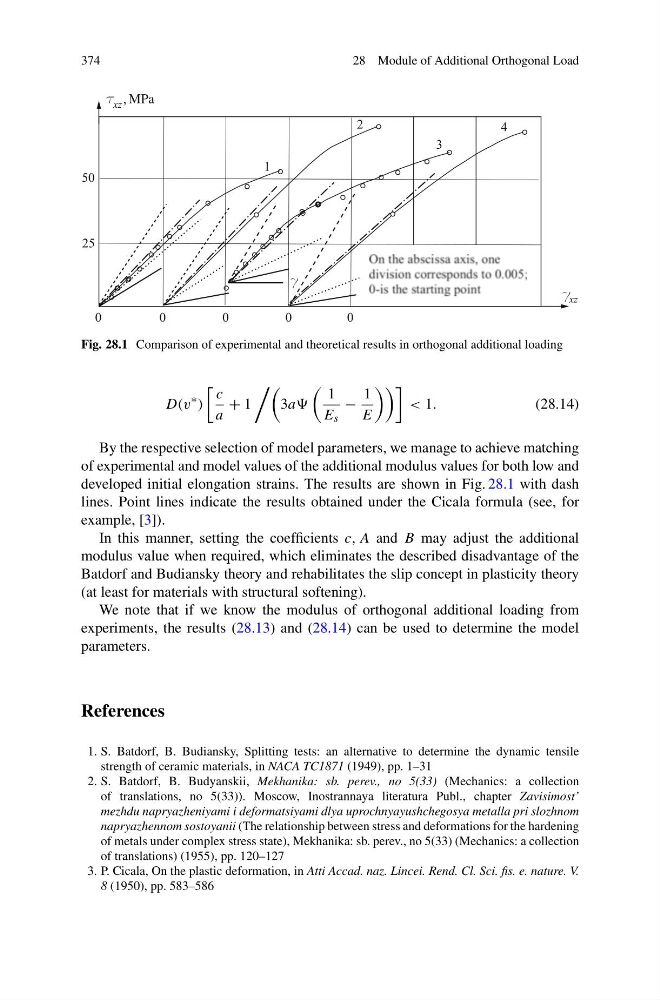
Fig. 28.1 Comparison of experimental and theoretical results in orthogonal additional loading
D(v
∗ )
c
a
+ 1
3aa
1
E s
−
1
E
< 1.
(28.14)
By the respective selection of model parameters, we manage to achieve matching
of experimental and model values of the additional modulus values for both low and
developed initial elongation strains. The results are shown in Fig. 28.1 with dash
lines. Point lines indicate the results obtained under the Cicala formula (see, for
example, [3]).
In this manner, setting the coefficients c, A and B may adjust the additional
modulus value when required, which eliminates the described disadvantage of the
Batdorf and Budiansky theory and rehabilitates the slip concept in plasticity theory
(at least for materials with structural softening).
We note that if we know the modulus of orthogonal additional loading from
experiments, the results (28.13) and (28.14) can be used to determine the model
parameters.
References
1. S. Batdorf, B. Budiansky, Splitting tests: an alternative to determine the dynamic tensile
strength of ceramic materials, in NACA TC1871 (1949), pp. 1–31
2. S. Batdorf, B. Budyanskii, Mekhanika: sb. perev., no 5(33) (Mechanics: a collection
of translations, no 5(33)). Moscow, Inostrannaya literatura Publ., chapter Zavisimost’
mezhdu napryazheniyami i deformatsiyami dlya uprochnyayushchegosya metalla pri slozhnom
napryazhennom sostoyanii (The relationship between stress and deformations for the hardening
of metals under complex stress state), Mekhanika: sb. perev., no 5(33) (Mechanics: a collection
of translations) (1955), pp. 120–127
3. P. Cicala, On the plastic deformation, in Atti Accad. naz. Lincei. Rend. Cl. Sci. fis. e. nature. V.
8 (1950), pp. 583–586
28 Module of Additional Orthogonal Load
Fig. 28.1 Comparison of experimental and theoretical results in orthogonal additional loading
D(v
∗ )
c
a
+ 1
3aa
1
E s
−
1
E
< 1.
(28.14)
By the respective selection of model parameters, we manage to achieve matching
of experimental and model values of the additional modulus values for both low and
developed initial elongation strains. The results are shown in Fig. 28.1 with dash
lines. Point lines indicate the results obtained under the Cicala formula (see, for
example, [3]).
In this manner, setting the coefficients c, A and B may adjust the additional
modulus value when required, which eliminates the described disadvantage of the
Batdorf and Budiansky theory and rehabilitates the slip concept in plasticity theory
(at least for materials with structural softening).
We note that if we know the modulus of orthogonal additional loading from
experiments, the results (28.13) and (28.14) can be used to determine the model
parameters.
References
1. S. Batdorf, B. Budiansky, Splitting tests: an alternative to determine the dynamic tensile
strength of ceramic materials, in NACA TC1871 (1949), pp. 1–31
2. S. Batdorf, B. Budyanskii, Mekhanika: sb. perev., no 5(33) (Mechanics: a collection
of translations, no 5(33)). Moscow, Inostrannaya literatura Publ., chapter Zavisimost’
mezhdu napryazheniyami i deformatsiyami dlya uprochnyayushchegosya metalla pri slozhnom
napryazhennom sostoyanii (The relationship between stress and deformations for the hardening
of metals under complex stress state), Mekhanika: sb. perev., no 5(33) (Mechanics: a collection
of translations) (1955), pp. 120–127
3. P. Cicala, On the plastic deformation, in Atti Accad. naz. Lincei. Rend. Cl. Sci. fis. e. nature. V.
8 (1950), pp. 583–586