

372
28 Module of Additional Orthogonal Load
K(e 2 ) =
1
15
π/2
0
dx
2 − e 2
2 sin
2 x
; E(e 2 ) =
π/2
0
1 − e 2
2 sin
2 xdx;
(e 1 , e 2 ) =
π/2
0
dx
(1 + e 1 sin
2 x)
1 − e 2
2 sin
2 x
; δ = cos 2v
∗
;
e 1 = −2 sin
2 v
∗
; e 2 = tg v
∗ ,
(28.11)
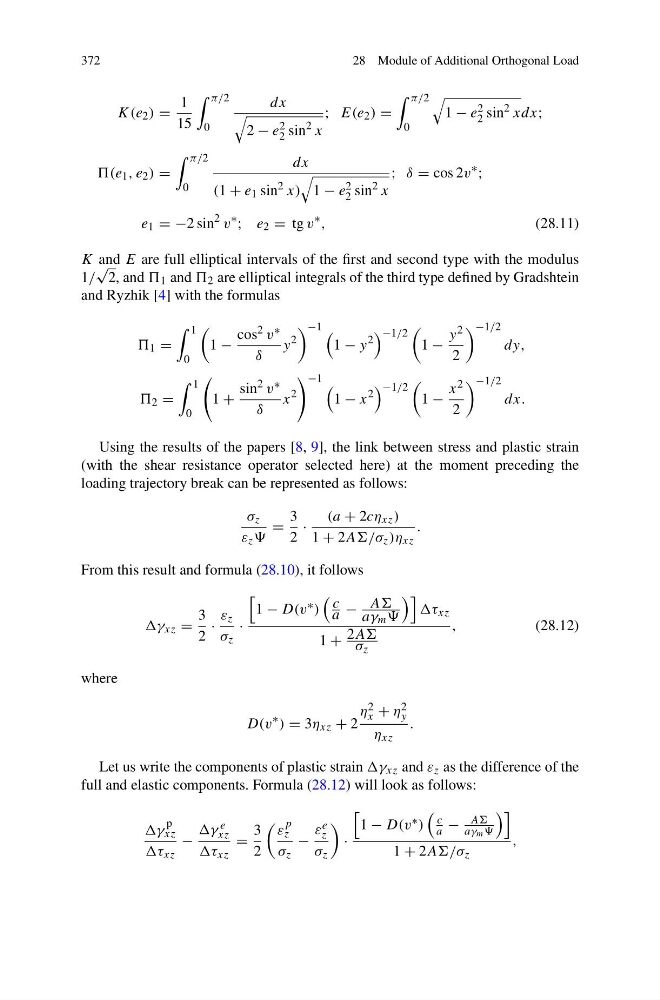
K and E are full elliptical intervals of the first and second type with the modulus
1/
√
2, and 1 and 2 are elliptical integrals of the third type defined by Gradshtein
and Ryzhik [4] with the formulas
1 =
1
0
1 −
cos 2 v ∗
δ
y
2
−1
1 − y
2
−1/2
1 −
y 2
2
−1/2
dy,
2 =
1
0
1 +
sin
2 v ∗
δ
x
2
−1
1 − x
2
−1/2
1 −
x 2
2
−1/2
dx.
Using the results of the papers [8, 9], the link between stress and plastic strain
(with the shear resistance operator selected here) at the moment preceding the
loading trajectory break can be represented as follows:
σ z
ε z
=
3
2
·
(a + 2cη xz )
1 + 2AA/σ z )η xz
.
From this result and formula (28.10), it follows
γ xz =
3
2
·
ε z
σ z
·
1 − D(v ∗ )
c
a − AA
aγ m
τ xz
1 + 2AA
σ z
,
(28.12)
where
D(v
∗ ) = 3η xz + 2
η 2
x + η 2
y
η xz
.
Let us write the components of plastic strain γ xz and ε z as the difference of the
full and elastic components. Formula (28.12) will look as follows:
γ
p
xz
τ xz
−
γ e
xz
τ xz
=
3
2
ε
p
z
σ z
−
ε e
z
σ z
·
1 − D(v ∗ )
c
a −
AA
aγ m
1 + 2AA/σ z
,
28 Module of Additional Orthogonal Load
K(e 2 ) =
1
15
π/2
0
dx
2 − e 2
2 sin
2 x
; E(e 2 ) =
π/2
0
1 − e 2
2 sin
2 xdx;
(e 1 , e 2 ) =
π/2
0
dx
(1 + e 1 sin
2 x)
1 − e 2
2 sin
2 x
; δ = cos 2v
∗
;
e 1 = −2 sin
2 v
∗
; e 2 = tg v
∗ ,
(28.11)
K and E are full elliptical intervals of the first and second type with the modulus
1/
√
2, and 1 and 2 are elliptical integrals of the third type defined by Gradshtein
and Ryzhik [4] with the formulas
1 =
1
0
1 −
cos 2 v ∗
δ
y
2
−1
1 − y
2
−1/2
1 −
y 2
2
−1/2
dy,
2 =
1
0
1 +
sin
2 v ∗
δ
x
2
−1
1 − x
2
−1/2
1 −
x 2
2
−1/2
dx.
Using the results of the papers [8, 9], the link between stress and plastic strain
(with the shear resistance operator selected here) at the moment preceding the
loading trajectory break can be represented as follows:
σ z
ε z
=
3
2
·
(a + 2cη xz )
1 + 2AA/σ z )η xz
.
From this result and formula (28.10), it follows
γ xz =
3
2
·
ε z
σ z
·
1 − D(v ∗ )
c
a − AA
aγ m
τ xz
1 + 2AA
σ z
,
(28.12)
where
D(v
∗ ) = 3η xz + 2
η 2
x + η 2
y
η xz
.
Let us write the components of plastic strain γ xz and ε z as the difference of the
full and elastic components. Formula (28.12) will look as follows:
γ
p
xz
τ xz
−
γ e
xz
τ xz
=
3
2
ε
p
z
σ z
−
ε e
z
σ z
·
1 − D(v ∗ )
c
a −
AA
aγ m
1 + 2AA/σ z
,