

28.3 Calculation of the Strain Increments and Additional Loading Modulus
371
The boundary of the area of additional slips is found from the condition that the
function (28.7) equals zero at this boundary:
ϕ νλ = 0.
(28.8)
28.3 Calculation of the Strain Increments and Additional
Loading Modulus
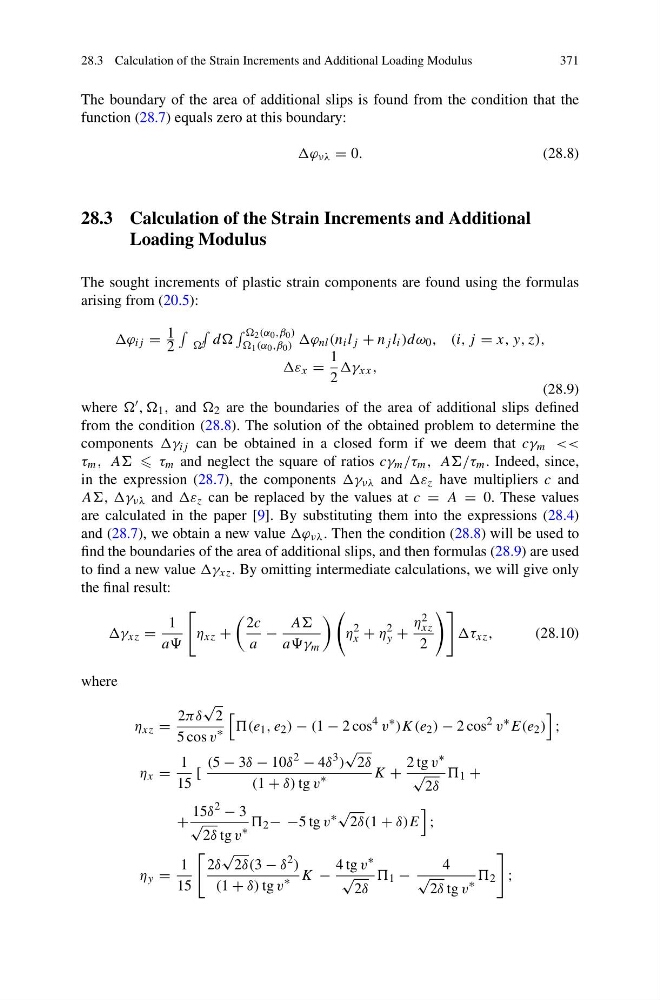
The sought increments of plastic strain components are found using the formulas
arising from (20.5):
ϕ ij = 1
2
dd
2 (α 0 ,β 0 )
1 (α 0 ,β 0 ) ϕ nl (n i l j + n j l i )dω 0 , (i,j = x, y, z),
ε x =
1
2
γ xx ,
(28.9)
where , , 1 , and 2 are the boundaries of the area of additional slips defined
from the condition (28.8). The solution of the obtained problem to determine the
components γ ij can be obtained in a closed form if we deem that cγ m <<
τ m , AA τ m and neglect the square of ratios cγ m /τ m , AA/τ m . Indeed, since,
in the expression (28.7), the components γ νλ and ε z have multipliers c and
AA, γ νλ and ε z can be replaced by the values at c = A = 0. These values
are calculated in the paper [9]. By substituting them into the expressions (28.4)
and (28.7), we obtain a new value ϕ νλ . Then the condition (28.8) will be used to
find the boundaries of the area of additional slips, and then formulas (28.9) are used
to find a new value γ xz . By omitting intermediate calculations, we will give only
the final result:
γ xz =
1
aa
η xz +
2c
a
−
AA
aaγ m
η
2
x + η
2
y +
η 2
xz
2
τ xz ,
(28.10)
where
η xz =
2πδ
√
2
5 cos v
∗
(e 1 , e 2 ) − (1 − 2 cos
4 v
∗ )K(e 2 ) − 2 cos
2 v
∗ E(e 2 )
;
η x =
1
15
[
(5 − 3δ − 10δ
2
− 4δ
3 )
√
2δ
(1 + δ) tg v
∗
K +
2 tg v
∗
√
2δ
1 +
+
15δ
2
− 3
√
2δ tg v
∗
2 − −5 tg v
∗
√
2δ(1 + δ)E
;
η y =
1
15
2δ
√
2δ(3 − δ
2 )
(1 + δ) tg v
∗ K −
4 tg v
∗
√
2δ
1 −
4
√
2δ tg v
∗
2
;
371
The boundary of the area of additional slips is found from the condition that the
function (28.7) equals zero at this boundary:
ϕ νλ = 0.
(28.8)
28.3 Calculation of the Strain Increments and Additional
Loading Modulus
The sought increments of plastic strain components are found using the formulas
arising from (20.5):
ϕ ij = 1
2
dd
2 (α 0 ,β 0 )
1 (α 0 ,β 0 ) ϕ nl (n i l j + n j l i )dω 0 , (i,j = x, y, z),
ε x =
1
2
γ xx ,
(28.9)
where , , 1 , and 2 are the boundaries of the area of additional slips defined
from the condition (28.8). The solution of the obtained problem to determine the
components γ ij can be obtained in a closed form if we deem that cγ m <<
τ m , AA τ m and neglect the square of ratios cγ m /τ m , AA/τ m . Indeed, since,
in the expression (28.7), the components γ νλ and ε z have multipliers c and
AA, γ νλ and ε z can be replaced by the values at c = A = 0. These values
are calculated in the paper [9]. By substituting them into the expressions (28.4)
and (28.7), we obtain a new value ϕ νλ . Then the condition (28.8) will be used to
find the boundaries of the area of additional slips, and then formulas (28.9) are used
to find a new value γ xz . By omitting intermediate calculations, we will give only
the final result:
γ xz =
1
aa
η xz +
2c
a
−
AA
aaγ m
η
2
x + η
2
y +
η 2
xz
2
τ xz ,
(28.10)
where
η xz =
2πδ
√
2
5 cos v
∗
(e 1 , e 2 ) − (1 − 2 cos
4 v
∗ )K(e 2 ) − 2 cos
2 v
∗ E(e 2 )
;
η x =
1
15
[
(5 − 3δ − 10δ
2
− 4δ
3 )
√
2δ
(1 + δ) tg v
∗
K +
2 tg v
∗
√
2δ
1 +
+
15δ
2
− 3
√
2δ tg v
∗
2 − −5 tg v
∗
√
2δ(1 + δ)E
;
η y =
1
15
2δ
√
2δ(3 − δ
2 )
(1 + δ) tg v
∗ K −
4 tg v
∗
√
2δ
1 −
4
√
2δ tg v
∗
2
;