

370
28 Module of Additional Orthogonal Load
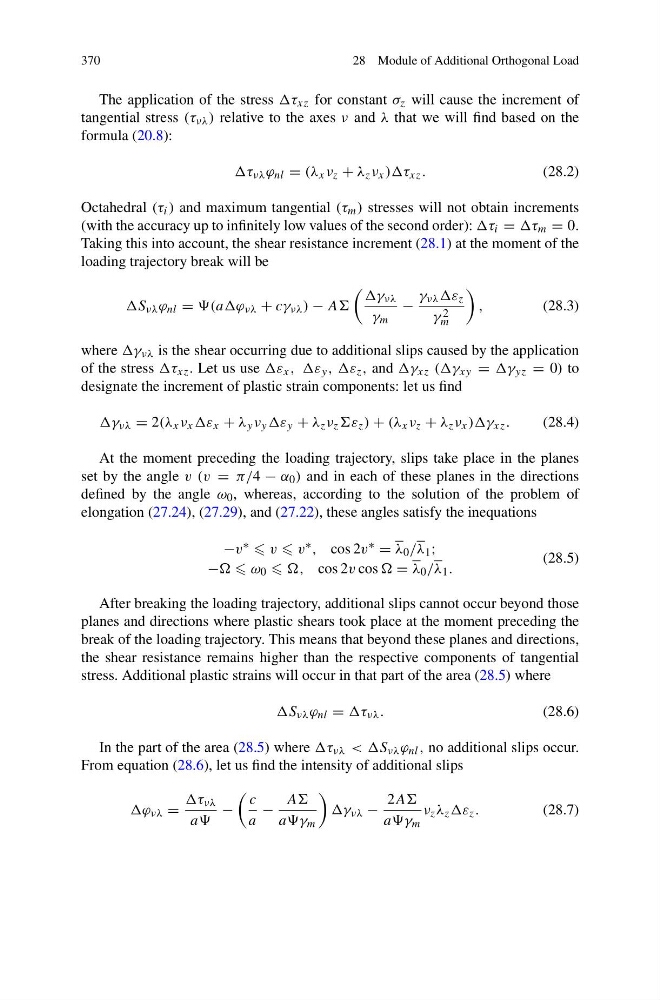
The application of the stress τ xz for constant σ z will cause the increment of
tangential stress (τ νλ ) relative to the axes ν and λ that we will find based on the
formula (20.8):
τ νλ ϕ nl = (λ x ν z + λ z ν x ))τ xz .
(28.2)
Octahedral (τ i ) and maximum tangential (τ m ) stresses will not obtain increments
(with the accuracy up to infinitely low values of the second order): τ i = τ m = 0.
Taking this into account, the shear resistance increment (28.1) at the moment of the
loading trajectory break will be
S νλ ϕ nl = νλ + cγ νλ ) − AA
γ νλ
γ m
−
γ νλ ε z
γ 2
m
,
(28.3)
where γ νλ is the shear occurring due to additional slips caused by the application
of the stress τ xz . Let us use ε x , ,ε y , ,ε z , and γ xz ((γ xy = γ yz = 0) to
designate the increment of plastic strain components: let us find
γ νλ = 2(λ x ν x ε x + λ y ν y ε y + λ z ν z ε z ) + (λ x ν z + λ z ν x ))γ xz .
(28.4)
At the moment preceding the loading trajectory, slips take place in the planes
set by the angle v (v = π/4 − α 0 ) and in each of these planes in the directions
defined by the angle ω 0 , whereas, according to the solution of the problem of
elongation (27.24), (27.29), and (27.22), these angles satisfy the inequations
−v ∗ v v ∗ , cos 2v ∗ = λ 0 /λ 1 ;
− ω 0 , cos 2v cos = λ 0 /λ 1 .
(28.5)
After breaking the loading trajectory, additional slips cannot occur beyond those
planes and directions where plastic shears took place at the moment preceding the
break of the loading trajectory. This means that beyond these planes and directions,
the shear resistance remains higher than the respective components of tangential
stress. Additional plastic strains will occur in that part of the area (28.5) where
S νλ ϕ nl = τ νλ .
(28.6)
In the part of the area (28.5) where τ νλ <
ϕ νλ =
τ νλ
aa
−
c
a
−
AA
aaγ m
γ νλ −
2AA
aaγ m
ν z λ z ε z .
(28.7)
28 Module of Additional Orthogonal Load
The application of the stress τ xz for constant σ z will cause the increment of
tangential stress (τ νλ ) relative to the axes ν and λ that we will find based on the
formula (20.8):
τ νλ ϕ nl = (λ x ν z + λ z ν x ))τ xz .
(28.2)
Octahedral (τ i ) and maximum tangential (τ m ) stresses will not obtain increments
(with the accuracy up to infinitely low values of the second order): τ i = τ m = 0.
Taking this into account, the shear resistance increment (28.1) at the moment of the
loading trajectory break will be
S νλ ϕ nl = νλ + cγ νλ ) − AA
γ νλ
γ m
−
γ νλ ε z
γ 2
m
,
(28.3)
where γ νλ is the shear occurring due to additional slips caused by the application
of the stress τ xz . Let us use ε x , ,ε y , ,ε z , and γ xz ((γ xy = γ yz = 0) to
designate the increment of plastic strain components: let us find
γ νλ = 2(λ x ν x ε x + λ y ν y ε y + λ z ν z ε z ) + (λ x ν z + λ z ν x ))γ xz .
(28.4)
At the moment preceding the loading trajectory, slips take place in the planes
set by the angle v (v = π/4 − α 0 ) and in each of these planes in the directions
defined by the angle ω 0 , whereas, according to the solution of the problem of
elongation (27.24), (27.29), and (27.22), these angles satisfy the inequations
−v ∗ v v ∗ , cos 2v ∗ = λ 0 /λ 1 ;
− ω 0 , cos 2v cos = λ 0 /λ 1 .
(28.5)
After breaking the loading trajectory, additional slips cannot occur beyond those
planes and directions where plastic shears took place at the moment preceding the
break of the loading trajectory. This means that beyond these planes and directions,
the shear resistance remains higher than the respective components of tangential
stress. Additional plastic strains will occur in that part of the area (28.5) where
S νλ ϕ nl = τ νλ .
(28.6)
In the part of the area (28.5) where τ νλ <
ϕ νλ =
τ νλ
aa
−
c
a
−
AA
aaγ m
γ νλ −
2AA
aaγ m
ν z λ z ε z .
(28.7)