

27.6 Plastic Strain in Loading and Compression
361
L νλ ϕ nl (t
∗ ) =
σ z (t ∗ ) + 2AA
2[t ∗ ]
sin 2α cos ω −
ψ[t ∗ ] − BB
[t ∗ ]
,
(27.41)
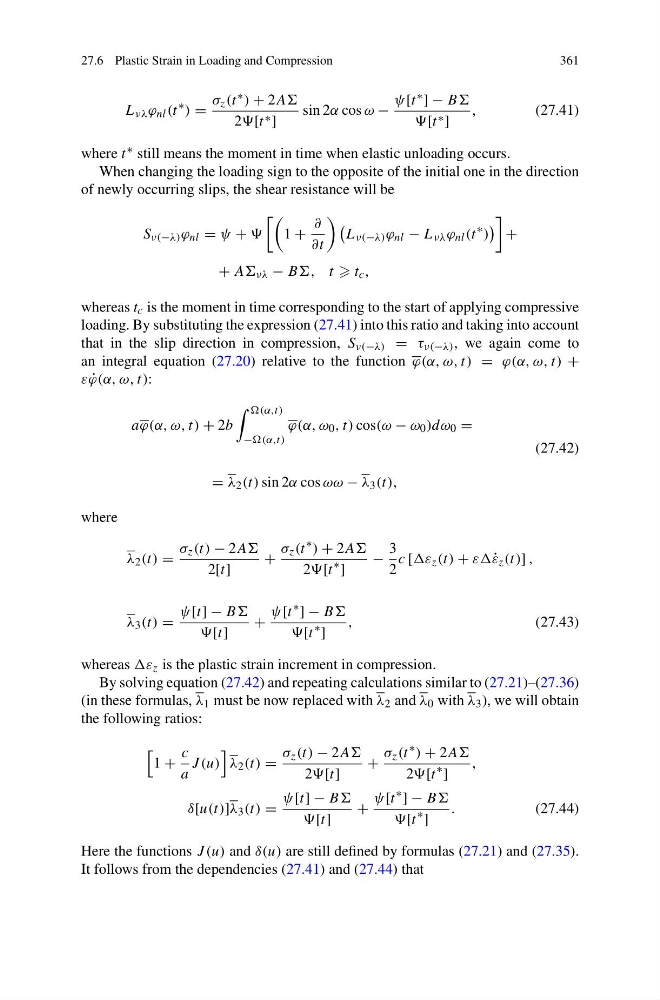
where t ∗ still means the moment in time when elastic unloading occurs.
When changing the loading sign to the opposite of the initial one in the direction
of newly occurring slips, the shear resistance will be
S ν(−λ) ϕ nl = ψ +
1 +
∂
∂t
L ν(−λ) ϕ nl − L νλ ϕ nl (t
∗ )
+
+ AA νλ − BB, t t c ,
whereas t c is the moment in time corresponding to the start of applying compressive
loading. By substituting the expression (27.41) into this ratio and taking into account
that in the slip direction in compression, S ν(−λ) = τ ν(−λ) , we again come to
an integral equation (27.20) relative to the function ϕ(α, ω, t) = ϕ(α, ω, t) +
ε ˙
ϕ(α, ω, t):
aϕ(α, ω, t) + 2b
(α,t)
−(α,t)
ϕ(α, ω 0 , t) cos(ω − ω 0 )dω 0 =
= λ 2 (t) sin 2α cos ωω − λ 3 (t),
(27.42)
where
λ 2 (t) =
σ z (t) − 2AA
2[t]
+
σ z (t
∗ ) + 2AA
2[t
∗
]
−
3
2
c [ε z (t) + εε˙ ε z (t)] ,
λ 3 (t) =
ψ[t] − BB
[t]
+
ψ[t
∗
] − BB
[t
∗
]
,
(27.43)
whereas ε z is the plastic strain increment in compression.
By solving equation (27.42) and repeating calculations similar to (27.21)–(27.36)
(in these formulas, λ 1 must be now replaced with λ 2 and λ 0 with λ 3 ), we will obtain
the following ratios:
1 +
c
a
J (u)
λ 2 (t) =
σ z (t) − 2AA
2[t]
+
σ z (t
∗ ) + 2AA
2[t
∗
]
,
δ[u(t)]λ 3 (t) =
ψ[t] − BB
[t]
+
ψ[t
∗
] − BB
[t
∗
]
.
(27.44)
Here the functions J (u) and δ(u) are still defined by formulas (27.21) and (27.35).
It follows from the dependencies (27.41) and (27.44) that
361
L νλ ϕ nl (t
∗ ) =
σ z (t ∗ ) + 2AA
2[t ∗ ]
sin 2α cos ω −
ψ[t ∗ ] − BB
[t ∗ ]
,
(27.41)
where t ∗ still means the moment in time when elastic unloading occurs.
When changing the loading sign to the opposite of the initial one in the direction
of newly occurring slips, the shear resistance will be
S ν(−λ) ϕ nl = ψ +
1 +
∂
∂t
L ν(−λ) ϕ nl − L νλ ϕ nl (t
∗ )
+
+ AA νλ − BB, t t c ,
whereas t c is the moment in time corresponding to the start of applying compressive
loading. By substituting the expression (27.41) into this ratio and taking into account
that in the slip direction in compression, S ν(−λ) = τ ν(−λ) , we again come to
an integral equation (27.20) relative to the function ϕ(α, ω, t) = ϕ(α, ω, t) +
ε ˙
ϕ(α, ω, t):
aϕ(α, ω, t) + 2b
(α,t)
−(α,t)
ϕ(α, ω 0 , t) cos(ω − ω 0 )dω 0 =
= λ 2 (t) sin 2α cos ωω − λ 3 (t),
(27.42)
where
λ 2 (t) =
σ z (t) − 2AA
2[t]
+
σ z (t
∗ ) + 2AA
2[t
∗
]
−
3
2
c [ε z (t) + εε˙ ε z (t)] ,
λ 3 (t) =
ψ[t] − BB
[t]
+
ψ[t
∗
] − BB
[t
∗
]
,
(27.43)
whereas ε z is the plastic strain increment in compression.
By solving equation (27.42) and repeating calculations similar to (27.21)–(27.36)
(in these formulas, λ 1 must be now replaced with λ 2 and λ 0 with λ 3 ), we will obtain
the following ratios:
1 +
c
a
J (u)
λ 2 (t) =
σ z (t) − 2AA
2[t]
+
σ z (t
∗ ) + 2AA
2[t
∗
]
,
δ[u(t)]λ 3 (t) =
ψ[t] − BB
[t]
+
ψ[t
∗
] − BB
[t
∗
]
.
(27.44)
Here the functions J (u) and δ(u) are still defined by formulas (27.21) and (27.35).
It follows from the dependencies (27.41) and (27.44) that