

360
27 Non-elastic Uniaxial Elongation–Compression
27.6 Plastic Strain in Loading and Compression
27.6.1 Increment of Non-elastic Strain in Loading
Assume that the rod is elongated beyond the yield stress to some stress σ z =
σ o
z , σ o
z = 3τ o
i /
√
2, where τ o
i is the octahedral tangential stress at the moment
t o . At t > t o , stress starts decreasing under some law so that
σ z (t) < σ
o
z , ˙
σ z (t) < 0
at
t > t
o .
(27.38)
For some time, strain will continue rising. Since neither the shear resistance S νλ
nor the tangential stress component τ νλ in the considered case changes its sign,
the ratios of the previous paragraph remain in force. In particular, formulas (27.34)
and (27.37) are true. Due to the conditions (27.38), formula (27.34) shows that in
the case of unloading, the parameter u decreases.
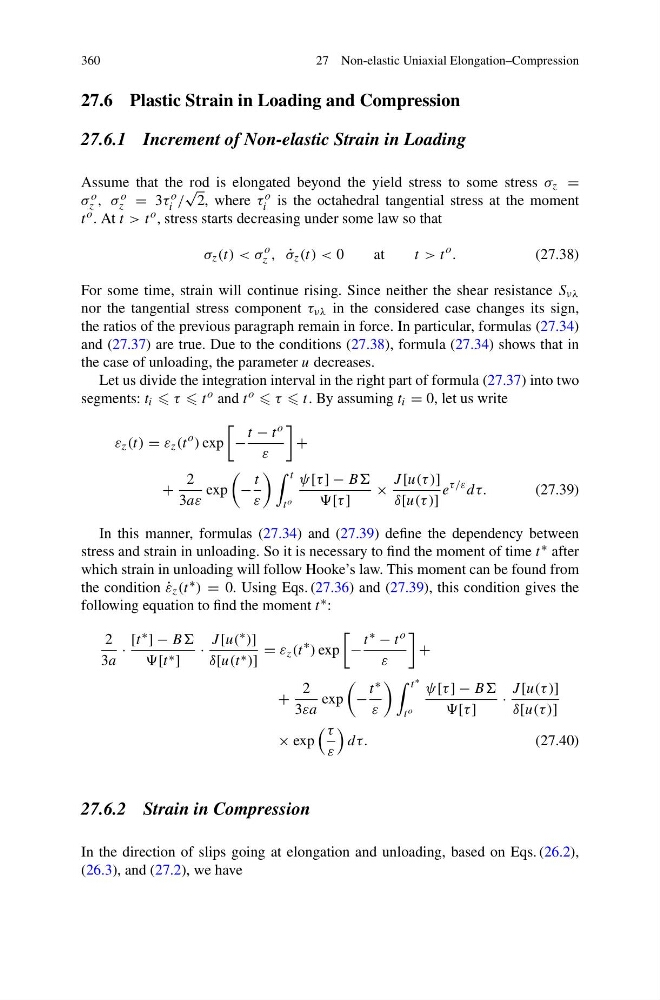
Let us divide the integration interval in the right part of formula (27.37) into two
segments: t i τ t o and t o τ t. By assuming t i = 0, let us write
ε z (t) = ε z (t
o ) exp
−
t − t o
ε
+
+
2
3aε
exp
−
t
ε
t
t o
ψ[τ ] − BB
[τ ]
×
J [u(τ )]
δ[u(τ )]
e
τ/ε dτ.
(27.39)
In this manner, formulas (27.34) and (27.39) define the dependency between
stress and strain in unloading. So it is necessary to find the moment of time t ∗ after
which strain in unloading will follow Hooke’s law. This moment can be found from
the condition ˙
ε z (t ∗ ) = 0. Using Eqs. (27.36) and (27.39), this condition gives the
following equation to find the moment t ∗ :
2
3a
·
[t ∗ ] − BB
[t ∗ ]
·
J [u( ∗ )]
δ[u(t ∗ )]
= ε z (t
∗ ) exp
−
t ∗ − t o
ε
+
+
2
3εa
exp
−
t ∗
ε
t ∗
t o
ψ[τ ] − BB
[τ ]
·
J [u(τ )]
δ[u(τ )]
× exp
τ
ε
dτ.
(27.40)
27.6.2 Strain in Compression
In the direction of slips going at elongation and unloading, based on Eqs. (26.2),
(26.3), and (27.2), we have
27 Non-elastic Uniaxial Elongation–Compression
27.6 Plastic Strain in Loading and Compression
27.6.1 Increment of Non-elastic Strain in Loading
Assume that the rod is elongated beyond the yield stress to some stress σ z =
σ o
z , σ o
z = 3τ o
i /
√
2, where τ o
i is the octahedral tangential stress at the moment
t o . At t > t o , stress starts decreasing under some law so that
σ z (t) < σ
o
z , ˙
σ z (t) < 0
at
t > t
o .
(27.38)
For some time, strain will continue rising. Since neither the shear resistance S νλ
nor the tangential stress component τ νλ in the considered case changes its sign,
the ratios of the previous paragraph remain in force. In particular, formulas (27.34)
and (27.37) are true. Due to the conditions (27.38), formula (27.34) shows that in
the case of unloading, the parameter u decreases.
Let us divide the integration interval in the right part of formula (27.37) into two
segments: t i τ t o and t o τ t. By assuming t i = 0, let us write
ε z (t) = ε z (t
o ) exp
−
t − t o
ε
+
+
2
3aε
exp
−
t
ε
t
t o
ψ[τ ] − BB
[τ ]
×
J [u(τ )]
δ[u(τ )]
e
τ/ε dτ.
(27.39)
In this manner, formulas (27.34) and (27.39) define the dependency between
stress and strain in unloading. So it is necessary to find the moment of time t ∗ after
which strain in unloading will follow Hooke’s law. This moment can be found from
the condition ˙
ε z (t ∗ ) = 0. Using Eqs. (27.36) and (27.39), this condition gives the
following equation to find the moment t ∗ :
2
3a
·
[t ∗ ] − BB
[t ∗ ]
·
J [u( ∗ )]
δ[u(t ∗ )]
= ε z (t
∗ ) exp
−
t ∗ − t o
ε
+
+
2
3εa
exp
−
t ∗
ε
t ∗
t o
ψ[τ ] − BB
[τ ]
·
J [u(τ )]
δ[u(τ )]
× exp
τ
ε
dτ.
(27.40)
27.6.2 Strain in Compression
In the direction of slips going at elongation and unloading, based on Eqs. (26.2),
(26.3), and (27.2), we have