

27.5 Determinant Equations in Uniaxial Elongation
359
where
δ(u) =
cos u
1 + b
a (2u − sin 2u)
.
(27.35)
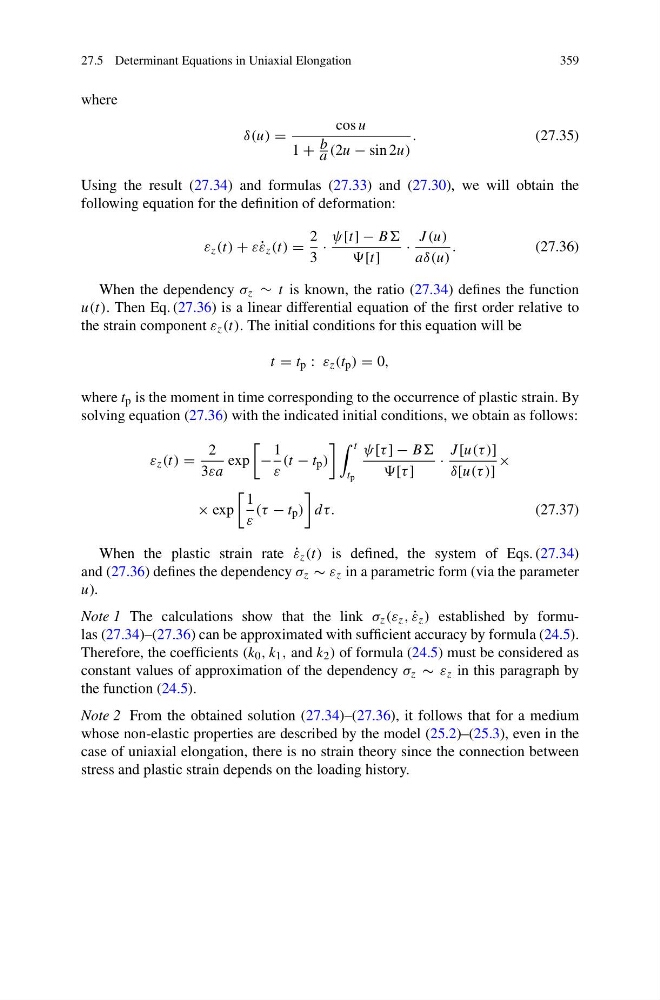
Using the result (27.34) and formulas (27.33) and (27.30), we will obtain the
following equation for the definition of deformation:
ε z (t) + ε ˙
ε z (t) =
2
3
·
ψ[t] − BB
[t]
·
J (u)
aδ(u)
.
(27.36)
When the dependency σ z ∼ t is known, the ratio (27.34) defines the function
u(t). Then Eq. (27.36) is a linear differential equation of the first order relative to
the strain component ε z (t). The initial conditions for this equation will be
t = t p : ε z (t p ) = 0,
where t p is the moment in time corresponding to the occurrence of plastic strain. By
solving equation (27.36) with the indicated initial conditions, we obtain as follows:
ε z (t) =
2
3εa
exp
−
1
ε
(t − t p )
t
t p
ψ[τ ] − BB
[τ ]
·
J [u(τ )]
δ[u(τ )]
×
× exp
1
ε
(τ − t p )
dτ.
(27.37)
When the plastic strain rate ˙
ε z (t) is defined, the system of Eqs. (27.34)
and (27.36) defines the dependency σ z ∼ ε z in a parametric form (via the parameter
u).
Note 1 The calculations show that the link σ z (ε z , ˙
ε z ) established by formulas (27.34)–(27.36) can be approximated with sufficient accuracy by formula (24.5).
Therefore, the coefficients (k 0 , k 1 , and k 2 ) of formula (24.5) must be considered as
constant values of approximation of the dependency σ z ∼ ε z in this paragraph by
the function (24.5).
Note 2 From the obtained solution (27.34)–(27.36), it follows that for a medium
whose non-elastic properties are described by the model (25.2)–(25.3), even in the
case of uniaxial elongation, there is no strain theory since the connection between
stress and plastic strain depends on the loading history.
359
where
δ(u) =
cos u
1 + b
a (2u − sin 2u)
.
(27.35)
Using the result (27.34) and formulas (27.33) and (27.30), we will obtain the
following equation for the definition of deformation:
ε z (t) + ε ˙
ε z (t) =
2
3
·
ψ[t] − BB
[t]
·
J (u)
aδ(u)
.
(27.36)
When the dependency σ z ∼ t is known, the ratio (27.34) defines the function
u(t). Then Eq. (27.36) is a linear differential equation of the first order relative to
the strain component ε z (t). The initial conditions for this equation will be
t = t p : ε z (t p ) = 0,
where t p is the moment in time corresponding to the occurrence of plastic strain. By
solving equation (27.36) with the indicated initial conditions, we obtain as follows:
ε z (t) =
2
3εa
exp
−
1
ε
(t − t p )
t
t p
ψ[τ ] − BB
[τ ]
·
J [u(τ )]
δ[u(τ )]
×
× exp
1
ε
(τ − t p )
dτ.
(27.37)
When the plastic strain rate ˙
ε z (t) is defined, the system of Eqs. (27.34)
and (27.36) defines the dependency σ z ∼ ε z in a parametric form (via the parameter
u).
Note 1 The calculations show that the link σ z (ε z , ˙
ε z ) established by formulas (27.34)–(27.36) can be approximated with sufficient accuracy by formula (24.5).
Therefore, the coefficients (k 0 , k 1 , and k 2 ) of formula (24.5) must be considered as
constant values of approximation of the dependency σ z ∼ ε z in this paragraph by
the function (24.5).
Note 2 From the obtained solution (27.34)–(27.36), it follows that for a medium
whose non-elastic properties are described by the model (25.2)–(25.3), even in the
case of uniaxial elongation, there is no strain theory since the connection between
stress and plastic strain depends on the loading history.