

362
27 Non-elastic Uniaxial Elongation–Compression
1 + ca
−1 J [u(t)]
δ[u(t)]
=
ε
−1 σ z (t) − AA + [t]Q 1
ψ[t] − BB + [t]Q 0
,
(27.45)
ε z (t) =
2
3aε
exp
−ε
−1 (t − t c )
×
×
t
t c
ψ[τ ] − BB + [τ ]Q 0
[τ ]δ[u(τ )]
· J [u(τ )] exp
ε
−1 (τ − t c )
dτ,
(27.46)
where
Q 1 =
0.5σ z (t ∗ ) + AA
[t ∗ ]
, Q 0 =
ψ[t ∗ ] − BB
[t ∗ ]
.
(27.47)
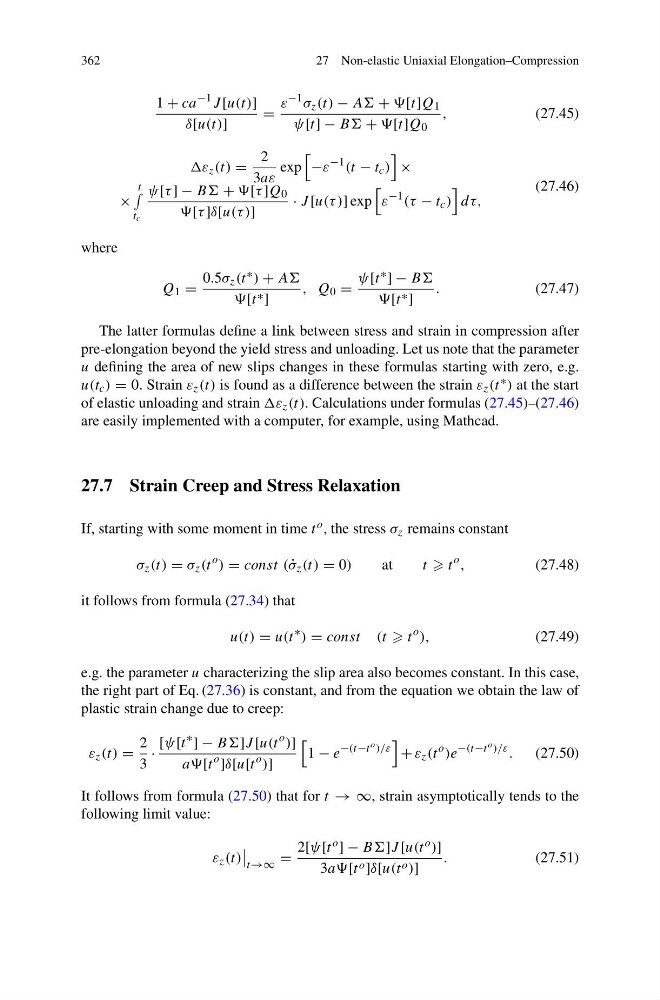
The latter formulas define a link between stress and strain in compression after
pre-elongation beyond the yield stress and unloading. Let us note that the parameter
u defining the area of new slips changes in these formulas starting with zero, e.g.
u(t c ) = 0. Strain ε z (t) is found as a difference between the strain ε z (t ∗ ) at the start
of elastic unloading and strain ε z (t). Calculations under formulas (27.45)–(27.46)
are easily implemented with a computer, for example, using Mathcad.
27.7 Strain Creep and Stress Relaxation
If, starting with some moment in time t o , the stress σ z remains constant
σ z (t) = σ z (t
o ) = const ( ˙
σ z (t) = 0)
at
t t
o ,
(27.48)
it follows from formula (27.34) that
u(t) = u(t
∗ ) = const (t t
o ),
(27.49)
e.g. the parameter u characterizing the slip area also becomes constant. In this case,
the right part of Eq. (27.36) is constant, and from the equation we obtain the law of
plastic strain change due to creep:
ε z (t) =
2
3
·
[ψ[t
∗
] − BB]J [u(t
o )]
aa[t
o
]δ[u[t
o )]
1 − e
−(t−t o )/ε
+ ε z (t
o )e
−(t−t o )/ε .
(27.50)
It follows from formula (27.50) that for t → ∞, strain asymptotically tends to the
following limit value:
ε z (t)
t→∞
=
2[ψ[t o ] − BB]J [u(t o )]
3aa[t o ]δ[u(t o )]
.
(27.51)
27 Non-elastic Uniaxial Elongation–Compression
1 + ca
−1 J [u(t)]
δ[u(t)]
=
ε
−1 σ z (t) − AA + [t]Q 1
ψ[t] − BB + [t]Q 0
,
(27.45)
ε z (t) =
2
3aε
exp
−ε
−1 (t − t c )
×
×
t
t c
ψ[τ ] − BB + [τ ]Q 0
[τ ]δ[u(τ )]
· J [u(τ )] exp
ε
−1 (τ − t c )
dτ,
(27.46)
where
Q 1 =
0.5σ z (t ∗ ) + AA
[t ∗ ]
, Q 0 =
ψ[t ∗ ] − BB
[t ∗ ]
.
(27.47)
The latter formulas define a link between stress and strain in compression after
pre-elongation beyond the yield stress and unloading. Let us note that the parameter
u defining the area of new slips changes in these formulas starting with zero, e.g.
u(t c ) = 0. Strain ε z (t) is found as a difference between the strain ε z (t ∗ ) at the start
of elastic unloading and strain ε z (t). Calculations under formulas (27.45)–(27.46)
are easily implemented with a computer, for example, using Mathcad.
27.7 Strain Creep and Stress Relaxation
If, starting with some moment in time t o , the stress σ z remains constant
σ z (t) = σ z (t
o ) = const ( ˙
σ z (t) = 0)
at
t t
o ,
(27.48)
it follows from formula (27.34) that
u(t) = u(t
∗ ) = const (t t
o ),
(27.49)
e.g. the parameter u characterizing the slip area also becomes constant. In this case,
the right part of Eq. (27.36) is constant, and from the equation we obtain the law of
plastic strain change due to creep:
ε z (t) =
2
3
·
[ψ[t
∗
] − BB]J [u(t
o )]
aa[t
o
]δ[u[t
o )]
1 − e
−(t−t o )/ε
+ ε z (t
o )e
−(t−t o )/ε .
(27.50)
It follows from formula (27.50) that for t → ∞, strain asymptotically tends to the
following limit value:
ε z (t)
t→∞
=
2[ψ[t o ] − BB]J [u(t o )]
3aa[t o ]δ[u(t o )]
.
(27.51)