

356
27 Non-elastic Uniaxial Elongation–Compression
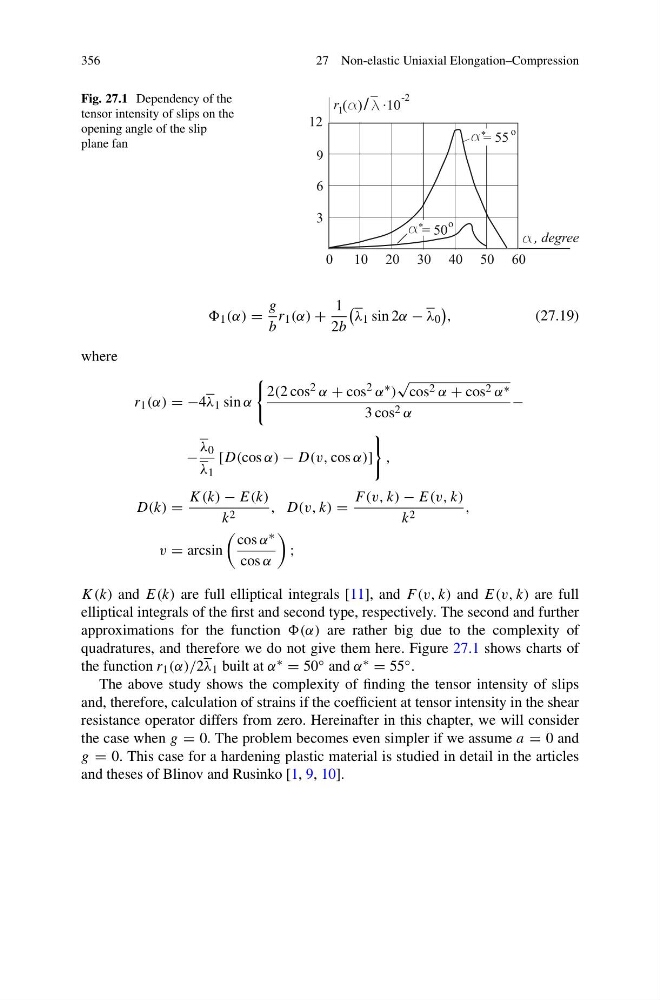
Fig. 27.1 Dependency of the
tensor intensity of slips on the
opening angle of the slip
plane fan
1 (α) =
g
b
r 1 (α) +
1
2b
λ 1 sin 2α − λ 0
,
(27.19)
where
r 1 (α) = −4λ 1 sin α
2(2 cos 2 α + cos 2 α ∗ )
√
cos 2 α + cos 2 α ∗
3 cos 2 α
−
−
λ 0
λ 1
[D(cos α) − D(v, cos α)]
,
D(k) =
K(k) − E(k)
k 2
, D(v,k) =
F (v, k) − E(v, k)
k 2
,
v = arcsin
cos α ∗
cos α
;
K(k) and E(k) are full elliptical integrals [11], and F (v, k) and E(v, k) are full
elliptical integrals of the first and second type, respectively. The second and further
approximations for the function are rather big due to the complexity of
quadratures, and therefore we do not give them here. Figure 27.1 shows charts of
the function r 1 (α)/2λ 1 built at α ∗ = 50 ◦ and α ∗ = 55 ◦ .
The above study shows the complexity of finding the tensor intensity of slips
and, therefore, calculation of strains if the coefficient at tensor intensity in the shear
resistance operator differs from zero. Hereinafter in this chapter, we will consider
the case when g = 0. The problem becomes even simpler if we assume a = 0 and
g = 0. This case for a hardening plastic material is studied in detail in the articles
and theses of Blinov and Rusinko [1, 9, 10].
27 Non-elastic Uniaxial Elongation–Compression
Fig. 27.1 Dependency of the
tensor intensity of slips on the
opening angle of the slip
plane fan
1 (α) =
g
b
r 1 (α) +
1
2b
λ 1 sin 2α − λ 0
,
(27.19)
where
r 1 (α) = −4λ 1 sin α
2(2 cos 2 α + cos 2 α ∗ )
√
cos 2 α + cos 2 α ∗
3 cos 2 α
−
−
λ 0
λ 1
[D(cos α) − D(v, cos α)]
,
D(k) =
K(k) − E(k)
k 2
, D(v,k) =
F (v, k) − E(v, k)
k 2
,
v = arcsin
cos α ∗
cos α
;
K(k) and E(k) are full elliptical integrals [11], and F (v, k) and E(v, k) are full
elliptical integrals of the first and second type, respectively. The second and further
approximations for the function are rather big due to the complexity of
quadratures, and therefore we do not give them here. Figure 27.1 shows charts of
the function r 1 (α)/2λ 1 built at α ∗ = 50 ◦ and α ∗ = 55 ◦ .
The above study shows the complexity of finding the tensor intensity of slips
and, therefore, calculation of strains if the coefficient at tensor intensity in the shear
resistance operator differs from zero. Hereinafter in this chapter, we will consider
the case when g = 0. The problem becomes even simpler if we assume a = 0 and
g = 0. This case for a hardening plastic material is studied in detail in the articles
and theses of Blinov and Rusinko [1, 9, 10].