

27.5 Determinant Equations in Uniaxial Elongation
357
27.5 Determinant Equations in Uniaxial Elongation
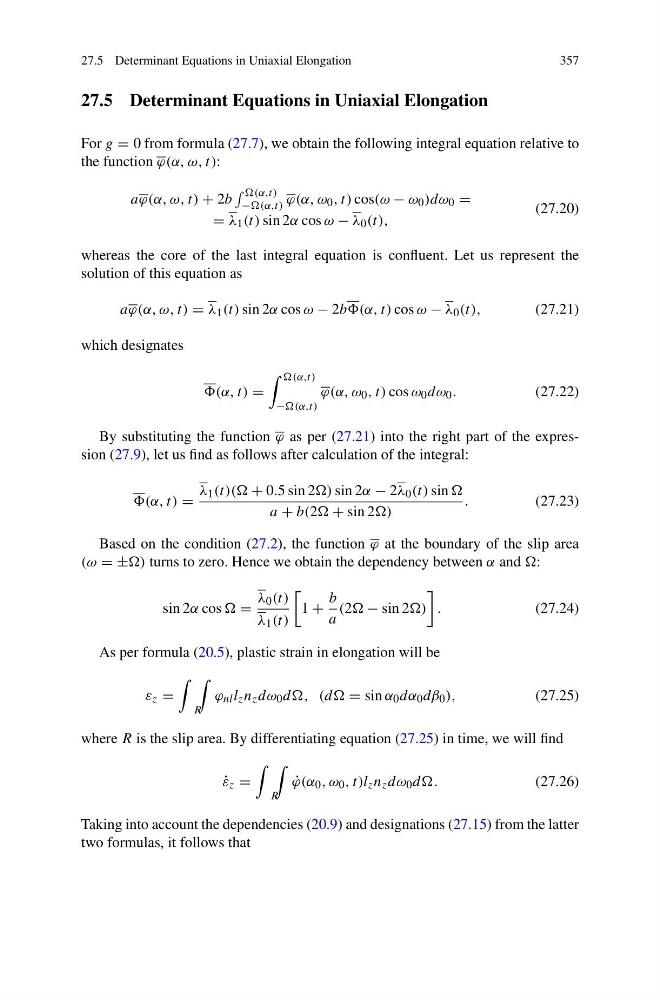
For g = 0 from formula (27.7), we obtain the following integral equation relative to
the function ϕ(α, ω, t):
aϕ(α, ω, t) + 2b
(α,t)
−(α,t) ϕ(α, ω 0 , t) cos(ω − ω 0 )dω 0 =
= λ 1 (t) sin 2α cos ω − λ 0 (t),
(27.20)
whereas the core of the last integral equation is confluent. Let us represent the
solution of this equation as
aϕ(α, ω, t) = λ 1 (t) sin 2α cos ω − 2b t) cos ω − λ 0 (t),
(27.21)
which designates
(α, t) =
(α,t)
−(α,t)
ϕ(α, ω 0 , t) cos ω 0 dω 0 .
(27.22)
By substituting the function ϕ as per (27.21) into the right part of the expression (27.9), let us find as follows after calculation of the integral:
t) =
λ 1 (t)(( + 0.5 sin 2) sin 2α − 2λ 0 (t) sin
a + b(2 + sin 2)
.
(27.23)
Based on the condition (27.2), the function ϕ at the boundary of the slip area
(ω = ±) turns to zero. Hence we obtain the dependency between α and :
sin 2α cos =
λ 0 (t)
λ 1 (t)
1 +
b
a
(2 − sin 2)
.
(27.24)
As per formula (20.5), plastic strain in elongation will be
ε z =
R
ϕ nl l z n z dω 0 dd, (dd = sin α 0 dα 0 dβ 0 ),
(27.25)
where R is the slip area. By differentiating equation (27.25) in time, we will find
˙
ε z =
R
˙
ϕ(α 0 , ω 0 , t)l z n z dω 0 dd.
(27.26)
Taking into account the dependencies (20.9) and designations (27.15) from the latter
two formulas, it follows that
357
27.5 Determinant Equations in Uniaxial Elongation
For g = 0 from formula (27.7), we obtain the following integral equation relative to
the function ϕ(α, ω, t):
aϕ(α, ω, t) + 2b
(α,t)
−(α,t) ϕ(α, ω 0 , t) cos(ω − ω 0 )dω 0 =
= λ 1 (t) sin 2α cos ω − λ 0 (t),
(27.20)
whereas the core of the last integral equation is confluent. Let us represent the
solution of this equation as
aϕ(α, ω, t) = λ 1 (t) sin 2α cos ω − 2b t) cos ω − λ 0 (t),
(27.21)
which designates
(α, t) =
(α,t)
−(α,t)
ϕ(α, ω 0 , t) cos ω 0 dω 0 .
(27.22)
By substituting the function ϕ as per (27.21) into the right part of the expression (27.9), let us find as follows after calculation of the integral:
t) =
λ 1 (t)(( + 0.5 sin 2) sin 2α − 2λ 0 (t) sin
a + b(2 + sin 2)
.
(27.23)
Based on the condition (27.2), the function ϕ at the boundary of the slip area
(ω = ±) turns to zero. Hence we obtain the dependency between α and :
sin 2α cos =
λ 0 (t)
λ 1 (t)
1 +
b
a
(2 − sin 2)
.
(27.24)
As per formula (20.5), plastic strain in elongation will be
ε z =
R
ϕ nl l z n z dω 0 dd, (dd = sin α 0 dα 0 dβ 0 ),
(27.25)
where R is the slip area. By differentiating equation (27.25) in time, we will find
˙
ε z =
R
˙
ϕ(α 0 , ω 0 , t)l z n z dω 0 dd.
(27.26)
Taking into account the dependencies (20.9) and designations (27.15) from the latter
two formulas, it follows that