

27.4 Study of the Tensor Intensity of Slips
355
ϕ(α, ω, t) = ϕ(α, ω, t) + ε
∂
∂t
ϕ(α, ω, t),
ε z (t) = ε z (t) + ε
d
dt
ε z (t);
(27.15)
λ 0 (t) =
ψ[t] − BB
[t]
, λ 1 (t) =
σ z (t) + 2AA
2[t]
−
3
2
cε z (t).
(27.16)
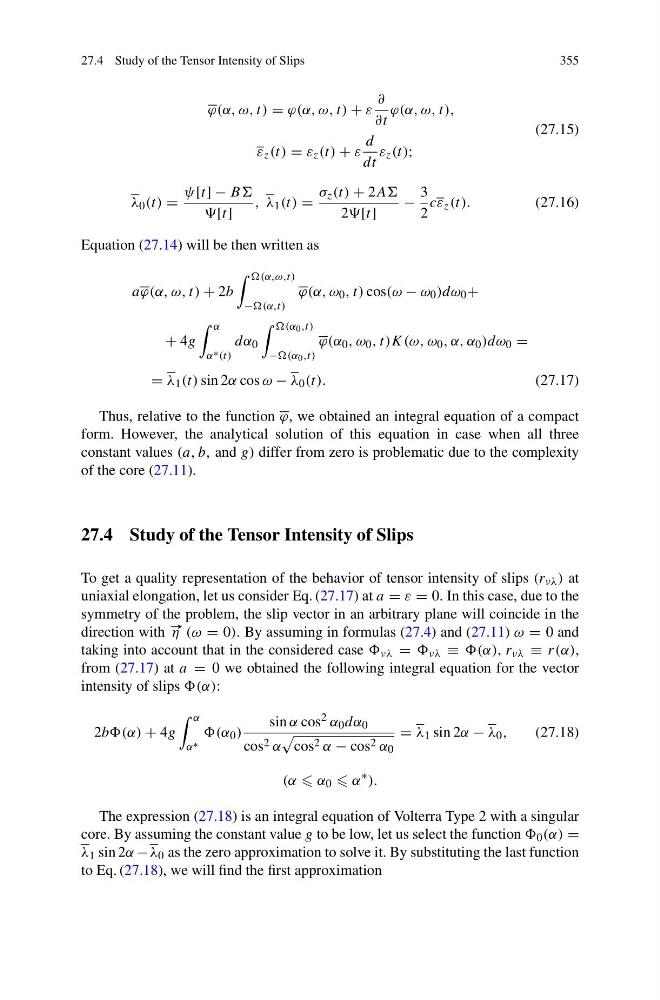
Equation (27.14) will be then written as
aϕ(α, ω, t) + 2b
(α,ω,t)
−(α,t)
ϕ(α, ω 0 , t) cos(ω − ω 0 )dω 0 +
+ 4g
α
α ∗ (t)
dα 0
(α 0 ,t)
−(α 0 ,t)
ϕ(α 0 , ω 0 , t)K(ω, ω 0 , α, α 0 )dω 0 =
= λ 1 (t) sin 2α cos ω − λ 0 (t).
(27.17)
Thus, relative to the function ϕ, we obtained an integral equation of a compact
form. However, the analytical solution of this equation in case when all three
constant values (a, b, and g) differ from zero is problematic due to the complexity
of the core (27.11).
27.4 Study of the Tensor Intensity of Slips
To get a quality representation of the behavior of tensor intensity of slips (r νλ ) at
uniaxial elongation, let us consider Eq. (27.17) at a = ε = 0. In this case, due to the
symmetry of the problem, the slip vector in an arbitrary plane will coincide in the
direction with #» η (ω = 0). By assuming in formulas (27.4) and (27.11) ω = 0 and
taking into account that in the considered case νλ = νλ ≡ r νλ ≡ r(α),
from (27.17) at a = 0 we obtained the following integral equation for the vector
intensity of slips
2bb(α) + 4g
α
α ∗
0 )
sin α cos 2 α 0 dα 0
cos 2 α
cos 2 α − cos 2 α 0
= λ 1 sin 2α − λ 0 ,
(27.18)
(α α 0 α
∗ ).
The expression (27.18) is an integral equation of Volterra Type 2 with a singular
core. By assuming the constant value g to be low, let us select the function 0 (α) =
λ 1 sin 2α − λ 0 as the zero approximation to solve it. By substituting the last function
to Eq. (27.18), we will find the first approximation
355
ϕ(α, ω, t) = ϕ(α, ω, t) + ε
∂
∂t
ϕ(α, ω, t),
ε z (t) = ε z (t) + ε
d
dt
ε z (t);
(27.15)
λ 0 (t) =
ψ[t] − BB
[t]
, λ 1 (t) =
σ z (t) + 2AA
2[t]
−
3
2
cε z (t).
(27.16)
Equation (27.14) will be then written as
aϕ(α, ω, t) + 2b
(α,ω,t)
−(α,t)
ϕ(α, ω 0 , t) cos(ω − ω 0 )dω 0 +
+ 4g
α
α ∗ (t)
dα 0
(α 0 ,t)
−(α 0 ,t)
ϕ(α 0 , ω 0 , t)K(ω, ω 0 , α, α 0 )dω 0 =
= λ 1 (t) sin 2α cos ω − λ 0 (t).
(27.17)
Thus, relative to the function ϕ, we obtained an integral equation of a compact
form. However, the analytical solution of this equation in case when all three
constant values (a, b, and g) differ from zero is problematic due to the complexity
of the core (27.11).
27.4 Study of the Tensor Intensity of Slips
To get a quality representation of the behavior of tensor intensity of slips (r νλ ) at
uniaxial elongation, let us consider Eq. (27.17) at a = ε = 0. In this case, due to the
symmetry of the problem, the slip vector in an arbitrary plane will coincide in the
direction with #» η (ω = 0). By assuming in formulas (27.4) and (27.11) ω = 0 and
taking into account that in the considered case νλ = νλ ≡ r νλ ≡ r(α),
from (27.17) at a = 0 we obtained the following integral equation for the vector
intensity of slips
2bb(α) + 4g
α
α ∗
0 )
sin α cos 2 α 0 dα 0
cos 2 α
cos 2 α − cos 2 α 0
= λ 1 sin 2α − λ 0 ,
(27.18)
(α α 0 α
∗ ).
The expression (27.18) is an integral equation of Volterra Type 2 with a singular
core. By assuming the constant value g to be low, let us select the function 0 (α) =
λ 1 sin 2α − λ 0 as the zero approximation to solve it. By substituting the last function
to Eq. (27.18), we will find the first approximation