

348
26 Full Bauschinger Effect
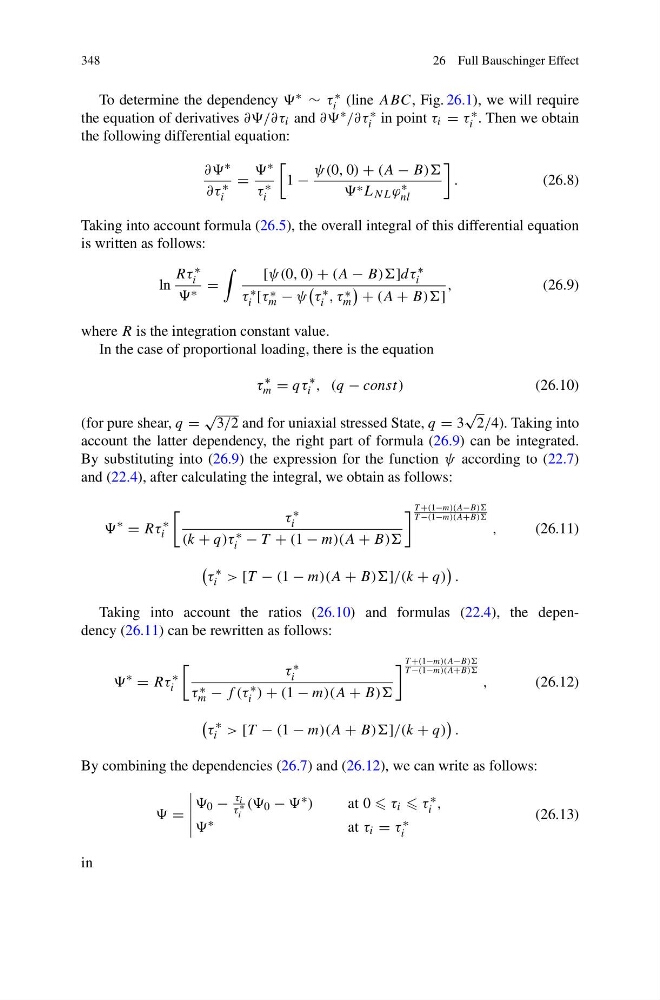
To determine the dependency ∗ ∼ τ ∗
i (line ABC, Fig. 26.1), we will require
the equation of derivatives ∂∂/∂τ i and ∂∂ ∗ /∂τ ∗
i in point τ i = τ ∗
i . Then we obtain
the following differential equation:
∂∂ ∗
∂τ ∗
i
=
∗
τ ∗
i
1 −
ψ(0, 0) + (A − B))
∗ L NL ϕ ∗
nl
.
(26.8)
Taking into account formula (26.5), the overall integral of this differential equation
is written as follows:
ln
Rτ ∗
i
∗ =
[ψ(0, 0) + (A − B))]dτ ∗
i
τ ∗
i [τ ∗
m − ψ
τ ∗
i , τ ∗
m
+ (A + B))]
,
(26.9)
where R is the integration constant value.
In the case of proportional loading, there is the equation
τ
∗
m = qτ
∗
i , (q − const)
(26.10)
(for pure shear, q =
√
3/2 and for uniaxial stressed State, q = 3
√
2/4). Taking into
account the latter dependency, the right part of formula (26.9) can be integrated.
By substituting into (26.9) the expression for the function ψ according to (22.7)
and (22.4), after calculating the integral, we obtain as follows:
∗
= Rτ
∗
i
τ ∗
i
(k + q)τ ∗
i − T + (1 − m)(A + B))
T +(1−m)(A−B))
T −(1−m)(A+B))
,
(26.11)
τ
∗
i > [T − (1 − m)(A + B))]/(k + q)
.
Taking into account the ratios (26.10) and formulas (22.4), the dependency (26.11) can be rewritten as follows:
∗
= Rτ
∗
i
τ ∗
i
τ ∗
m − f (τ ∗
i ) + (1 − m)(A + B))
T +(1−m)(A−B))
T −(1−m)(A+B))
,
(26.12)
τ
∗
i > [T − (1 − m)(A + B))]/(k + q)
.
By combining the dependencies (26.7) and (26.12), we can write as follows:
=
0 −
τ i
τ ∗
i
(( 0 − ∗ )
at 0 τ i τ ∗
i ,
∗
at τ i = τ ∗
i
(26.13)
in
26 Full Bauschinger Effect
To determine the dependency ∗ ∼ τ ∗
i (line ABC, Fig. 26.1), we will require
the equation of derivatives ∂∂/∂τ i and ∂∂ ∗ /∂τ ∗
i in point τ i = τ ∗
i . Then we obtain
the following differential equation:
∂∂ ∗
∂τ ∗
i
=
∗
τ ∗
i
1 −
ψ(0, 0) + (A − B))
∗ L NL ϕ ∗
nl
.
(26.8)
Taking into account formula (26.5), the overall integral of this differential equation
is written as follows:
ln
Rτ ∗
i
∗ =
[ψ(0, 0) + (A − B))]dτ ∗
i
τ ∗
i [τ ∗
m − ψ
τ ∗
i , τ ∗
m
+ (A + B))]
,
(26.9)
where R is the integration constant value.
In the case of proportional loading, there is the equation
τ
∗
m = qτ
∗
i , (q − const)
(26.10)
(for pure shear, q =
√
3/2 and for uniaxial stressed State, q = 3
√
2/4). Taking into
account the latter dependency, the right part of formula (26.9) can be integrated.
By substituting into (26.9) the expression for the function ψ according to (22.7)
and (22.4), after calculating the integral, we obtain as follows:
∗
= Rτ
∗
i
τ ∗
i
(k + q)τ ∗
i − T + (1 − m)(A + B))
T +(1−m)(A−B))
T −(1−m)(A+B))
,
(26.11)
τ
∗
i > [T − (1 − m)(A + B))]/(k + q)
.
Taking into account the ratios (26.10) and formulas (22.4), the dependency (26.11) can be rewritten as follows:
∗
= Rτ
∗
i
τ ∗
i
τ ∗
m − f (τ ∗
i ) + (1 − m)(A + B))
T +(1−m)(A−B))
T −(1−m)(A+B))
,
(26.12)
τ
∗
i > [T − (1 − m)(A + B))]/(k + q)
.
By combining the dependencies (26.7) and (26.12), we can write as follows:
=
0 −
τ i
τ ∗
i
(( 0 − ∗ )
at 0 τ i τ ∗
i ,
∗
at τ i = τ ∗
i
(26.13)
in