

References
349
τ
∗
i > [T − (1 − m)(A + B))]/(k + q)
.
Let us note that in the expression (25.3) for the integral operator L νλ , each addend
contains a multiplier as the constant value (a, b, c, g). When substituting into the
shear resistance (25.2) the functions using formulas (26.12) and (26.13), we can
re-designate a 1 = aR, . . . , c 1 = cR, where a 1 , . . . , c 1 are new constant values. Not
to implement such redesignations, below we adopt the integration constant value
R = 1.
26.4 Function in Almost Simple Strain
Formulas (26.13) define the function in proportional loading to the stress τ ∗
i
with further unloading and proportional loading in the opposite direction. In what
follows, we will show that using the expressions (26.13) for the function gives
high-quality diagrams in alternating-sign loading. Moreover, as said above, when
building formulas (26.13), the dependency of the function on the directions of
further additional loading is indirectly taken into account. This allows suggesting
that for the case of almost simple strain, the function can also be adopted in
the form (26.13) if in the expressions (26.5) and (26.6), the value of the operator
L NL ϕ ∗
nl at the time t ∗ is replaced by the current value of this operator L NL ϕ nl in the
direction of maximum tangential stress at the current moment in time t. In the case
of such replacement, the expression (26.12) remains the same, and only the upper
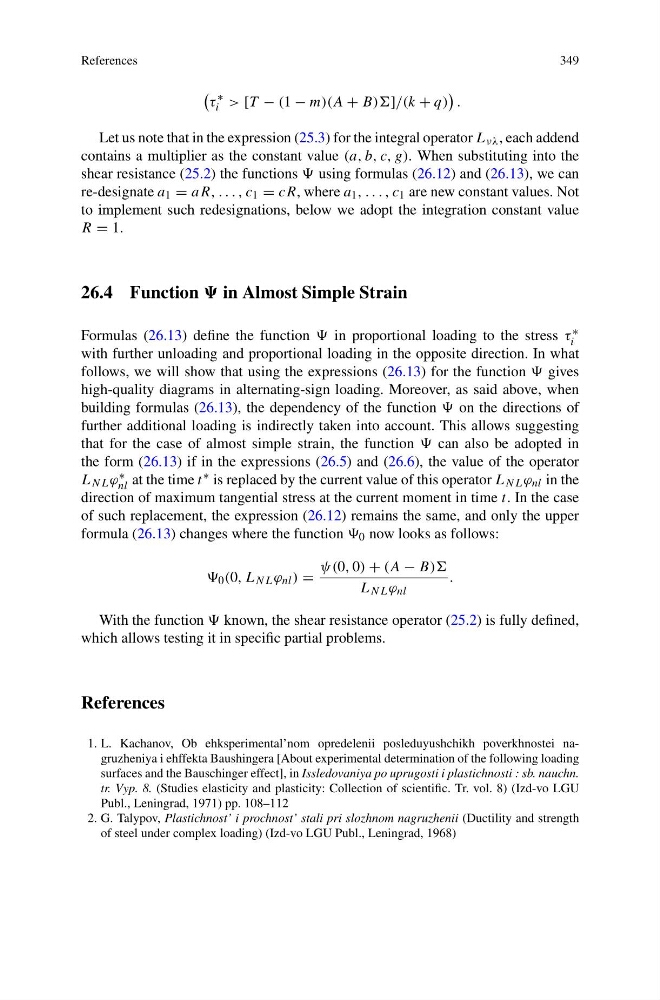
formula (26.13) changes where the function 0 now looks as follows:
0 (0, L NL ϕ nl ) =
ψ(0, 0) + (A − B))
L NL ϕ nl
.
With the function known, the shear resistance operator (25.2) is fully defined,
which allows testing it in specific partial problems.
References
1. L. Kachanov, Ob ehksperimental’nom opredelenii posleduyushchikh poverkhnostei nagruzheniya i ehffekta Baushingera [About experimental determination of the following loading
surfaces and the Bauschinger effect], in Issledovaniya po uprugosti i plastichnosti : sb. nauchn.
tr. Vyp. 8. (Studies elasticity and plasticity: Collection of scientific. Tr. vol. 8) (Izd-vo LGU
Publ., Leningrad, 1971) pp. 108–112
2. G. Talypov, Plastichnost’ i prochnost’ stali pri slozhnom nagruzhenii (Ductility and strength
of steel under complex loading) (Izd-vo LGU Publ., Leningrad, 1968)
349
τ
∗
i > [T − (1 − m)(A + B))]/(k + q)
.
Let us note that in the expression (25.3) for the integral operator L νλ , each addend
contains a multiplier as the constant value (a, b, c, g). When substituting into the
shear resistance (25.2) the functions using formulas (26.12) and (26.13), we can
re-designate a 1 = aR, . . . , c 1 = cR, where a 1 , . . . , c 1 are new constant values. Not
to implement such redesignations, below we adopt the integration constant value
R = 1.
26.4 Function in Almost Simple Strain
Formulas (26.13) define the function in proportional loading to the stress τ ∗
i
with further unloading and proportional loading in the opposite direction. In what
follows, we will show that using the expressions (26.13) for the function gives
high-quality diagrams in alternating-sign loading. Moreover, as said above, when
building formulas (26.13), the dependency of the function on the directions of
further additional loading is indirectly taken into account. This allows suggesting
that for the case of almost simple strain, the function can also be adopted in
the form (26.13) if in the expressions (26.5) and (26.6), the value of the operator
L NL ϕ ∗
nl at the time t ∗ is replaced by the current value of this operator L NL ϕ nl in the
direction of maximum tangential stress at the current moment in time t. In the case
of such replacement, the expression (26.12) remains the same, and only the upper
formula (26.13) changes where the function 0 now looks as follows:
0 (0, L NL ϕ nl ) =
ψ(0, 0) + (A − B))
L NL ϕ nl
.
With the function known, the shear resistance operator (25.2) is fully defined,
which allows testing it in specific partial problems.
References
1. L. Kachanov, Ob ehksperimental’nom opredelenii posleduyushchikh poverkhnostei nagruzheniya i ehffekta Baushingera [About experimental determination of the following loading
surfaces and the Bauschinger effect], in Issledovaniya po uprugosti i plastichnosti : sb. nauchn.
tr. Vyp. 8. (Studies elasticity and plasticity: Collection of scientific. Tr. vol. 8) (Izd-vo LGU
Publ., Leningrad, 1971) pp. 108–112
2. G. Talypov, Plastichnost’ i prochnost’ stali pri slozhnom nagruzhenii (Ductility and strength
of steel under complex loading) (Izd-vo LGU Publ., Leningrad, 1968)