

24.4 Simplified Model of Non-elastic Strain Growth
335
zone must be considered as a material layer whose strength properties differ from the
properties of an elastic material remotely located from the boundary of the elastic
and plastic zones. The strength σ b of the boundary layer 1 can be deemed the function
of the density of dislocations in the plastic zone. The latter is related to the plastic
strain. Since plastic strain in the element that has become plastic reaches the value
of macro-strain ε 0 over a short period of time at the end of the yield plateau in
these test conditions, the boundary layer strength σ b can be finally deemed to be
dependent on the value ε 0 , e.g.
σ b = p(ε 0 ),
(24.2)
where p is some positive function of this argument.
Since the boundary layer thickness is indefinitely low, there is a high frequency
of stress variance in the yield process (as compared to the own frequency of the
test machine). If the yield stress substantially exceeds the initial shear resistance,
the formation of the initial yield drop will be accompanied by a jerk that will cause
low-frequency converging oscillations mainly defined by the machine design. In a
steady-state process, the “physical” yield stress means some average value between
the upper yield stress and initial shear resistance; its calculation under the defined
upper yield stress and shear resistance is a complex task of dynamics that we will
consider in a simplified setting.
24.4 Simplified Model of Non-elastic Strain Growth
As established above, three zones exist in the specimen at the same time whose
material has various strength properties and various degrees of deformation: a zone
of elastic material where stresses are related to strain by Hooke’s law, a plastic zone
whose strain properties are described by its relations, and a boundary layer where
stress cannot exceed its strength (24.2). If we know the material properties in all
three zones, we can build a pattern of yield propagation in a sample. Let us consider
the first stage of this task.
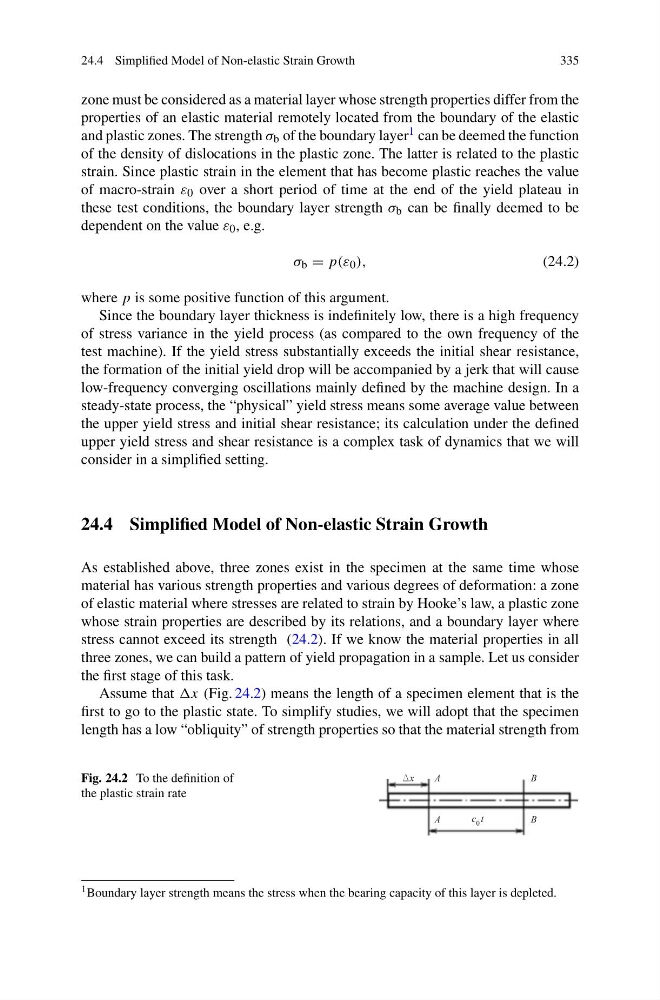
Assume that x (Fig. 24.2) means the length of a specimen element that is the
first to go to the plastic state. To simplify studies, we will adopt that the specimen
length has a low “obliquity” of strength properties so that the material strength from
Fig. 24.2 To the definition of
the plastic strain rate
1 Boundary layer strength means the stress when the bearing capacity of this layer is depleted.
335
zone must be considered as a material layer whose strength properties differ from the
properties of an elastic material remotely located from the boundary of the elastic
and plastic zones. The strength σ b of the boundary layer 1 can be deemed the function
of the density of dislocations in the plastic zone. The latter is related to the plastic
strain. Since plastic strain in the element that has become plastic reaches the value
of macro-strain ε 0 over a short period of time at the end of the yield plateau in
these test conditions, the boundary layer strength σ b can be finally deemed to be
dependent on the value ε 0 , e.g.
σ b = p(ε 0 ),
(24.2)
where p is some positive function of this argument.
Since the boundary layer thickness is indefinitely low, there is a high frequency
of stress variance in the yield process (as compared to the own frequency of the
test machine). If the yield stress substantially exceeds the initial shear resistance,
the formation of the initial yield drop will be accompanied by a jerk that will cause
low-frequency converging oscillations mainly defined by the machine design. In a
steady-state process, the “physical” yield stress means some average value between
the upper yield stress and initial shear resistance; its calculation under the defined
upper yield stress and shear resistance is a complex task of dynamics that we will
consider in a simplified setting.
24.4 Simplified Model of Non-elastic Strain Growth
As established above, three zones exist in the specimen at the same time whose
material has various strength properties and various degrees of deformation: a zone
of elastic material where stresses are related to strain by Hooke’s law, a plastic zone
whose strain properties are described by its relations, and a boundary layer where
stress cannot exceed its strength (24.2). If we know the material properties in all
three zones, we can build a pattern of yield propagation in a sample. Let us consider
the first stage of this task.
Assume that x (Fig. 24.2) means the length of a specimen element that is the
first to go to the plastic state. To simplify studies, we will adopt that the specimen
length has a low “obliquity” of strength properties so that the material strength from
Fig. 24.2 To the definition of
the plastic strain rate
1 Boundary layer strength means the stress when the bearing capacity of this layer is depleted.