

334
24 Specimen Elongation with Yield Drop
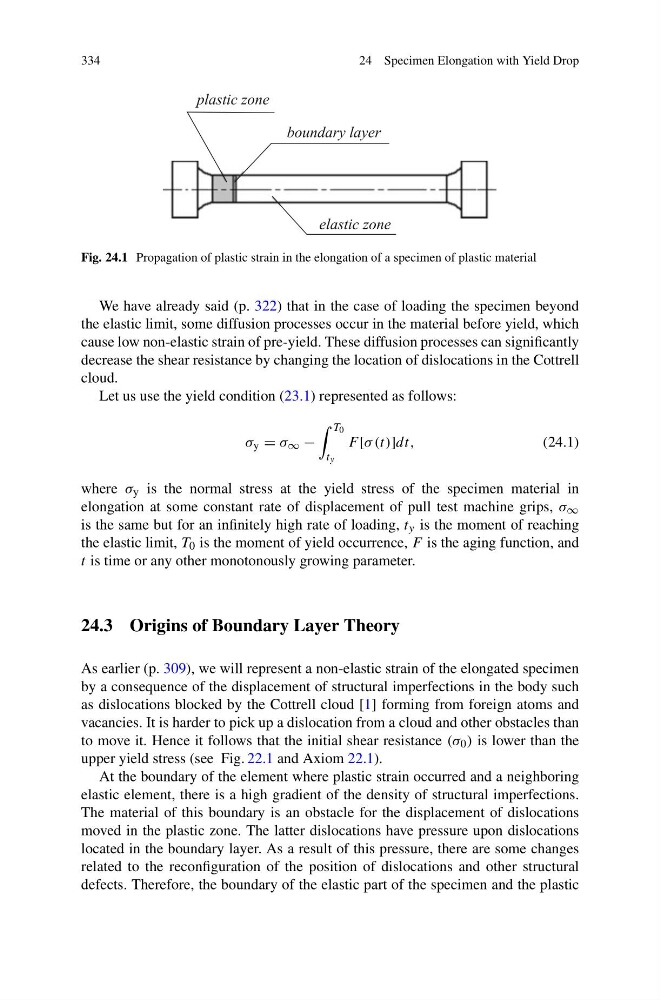
Fig. 24.1 Propagation of plastic strain in the elongation of a specimen of plastic material
We have already said (p. 322) that in the case of loading the specimen beyond
the elastic limit, some diffusion processes occur in the material before yield, which
cause low non-elastic strain of pre-yield. These diffusion processes can significantly
decrease the shear resistance by changing the location of dislocations in the Cottrell
cloud.
Let us use the yield condition (23.1) represented as follows:
σ y = σ ∞ −
T 0
t y
F [σ (t)]dt,
(24.1)
where σ y is the normal stress at the yield stress of the specimen material in
elongation at some constant rate of displacement of pull test machine grips, σ ∞
is the same but for an infinitely high rate of loading, t y is the moment of reaching
the elastic limit, T 0 is the moment of yield occurrence, F is the aging function, and
t is time or any other monotonously growing parameter.
24.3 Origins of Boundary Layer Theory
As earlier (p. 309), we will represent a non-elastic strain of the elongated specimen
by a consequence of the displacement of structural imperfections in the body such
as dislocations blocked by the Cottrell cloud [1] forming from foreign atoms and
vacancies. It is harder to pick up a dislocation from a cloud and other obstacles than
to move it. Hence it follows that the initial shear resistance (σ 0 ) is lower than the
upper yield stress (see Fig. 22.1 and Axiom 22.1).
At the boundary of the element where plastic strain occurred and a neighboring
elastic element, there is a high gradient of the density of structural imperfections.
The material of this boundary is an obstacle for the displacement of dislocations
moved in the plastic zone. The latter dislocations have pressure upon dislocations
located in the boundary layer. As a result of this pressure, there are some changes
related to the reconfiguration of the position of dislocations and other structural
defects. Therefore, the boundary of the elastic part of the specimen and the plastic
24 Specimen Elongation with Yield Drop
Fig. 24.1 Propagation of plastic strain in the elongation of a specimen of plastic material
We have already said (p. 322) that in the case of loading the specimen beyond
the elastic limit, some diffusion processes occur in the material before yield, which
cause low non-elastic strain of pre-yield. These diffusion processes can significantly
decrease the shear resistance by changing the location of dislocations in the Cottrell
cloud.
Let us use the yield condition (23.1) represented as follows:
σ y = σ ∞ −
T 0
t y
F [σ (t)]dt,
(24.1)
where σ y is the normal stress at the yield stress of the specimen material in
elongation at some constant rate of displacement of pull test machine grips, σ ∞
is the same but for an infinitely high rate of loading, t y is the moment of reaching
the elastic limit, T 0 is the moment of yield occurrence, F is the aging function, and
t is time or any other monotonously growing parameter.
24.3 Origins of Boundary Layer Theory
As earlier (p. 309), we will represent a non-elastic strain of the elongated specimen
by a consequence of the displacement of structural imperfections in the body such
as dislocations blocked by the Cottrell cloud [1] forming from foreign atoms and
vacancies. It is harder to pick up a dislocation from a cloud and other obstacles than
to move it. Hence it follows that the initial shear resistance (σ 0 ) is lower than the
upper yield stress (see Fig. 22.1 and Axiom 22.1).
At the boundary of the element where plastic strain occurred and a neighboring
elastic element, there is a high gradient of the density of structural imperfections.
The material of this boundary is an obstacle for the displacement of dislocations
moved in the plastic zone. The latter dislocations have pressure upon dislocations
located in the boundary layer. As a result of this pressure, there are some changes
related to the reconfiguration of the position of dislocations and other structural
defects. Therefore, the boundary of the elastic part of the specimen and the plastic