

308
20 Problem Setting
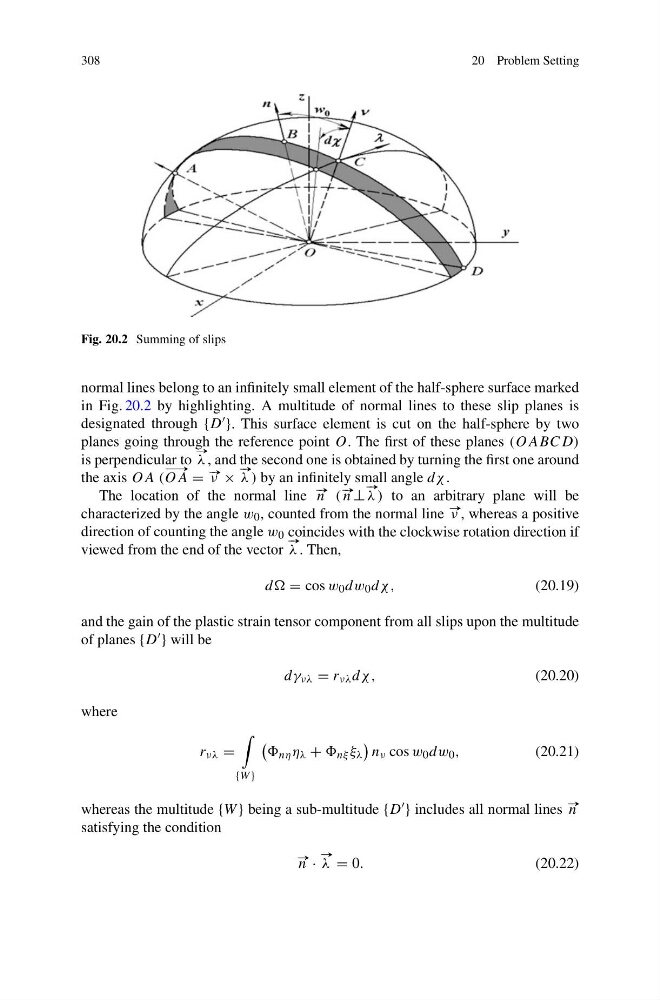
Fig. 20.2 Summing of slips
normal lines belong to an infinitely small element of the half-sphere surface marked
in Fig. 20.2 by highlighting. A multitude of normal lines to these slip planes is
designated through {D }. This surface element is cut on the half-sphere by two
planes going through the reference point O. The first of these planes (OABCD)
is perpendicular to
#»
λ , and the second one is obtained by turning the first one around
the axis OA (
# »
OA = #» ν ×
#»
λ ) by an infinitely small angle dχ.
The location of the normal line #» n ( #» n ⊥
#»
λ ) to an arbitrary plane will be
characterized by the angle w 0 , counted from the normal line #» ν , whereas a positive
direction of counting the angle w 0 coincides with the clockwise rotation direction if
viewed from the end of the vector
#»
λ . Then,
dd = cos w 0 dw 0 dχ,
(20.19)
and the gain of the plastic strain tensor component from all slips upon the multitude
of planes {D } will be
dγ νλ = r νλ dχ,
(20.20)
where
r νλ =
{W }
nη η λ + nξ ξ λ
n ν cos w 0 dw 0 ,
(20.21)
whereas the multitude {W } being a sub-multitude {D } includes all normal lines #» n
satisfying the condition
#» n ·
#»
λ = 0.
(20.22)
20 Problem Setting
Fig. 20.2 Summing of slips
normal lines belong to an infinitely small element of the half-sphere surface marked
in Fig. 20.2 by highlighting. A multitude of normal lines to these slip planes is
designated through {D }. This surface element is cut on the half-sphere by two
planes going through the reference point O. The first of these planes (OABCD)
is perpendicular to
#»
λ , and the second one is obtained by turning the first one around
the axis OA (
# »
OA = #» ν ×
#»
λ ) by an infinitely small angle dχ.
The location of the normal line #» n ( #» n ⊥
#»
λ ) to an arbitrary plane will be
characterized by the angle w 0 , counted from the normal line #» ν , whereas a positive
direction of counting the angle w 0 coincides with the clockwise rotation direction if
viewed from the end of the vector
#»
λ . Then,
dd = cos w 0 dw 0 dχ,
(20.19)
and the gain of the plastic strain tensor component from all slips upon the multitude
of planes {D } will be
dγ νλ = r νλ dχ,
(20.20)
where
r νλ =
{W }
nη η λ + nξ ξ λ
n ν cos w 0 dw 0 ,
(20.21)
whereas the multitude {W } being a sub-multitude {D } includes all normal lines #» n
satisfying the condition
#» n ·
#»
λ = 0.
(20.22)