

20.3 Slip Synthesis
307
or in projections:
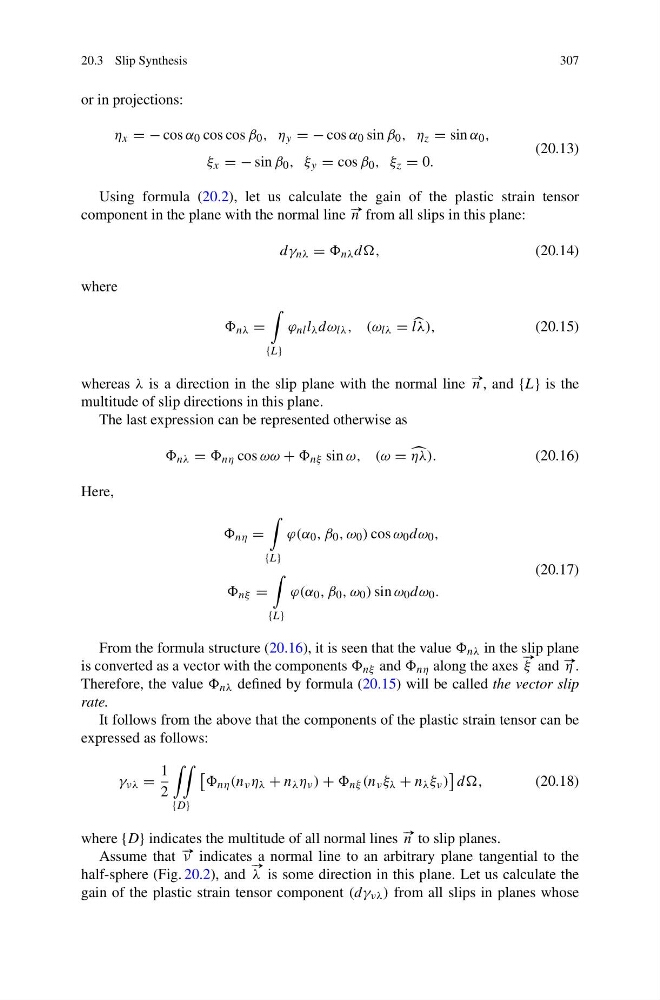
η x = − cos α 0 cos cos β 0 , η y = − cos α 0 sin β 0 , η z = sin α 0 ,
ξ x = − sin β 0 , ξ y = cos β 0 , ξ z = 0.
(20.13)
Using formula (20.2), let us calculate the gain of the plastic strain tensor
component in the plane with the normal line #» n from all slips in this plane:
dγ nλ = nλ dd,
(20.14)
where
nλ =
{L}
ϕ nl l λ dω lλ , (ω lλ =
lλ),
(20.15)
whereas λ is a direction in the slip plane with the normal line #» n , and {L} is the
multitude of slip directions in this plane.
The last expression can be represented otherwise as
nλ = nη cos ωω + nξ sin ω, (ω =
ηλ).
(20.16)
Here,
nη =
{L}
ϕ(α 0 , β 0 , ω 0 ) cos ω 0 dω 0 ,
nξ =
{L}
ϕ(α 0 , β 0 , ω 0 ) sin ω 0 dω 0 .
(20.17)
From the formula structure (20.16), it is seen that the value nλ in the slip plane
is converted as a vector with the components nξ and nη along the axes
#»
ξ and #» η .
Therefore, the value nλ defined by formula (20.15) will be called the vector slip
rate.
It follows from the above that the components of the plastic strain tensor can be
expressed as follows:
γ νλ =
1
2
{D}
nη (n ν η λ + n λ η ν ) + nξ (n ν ξ λ + n λ ξ ν )
dd,
(20.18)
where {D} indicates the multitude of all normal lines #» n to slip planes.
Assume that #» ν indicates a normal line to an arbitrary plane tangential to the
half-sphere (Fig. 20.2), and
#»
λ is some direction in this plane. Let us calculate the
gain of the plastic strain tensor component (dγ νλ ) from all slips in planes whose
307
or in projections:
η x = − cos α 0 cos cos β 0 , η y = − cos α 0 sin β 0 , η z = sin α 0 ,
ξ x = − sin β 0 , ξ y = cos β 0 , ξ z = 0.
(20.13)
Using formula (20.2), let us calculate the gain of the plastic strain tensor
component in the plane with the normal line #» n from all slips in this plane:
dγ nλ = nλ dd,
(20.14)
where
nλ =
{L}
ϕ nl l λ dω lλ , (ω lλ =
lλ),
(20.15)
whereas λ is a direction in the slip plane with the normal line #» n , and {L} is the
multitude of slip directions in this plane.
The last expression can be represented otherwise as
nλ = nη cos ωω + nξ sin ω, (ω =
ηλ).
(20.16)
Here,
nη =
{L}
ϕ(α 0 , β 0 , ω 0 ) cos ω 0 dω 0 ,
nξ =
{L}
ϕ(α 0 , β 0 , ω 0 ) sin ω 0 dω 0 .
(20.17)
From the formula structure (20.16), it is seen that the value nλ in the slip plane
is converted as a vector with the components nξ and nη along the axes
#»
ξ and #» η .
Therefore, the value nλ defined by formula (20.15) will be called the vector slip
rate.
It follows from the above that the components of the plastic strain tensor can be
expressed as follows:
γ νλ =
1
2
{D}
nη (n ν η λ + n λ η ν ) + nξ (n ν ξ λ + n λ ξ ν )
dd,
(20.18)
where {D} indicates the multitude of all normal lines #» n to slip planes.
Assume that #» ν indicates a normal line to an arbitrary plane tangential to the
half-sphere (Fig. 20.2), and
#»
λ is some direction in this plane. Let us calculate the
gain of the plastic strain tensor component (dγ νλ ) from all slips in planes whose