

256
17 Additions and Generalizations to the Strain Theory of Plasticity
17.7 Loading Surface
We have already said (p. 201) that the yield condition in the case of primary loading
of a virgin material can be represented as
f (J 1 , J 2 , J 3 ) = k
2 , (k = const),
where J i are invariants of the stress tensor. If we assume that the first invariant (J 1 )
does not affect the conditions of occurrence and development of plastic strain, the
plasticity condition looks as follows:
f (J
2 , J
3 ) = k
2 .
(17.17)
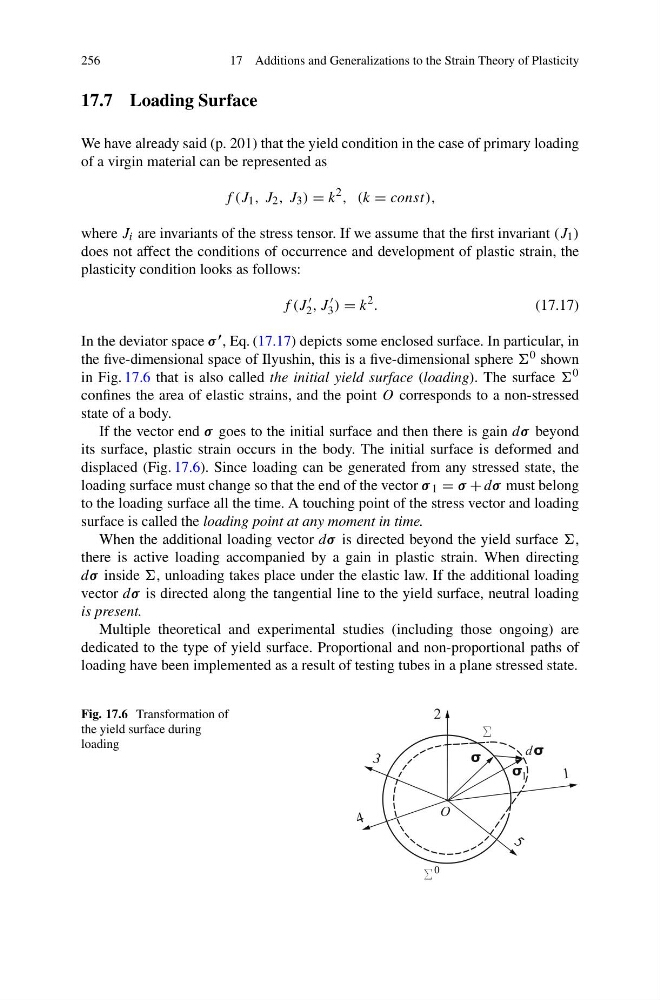
In the deviator space σ , Eq. (17.17) depicts some enclosed surface. In particular, in
the five-dimensional space of Ilyushin, this is a five-dimensional sphere 0 shown
in Fig. 17.6 that is also called the initial yield surface (loading). The surface 0
confines the area of elastic strains, and the point O corresponds to a non-stressed
state of a body.
If the vector end σ goes to the initial surface and then there is gain dσ beyond
its surface, plastic strain occurs in the body. The initial surface is deformed and
displaced (Fig. 17.6). Since loading can be generated from any stressed state, the
loading surface must change so that the end of the vector σ 1 = σ + dσ must belong
to the loading surface all the time. A touching point of the stress vector and loading
surface is called the loading point at any moment in time.
When the additional loading vector dσ is directed beyond the yield surface ,
there is active loading accompanied by a gain in plastic strain. When directing
dσ inside , unloading takes place under the elastic law. If the additional loading
vector dσ is directed along the tangential line to the yield surface, neutral loading
is present.
Multiple theoretical and experimental studies (including those ongoing) are
dedicated to the type of yield surface. Proportional and non-proportional paths of
loading have been implemented as a result of testing tubes in a plane stressed state.
Fig. 17.6 Transformation of
the yield surface during
loading
17 Additions and Generalizations to the Strain Theory of Plasticity
17.7 Loading Surface
We have already said (p. 201) that the yield condition in the case of primary loading
of a virgin material can be represented as
f (J 1 , J 2 , J 3 ) = k
2 , (k = const),
where J i are invariants of the stress tensor. If we assume that the first invariant (J 1 )
does not affect the conditions of occurrence and development of plastic strain, the
plasticity condition looks as follows:
f (J
2 , J
3 ) = k
2 .
(17.17)
In the deviator space σ , Eq. (17.17) depicts some enclosed surface. In particular, in
the five-dimensional space of Ilyushin, this is a five-dimensional sphere 0 shown
in Fig. 17.6 that is also called the initial yield surface (loading). The surface 0
confines the area of elastic strains, and the point O corresponds to a non-stressed
state of a body.
If the vector end σ goes to the initial surface and then there is gain dσ beyond
its surface, plastic strain occurs in the body. The initial surface is deformed and
displaced (Fig. 17.6). Since loading can be generated from any stressed state, the
loading surface must change so that the end of the vector σ 1 = σ + dσ must belong
to the loading surface all the time. A touching point of the stress vector and loading
surface is called the loading point at any moment in time.
When the additional loading vector dσ is directed beyond the yield surface ,
there is active loading accompanied by a gain in plastic strain. When directing
dσ inside , unloading takes place under the elastic law. If the additional loading
vector dσ is directed along the tangential line to the yield surface, neutral loading
is present.
Multiple theoretical and experimental studies (including those ongoing) are
dedicated to the type of yield surface. Proportional and non-proportional paths of
loading have been implemented as a result of testing tubes in a plane stressed state.
Fig. 17.6 Transformation of
the yield surface during
loading