

17.6 Delay Law
255
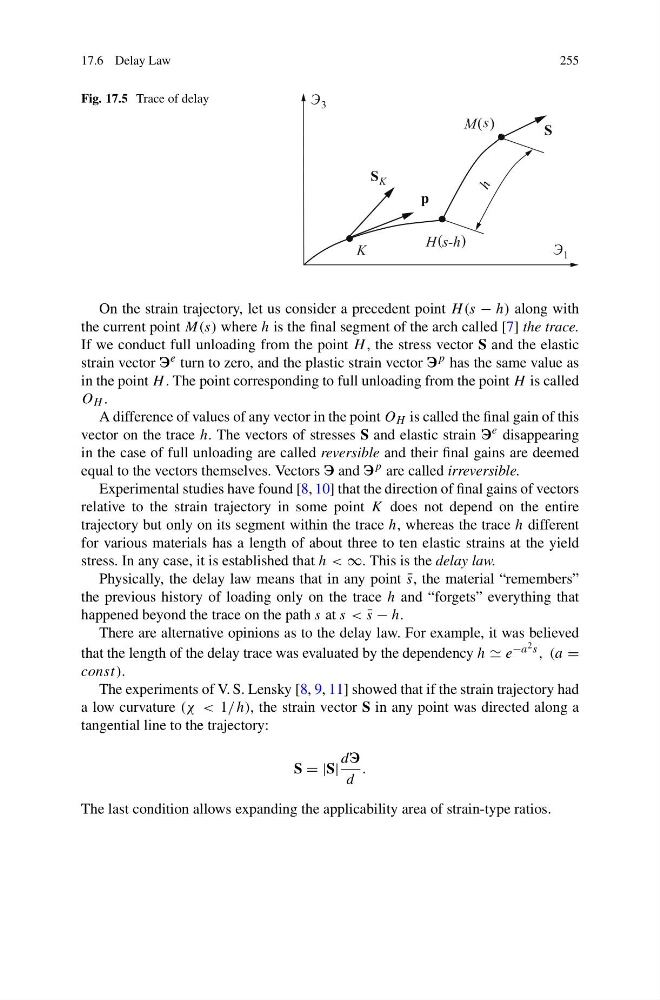
Fig. 17.5 Trace of delay
On the strain trajectory, let us consider a precedent point H (s − h) along with
the current point M(s) where h is the final segment of the arch called [7] the trace.
If we conduct full unloading from the point H , the stress vector S and the elastic
strain vector Э
e turn to zero, and the plastic strain vector Э
p has the same value as
in the point H . The point corresponding to full unloading from the point H is called
O H .
A difference of values of any vector in the point O H is called the final gain of this
vector on the trace h. The vectors of stresses S and elastic strain Э
e disappearing
in the case of full unloading are called reversible and their final gains are deemed
equal to the vectors themselves. Vectors Э and Э
p are called irreversible.
Experimental studies have found [8, 10] that the direction of final gains of vectors
relative to the strain trajectory in some point K does not depend on the entire
trajectory but only on its segment within the trace h, whereas the trace h different
for various materials has a length of about three to ten elastic strains at the yield
stress. In any case, it is established that h < ∞. This is the delay law.
Physically, the delay law means that in any point ¯
s, the material “remembers”
the previous history of loading only on the trace h and “forgets” everything that
happened beyond the trace on the path s at s < ¯
s − h.
There are alternative opinions as to the delay law. For example, it was believed
that the length of the delay trace was evaluated by the dependency h e −a 2 s , (a =
const).
The experiments of V. S. Lensky [8, 9, 11] showed that if the strain trajectory had
a low curvature (χ < 1/h), the strain vector S in any point was directed along a
tangential line to the trajectory:
S = |S|
dЭ
d
.
The last condition allows expanding the applicability area of strain-type ratios.
255
Fig. 17.5 Trace of delay
On the strain trajectory, let us consider a precedent point H (s − h) along with
the current point M(s) where h is the final segment of the arch called [7] the trace.
If we conduct full unloading from the point H , the stress vector S and the elastic
strain vector Э
e turn to zero, and the plastic strain vector Э
p has the same value as
in the point H . The point corresponding to full unloading from the point H is called
O H .
A difference of values of any vector in the point O H is called the final gain of this
vector on the trace h. The vectors of stresses S and elastic strain Э
e disappearing
in the case of full unloading are called reversible and their final gains are deemed
equal to the vectors themselves. Vectors Э and Э
p are called irreversible.
Experimental studies have found [8, 10] that the direction of final gains of vectors
relative to the strain trajectory in some point K does not depend on the entire
trajectory but only on its segment within the trace h, whereas the trace h different
for various materials has a length of about three to ten elastic strains at the yield
stress. In any case, it is established that h < ∞. This is the delay law.
Physically, the delay law means that in any point ¯
s, the material “remembers”
the previous history of loading only on the trace h and “forgets” everything that
happened beyond the trace on the path s at s < ¯
s − h.
There are alternative opinions as to the delay law. For example, it was believed
that the length of the delay trace was evaluated by the dependency h e −a 2 s , (a =
const).
The experiments of V. S. Lensky [8, 9, 11] showed that if the strain trajectory had
a low curvature (χ < 1/h), the strain vector S in any point was directed along a
tangential line to the trajectory:
S = |S|
dЭ
d
.
The last condition allows expanding the applicability area of strain-type ratios.