

17.8 Drucker Postulate
257
Let us take into account the following results. First of all, the initial yield surface
of an isotropic material according to experimental works better complies with the
Mises condition than the Tresca condition. Second, in most experimental studies, a
convex smooth surface was obtained after preliminary simple loading, but in some
cases of proportional plastic loading, we see a trend to forming an area of large
curvature near the loading point reminding of blunt angles. The latter was used as a
basis for a hypothesis of singular yield surfaces that will be discussed later.
17.8 Drucker Postulate
As shown above (p. 247), the theory of low elastic–plastic strains does not satisfy
the continuity condition when switching from active loading to unloading. When
analyzing other variants of plasticity theory, we can face such anti-natural and
physically unacceptable consequences of various theories.
Therefore, it is desirable to have some universal criterion that must be satisfied
as a minimal requirement for plasticity theory. This criterion was formulated by
Drucker [2, 3].
Assume that when loading a body beyond the elasticity limits, some stressed state
σ ∗
ij was reached, which is depicted in a non-dimensional space by the loading point
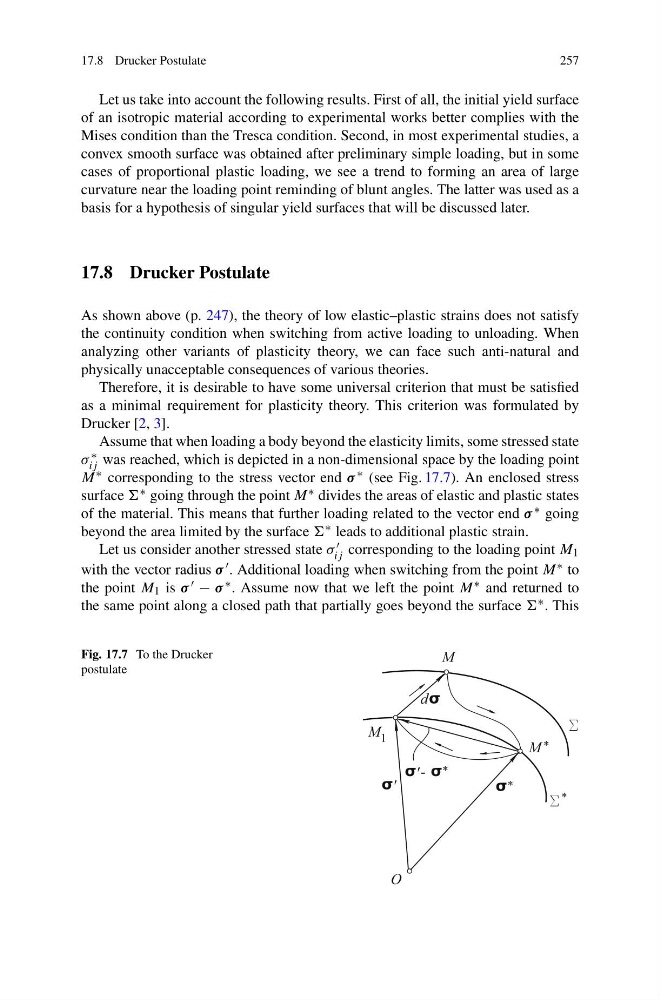
M ∗ corresponding to the stress vector end σ ∗ (see Fig. 17.7). An enclosed stress
surface ∗ going through the point M ∗ divides the areas of elastic and plastic states
of the material. This means that further loading related to the vector end σ ∗ going
beyond the area limited by the surface ∗ leads to additional plastic strain.
Let us consider another stressed state σ
ij corresponding to the loading point M 1
with the vector radius σ . Additional loading when switching from the point M ∗ to
the point M 1 is σ − σ ∗ . Assume now that we left the point M ∗ and returned to
the same point along a closed path that partially goes beyond the surface ∗ . This
Fig. 17.7 To the Drucker
postulate
O
M
M 1
*
M
σ
d
σ'
σ *
σ *
σ' -
*
257
Let us take into account the following results. First of all, the initial yield surface
of an isotropic material according to experimental works better complies with the
Mises condition than the Tresca condition. Second, in most experimental studies, a
convex smooth surface was obtained after preliminary simple loading, but in some
cases of proportional plastic loading, we see a trend to forming an area of large
curvature near the loading point reminding of blunt angles. The latter was used as a
basis for a hypothesis of singular yield surfaces that will be discussed later.
17.8 Drucker Postulate
As shown above (p. 247), the theory of low elastic–plastic strains does not satisfy
the continuity condition when switching from active loading to unloading. When
analyzing other variants of plasticity theory, we can face such anti-natural and
physically unacceptable consequences of various theories.
Therefore, it is desirable to have some universal criterion that must be satisfied
as a minimal requirement for plasticity theory. This criterion was formulated by
Drucker [2, 3].
Assume that when loading a body beyond the elasticity limits, some stressed state
σ ∗
ij was reached, which is depicted in a non-dimensional space by the loading point
M ∗ corresponding to the stress vector end σ ∗ (see Fig. 17.7). An enclosed stress
surface ∗ going through the point M ∗ divides the areas of elastic and plastic states
of the material. This means that further loading related to the vector end σ ∗ going
beyond the area limited by the surface ∗ leads to additional plastic strain.
Let us consider another stressed state σ
ij corresponding to the loading point M 1
with the vector radius σ . Additional loading when switching from the point M ∗ to
the point M 1 is σ − σ ∗ . Assume now that we left the point M ∗ and returned to
the same point along a closed path that partially goes beyond the surface ∗ . This
Fig. 17.7 To the Drucker
postulate
O
M
M 1
*
M
σ
d
σ'
σ *
σ *
σ' -
*