

16.5 Torsion of a Beam of Ideally Plastic Material
237
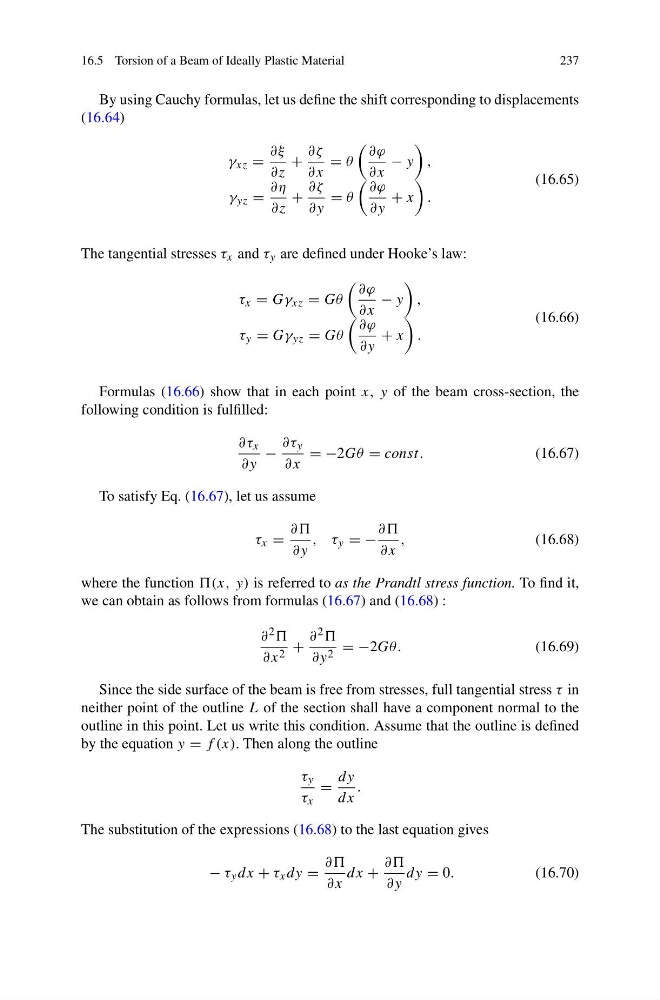
By using Cauchy formulas, let us define the shift corresponding to displacements
(16.64)
γ xz =
∂ξ
∂z
+
∂ζ
∂x
= θ
∂ϕ
∂x
− y
,
γ yz =
∂η
∂z
+
∂ζ
∂y
= θ
∂ϕ
∂y
+ x
.
(16.65)
The tangential stresses τ x and τ y are defined under Hooke’s law:
τ x = Gγ xz = Gθ
∂ϕ
∂x
− y
,
τ y = Gγ yz = Gθ
∂ϕ
∂y
+ x
.
(16.66)
Formulas (16.66) show that in each point x, y of the beam cross-section, the
following condition is fulfilled:
∂τ x
∂y
−
∂τ y
∂x
= −2Gθ = const.
(16.67)
To satisfy Eq. (16.67), let us assume
τ x =
∂∂
∂y
, τ y = −
∂∂
∂x
,
(16.68)
where the function y) is referred to as the Prandtl stress function. To find it,
we can obtain as follows from formulas (16.67) and (16.68) :
∂ 2
∂x 2 +
∂ 2
∂y 2 = −2Gθ.
(16.69)
Since the side surface of the beam is free from stresses, full tangential stress τ in
neither point of the outline L of the section shall have a component normal to the
outline in this point. Let us write this condition. Assume that the outline is defined
by the equation y = f (x). Then along the outline
τ y
τ x
=
dy
dx
.
The substitution of the expressions (16.68) to the last equation gives
− τ y dx + τ x dy =
∂∂
∂x
dx +
∂∂
∂y
dy = 0.
(16.70)
237
By using Cauchy formulas, let us define the shift corresponding to displacements
(16.64)
γ xz =
∂ξ
∂z
+
∂ζ
∂x
= θ
∂ϕ
∂x
− y
,
γ yz =
∂η
∂z
+
∂ζ
∂y
= θ
∂ϕ
∂y
+ x
.
(16.65)
The tangential stresses τ x and τ y are defined under Hooke’s law:
τ x = Gγ xz = Gθ
∂ϕ
∂x
− y
,
τ y = Gγ yz = Gθ
∂ϕ
∂y
+ x
.
(16.66)
Formulas (16.66) show that in each point x, y of the beam cross-section, the
following condition is fulfilled:
∂τ x
∂y
−
∂τ y
∂x
= −2Gθ = const.
(16.67)
To satisfy Eq. (16.67), let us assume
τ x =
∂∂
∂y
, τ y = −
∂∂
∂x
,
(16.68)
where the function y) is referred to as the Prandtl stress function. To find it,
we can obtain as follows from formulas (16.67) and (16.68) :
∂ 2
∂x 2 +
∂ 2
∂y 2 = −2Gθ.
(16.69)
Since the side surface of the beam is free from stresses, full tangential stress τ in
neither point of the outline L of the section shall have a component normal to the
outline in this point. Let us write this condition. Assume that the outline is defined
by the equation y = f (x). Then along the outline
τ y
τ x
=
dy
dx
.
The substitution of the expressions (16.68) to the last equation gives
− τ y dx + τ x dy =
∂∂
∂x
dx +
∂∂
∂y
dy = 0.
(16.70)