

236
16 Solution of the Simplest Problems for the Strain Theory of Plasticity
Fig. 16.7 Epures of
tangential stresses
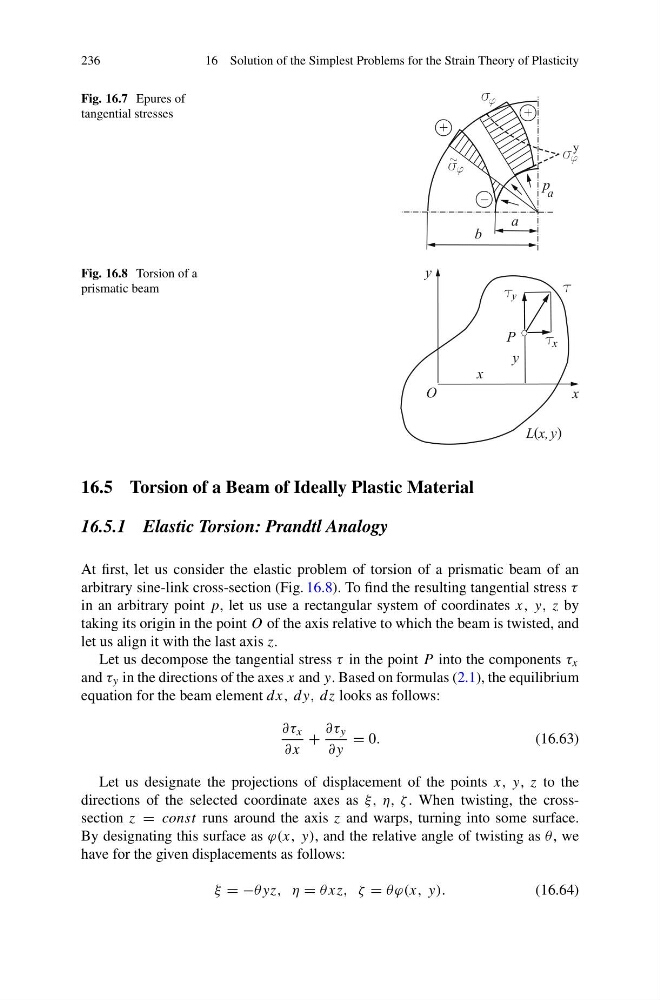
Fig. 16.8 Torsion of a
prismatic beam
16.5 Torsion of a Beam of Ideally Plastic Material
16.5.1 Elastic Torsion: Prandtl Analogy
At first, let us consider the elastic problem of torsion of a prismatic beam of an
arbitrary sine-link cross-section (Fig. 16.8). To find the resulting tangential stress τ
in an arbitrary point p, let us use a rectangular system of coordinates x, y, z by
taking its origin in the point O of the axis relative to which the beam is twisted, and
let us align it with the last axis z.
Let us decompose the tangential stress τ in the point P into the components τ x
and τ y in the directions of the axes x and y. Based on formulas (2.1), the equilibrium
equation for the beam element dx, dy, dz looks as follows:
∂τ x
∂x
+
∂τ y
∂y
= 0.
(16.63)
Let us designate the projections of displacement of the points x, y, z to the
directions of the selected coordinate axes as ξ, η, ζ . When twisting, the crosssection z = const runs around the axis z and warps, turning into some surface.
By designating this surface as ϕ(x, y), and the relative angle of twisting as θ , we
have for the given displacements as follows:
ξ = −θyz, η = θxz, ζ = θ ϕ(x, y).
(16.64)
16 Solution of the Simplest Problems for the Strain Theory of Plasticity
Fig. 16.7 Epures of
tangential stresses
Fig. 16.8 Torsion of a
prismatic beam
16.5 Torsion of a Beam of Ideally Plastic Material
16.5.1 Elastic Torsion: Prandtl Analogy
At first, let us consider the elastic problem of torsion of a prismatic beam of an
arbitrary sine-link cross-section (Fig. 16.8). To find the resulting tangential stress τ
in an arbitrary point p, let us use a rectangular system of coordinates x, y, z by
taking its origin in the point O of the axis relative to which the beam is twisted, and
let us align it with the last axis z.
Let us decompose the tangential stress τ in the point P into the components τ x
and τ y in the directions of the axes x and y. Based on formulas (2.1), the equilibrium
equation for the beam element dx, dy, dz looks as follows:
∂τ x
∂x
+
∂τ y
∂y
= 0.
(16.63)
Let us designate the projections of displacement of the points x, y, z to the
directions of the selected coordinate axes as ξ, η, ζ . When twisting, the crosssection z = const runs around the axis z and warps, turning into some surface.
By designating this surface as ϕ(x, y), and the relative angle of twisting as θ , we
have for the given displacements as follows:
ξ = −θyz, η = θxz, ζ = θ ϕ(x, y).
(16.64)