

238
16 Solution of the Simplest Problems for the Strain Theory of Plasticity
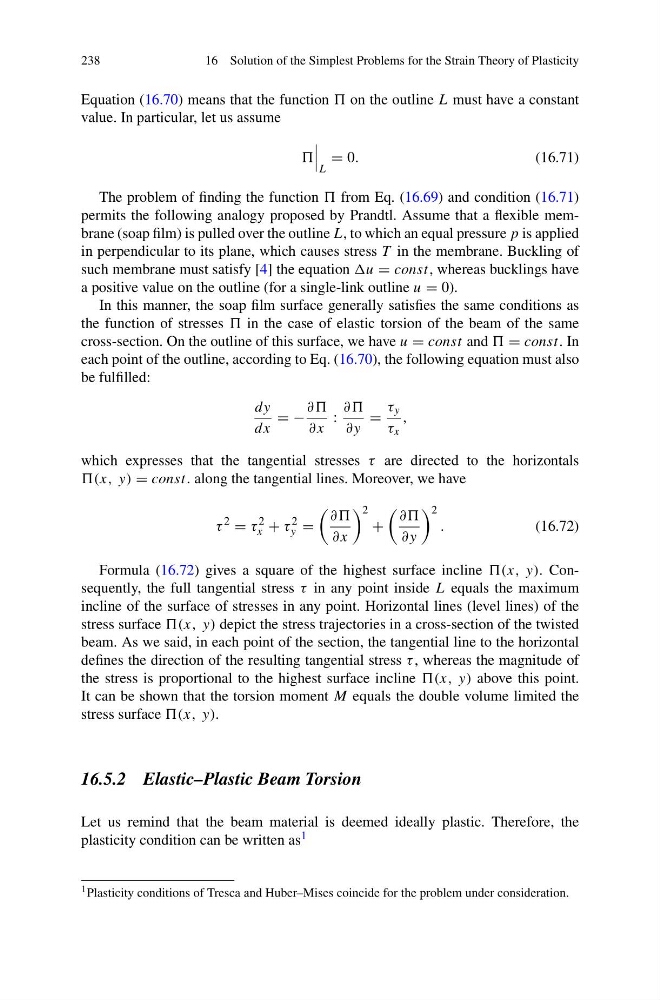
Equation (16.70) means that the function on the outline L must have a constant
value. In particular, let us assume
L
= 0.
(16.71)
The problem of finding the function from Eq. (16.69) and condition (16.71)
permits the following analogy proposed by Prandtl. Assume that a flexible membrane (soap film) is pulled over the outline L, to which an equal pressure p is applied
in perpendicular to its plane, which causes stress T in the membrane. Buckling of
such membrane must satisfy [4] the equation u = const, whereas bucklings have
a positive value on the outline (for a single-link outline u = 0).
In this manner, the soap film surface generally satisfies the same conditions as
the function of stresses in the case of elastic torsion of the beam of the same
cross-section. On the outline of this surface, we have u = const and = const. In
each point of the outline, according to Eq. (16.70), the following equation must also
be fulfilled:
dy
dx
= −
∂∂
∂x
:
∂∂
∂y
=
τ y
τ x
,
which expresses that the tangential stresses τ are directed to the horizontals
y) = const. along the tangential lines. Moreover, we have
τ
2
= τ
2
x + τ
2
y =
∂∂
∂x
2
+
∂∂
∂y
2
.
(16.72)
Formula (16.72) gives a square of the highest surface incline (x, y). Consequently, the full tangential stress τ in any point inside L equals the maximum
incline of the surface of stresses in any point. Horizontal lines (level lines) of the
stress surface y) depict the stress trajectories in a cross-section of the twisted
beam. As we said, in each point of the section, the tangential line to the horizontal
defines the direction of the resulting tangential stress τ , whereas the magnitude of
the stress is proportional to the highest surface incline y) above this point.
It can be shown that the torsion moment M equals the double volume limited the
stress surface y).
16.5.2 Elastic–Plastic Beam Torsion
Let us remind that the beam material is deemed ideally plastic. Therefore, the
plasticity condition can be written as 1
1 Plasticity conditions of Tresca and Huber–Mises coincide for the problem under consideration.
16 Solution of the Simplest Problems for the Strain Theory of Plasticity
Equation (16.70) means that the function on the outline L must have a constant
value. In particular, let us assume
L
= 0.
(16.71)
The problem of finding the function from Eq. (16.69) and condition (16.71)
permits the following analogy proposed by Prandtl. Assume that a flexible membrane (soap film) is pulled over the outline L, to which an equal pressure p is applied
in perpendicular to its plane, which causes stress T in the membrane. Buckling of
such membrane must satisfy [4] the equation u = const, whereas bucklings have
a positive value on the outline (for a single-link outline u = 0).
In this manner, the soap film surface generally satisfies the same conditions as
the function of stresses in the case of elastic torsion of the beam of the same
cross-section. On the outline of this surface, we have u = const and = const. In
each point of the outline, according to Eq. (16.70), the following equation must also
be fulfilled:
dy
dx
= −
∂∂
∂x
:
∂∂
∂y
=
τ y
τ x
,
which expresses that the tangential stresses τ are directed to the horizontals
y) = const. along the tangential lines. Moreover, we have
τ
2
= τ
2
x + τ
2
y =
∂∂
∂x
2
+
∂∂
∂y
2
.
(16.72)
Formula (16.72) gives a square of the highest surface incline (x, y). Consequently, the full tangential stress τ in any point inside L equals the maximum
incline of the surface of stresses in any point. Horizontal lines (level lines) of the
stress surface y) depict the stress trajectories in a cross-section of the twisted
beam. As we said, in each point of the section, the tangential line to the horizontal
defines the direction of the resulting tangential stress τ , whereas the magnitude of
the stress is proportional to the highest surface incline y) above this point.
It can be shown that the torsion moment M equals the double volume limited the
stress surface y).
16.5.2 Elastic–Plastic Beam Torsion
Let us remind that the beam material is deemed ideally plastic. Therefore, the
plasticity condition can be written as 1
1 Plasticity conditions of Tresca and Huber–Mises coincide for the problem under consideration.