

16.2 Torsion of a Round-Section Beam
223
16.2 Torsion of a Round-Section Beam
The solution to the problem of elastic–plastic torsion of a straight beam of a round
cross-section is obtained fundamentally in the suggestion that the hypothesis of
plane sections and no radius curvature is true.
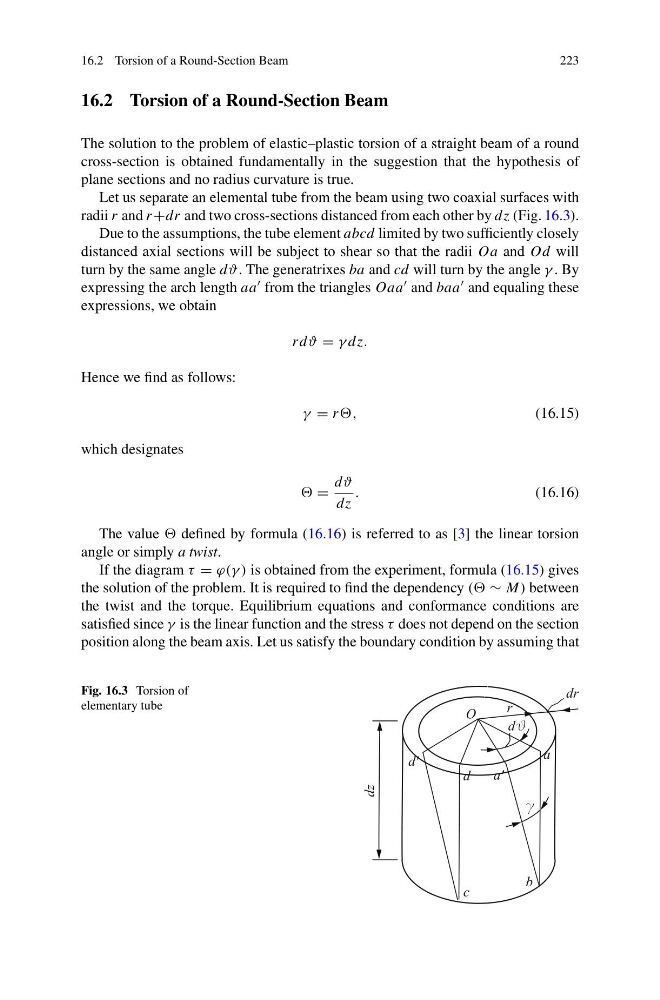
Let us separate an elemental tube from the beam using two coaxial surfaces with
radii r and r +dr and two cross-sections distanced from each other by dz (Fig. 16.3).
Due to the assumptions, the tube element abcd limited by two sufficiently closely
distanced axial sections will be subject to shear so that the radii Oa and Od will
turn by the same angle dϑ. The generatrixes ba and cd will turn by the angle γ . By
expressing the arch length aa from the triangles Oaa and baa and equaling these
expressions, we obtain
rdϑ = γ dz.
Hence we find as follows:
γ = rr,
(16.15)
which designates
=
dϑ
dz
.
(16.16)
The value defined by formula (16.16) is referred to as [3] the linear torsion
angle or simply a twist.
If the diagram τ = ϕ(γ ) is obtained from the experiment, formula (16.15) gives
the solution of the problem. It is required to find the dependency (( ∼ M) between
the twist and the torque. Equilibrium equations and conformance conditions are
satisfied since γ is the linear function and the stress τ does not depend on the section
position along the beam axis. Let us satisfy the boundary condition by assuming that
Fig. 16.3 Torsion of
elementary tube
223
16.2 Torsion of a Round-Section Beam
The solution to the problem of elastic–plastic torsion of a straight beam of a round
cross-section is obtained fundamentally in the suggestion that the hypothesis of
plane sections and no radius curvature is true.
Let us separate an elemental tube from the beam using two coaxial surfaces with
radii r and r +dr and two cross-sections distanced from each other by dz (Fig. 16.3).
Due to the assumptions, the tube element abcd limited by two sufficiently closely
distanced axial sections will be subject to shear so that the radii Oa and Od will
turn by the same angle dϑ. The generatrixes ba and cd will turn by the angle γ . By
expressing the arch length aa from the triangles Oaa and baa and equaling these
expressions, we obtain
rdϑ = γ dz.
Hence we find as follows:
γ = rr,
(16.15)
which designates
=
dϑ
dz
.
(16.16)
The value defined by formula (16.16) is referred to as [3] the linear torsion
angle or simply a twist.
If the diagram τ = ϕ(γ ) is obtained from the experiment, formula (16.15) gives
the solution of the problem. It is required to find the dependency (( ∼ M) between
the twist and the torque. Equilibrium equations and conformance conditions are
satisfied since γ is the linear function and the stress τ does not depend on the section
position along the beam axis. Let us satisfy the boundary condition by assuming that
Fig. 16.3 Torsion of
elementary tube