

222
16 Solution of the Simplest Problems for the Strain Theory of Plasticity
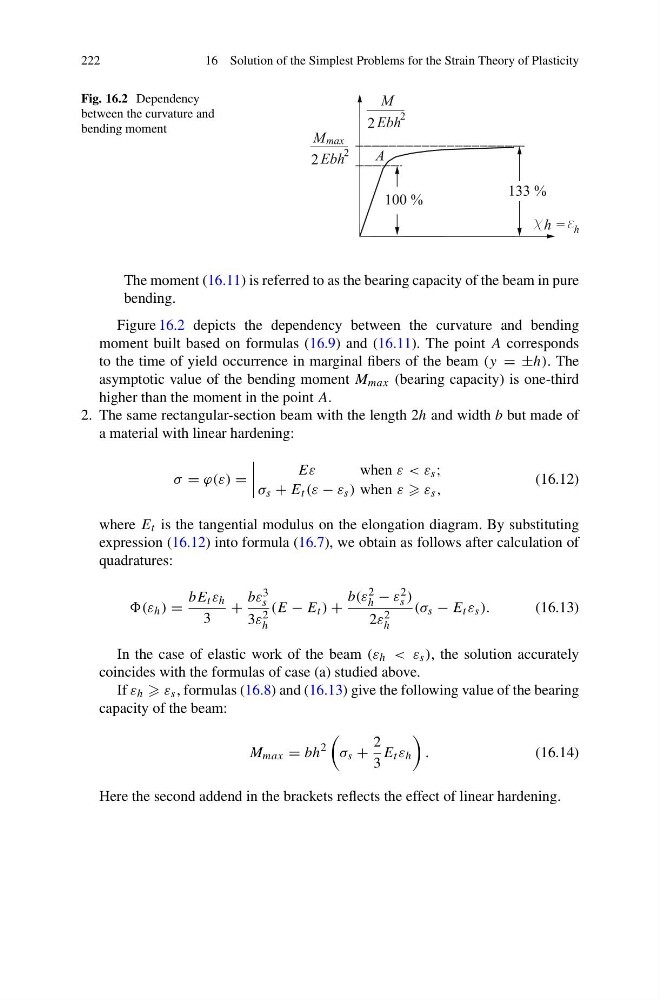
Fig. 16.2 Dependency
between the curvature and
bending moment
The moment (16.11) is referred to as the bearing capacity of the beam in pure
bending.
Figure 16.2 depicts the dependency between the curvature and bending
moment built based on formulas (16.9) and (16.11). The point A corresponds
to the time of yield occurrence in marginal fibers of the beam (y = ±h). The
asymptotic value of the bending moment M max (bearing capacity) is one-third
higher than the moment in the point A.
2. The same rectangular-section beam with the length 2h and width b but made of
a material with linear hardening:
σ = ϕ(ε) =
Eε
when ε < ε s ;
σ s + E t (ε − ε s ) when ε ε s ,
(16.12)
where E t is the tangential modulus on the elongation diagram. By substituting
expression (16.12) into formula (16.7), we obtain as follows after calculation of
quadratures:
h ) =
bE t ε h
3
+
bε 3
s
3ε 2
h
(E − E t ) +
b(ε 2
h − ε 2
s )
2ε 2
h
(σ s − E t ε s ).
(16.13)
In the case of elastic work of the beam (ε h < ε s ), the solution accurately
coincides with the formulas of case (a) studied above.
If ε h ε s , formulas (16.8) and (16.13) give the following value of the bearing
capacity of the beam:
M max = bh
2
σ s +
2
3
E t ε h
.
(16.14)
Here the second addend in the brackets reflects the effect of linear hardening.
16 Solution of the Simplest Problems for the Strain Theory of Plasticity
Fig. 16.2 Dependency
between the curvature and
bending moment
The moment (16.11) is referred to as the bearing capacity of the beam in pure
bending.
Figure 16.2 depicts the dependency between the curvature and bending
moment built based on formulas (16.9) and (16.11). The point A corresponds
to the time of yield occurrence in marginal fibers of the beam (y = ±h). The
asymptotic value of the bending moment M max (bearing capacity) is one-third
higher than the moment in the point A.
2. The same rectangular-section beam with the length 2h and width b but made of
a material with linear hardening:
σ = ϕ(ε) =
Eε
when ε < ε s ;
σ s + E t (ε − ε s ) when ε ε s ,
(16.12)
where E t is the tangential modulus on the elongation diagram. By substituting
expression (16.12) into formula (16.7), we obtain as follows after calculation of
quadratures:
h ) =
bE t ε h
3
+
bε 3
s
3ε 2
h
(E − E t ) +
b(ε 2
h − ε 2
s )
2ε 2
h
(σ s − E t ε s ).
(16.13)
In the case of elastic work of the beam (ε h < ε s ), the solution accurately
coincides with the formulas of case (a) studied above.
If ε h ε s , formulas (16.8) and (16.13) give the following value of the bearing
capacity of the beam:
M max = bh
2
σ s +
2
3
E t ε h
.
(16.14)
Here the second addend in the brackets reflects the effect of linear hardening.