

16.1 Pure Bending of a Straight Beam
221
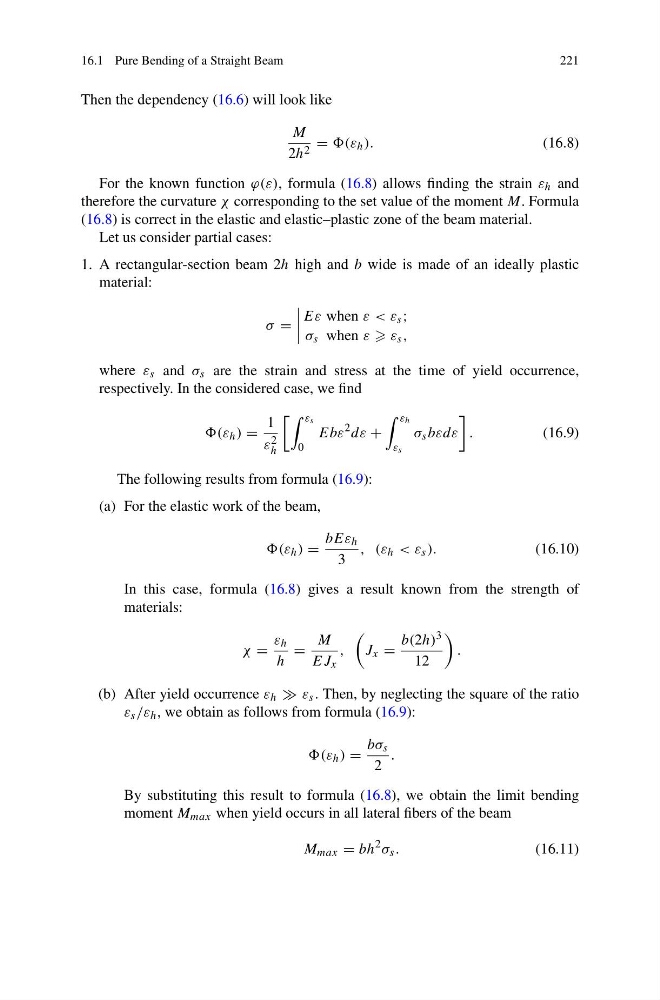
Then the dependency (16.6) will look like
M
2h 2 = h ).
(16.8)
For the known function ϕ(ε), formula (16.8) allows finding the strain ε h and
therefore the curvature χ corresponding to the set value of the moment M. Formula
(16.8) is correct in the elastic and elastic–plastic zone of the beam material.
Let us consider partial cases:
1. A rectangular-section beam 2h high and b wide is made of an ideally plastic
material:
σ =
Eε when ε < ε s ;
σ s when ε ε s ,
where ε s and σ s are the strain and stress at the time of yield occurrence,
respectively. In the considered case, we find
h ) =
1
ε 2
h
ε s
0
Ebε
2 dε +
ε h
ε s
σ s bεdε
.
(16.9)
The following results from formula (16.9):
(a) For the elastic work of the beam,
h ) =
bEε h
3
, (ε h < ε s ).
(16.10)
In this case, formula (16.8) gives a result known from the strength of
materials:
χ =
ε h
h
=
M
EJ x
,
J x =
b(2h) 3
12
.
(b) After yield occurrence ε h ε s . Then, by neglecting the square of the ratio
ε s /ε h , we obtain as follows from formula (16.9):
h ) =
bσ s
2
.
By substituting this result to formula (16.8), we obtain the limit bending
moment M max when yield occurs in all lateral fibers of the beam
M max = bh
2 σ s .
(16.11)
221
Then the dependency (16.6) will look like
M
2h 2 = h ).
(16.8)
For the known function ϕ(ε), formula (16.8) allows finding the strain ε h and
therefore the curvature χ corresponding to the set value of the moment M. Formula
(16.8) is correct in the elastic and elastic–plastic zone of the beam material.
Let us consider partial cases:
1. A rectangular-section beam 2h high and b wide is made of an ideally plastic
material:
σ =
Eε when ε < ε s ;
σ s when ε ε s ,
where ε s and σ s are the strain and stress at the time of yield occurrence,
respectively. In the considered case, we find
h ) =
1
ε 2
h
ε s
0
Ebε
2 dε +
ε h
ε s
σ s bεdε
.
(16.9)
The following results from formula (16.9):
(a) For the elastic work of the beam,
h ) =
bEε h
3
, (ε h < ε s ).
(16.10)
In this case, formula (16.8) gives a result known from the strength of
materials:
χ =
ε h
h
=
M
EJ x
,
J x =
b(2h) 3
12
.
(b) After yield occurrence ε h ε s . Then, by neglecting the square of the ratio
ε s /ε h , we obtain as follows from formula (16.9):
h ) =
bσ s
2
.
By substituting this result to formula (16.8), we obtain the limit bending
moment M max when yield occurs in all lateral fibers of the beam
M max = bh
2 σ s .
(16.11)