

224
16 Solution of the Simplest Problems for the Strain Theory of Plasticity
M =
R
0
τ r · 2πrdr = 2π
R
0
ϕ(γ )r
2 dr
=
2πR 3
γ 3
R
γ R
0
ϕ(γ )γ
2 dγ =
2π
φ 3
γ R
0
ϕ(γ )γ
2 dγ,
(16.17)
where R is the cross-section radius and γ R is the shear on the outline and is
designated as
φ =
γ R
R
.
Similarly to formula (16.8), let us write the dependency (16.17) as
M
2πR 3 = R ); (γ R ) =
1
γ 3
R
γ R
0
ϕ(γ )γ
2 dγ.
(16.18)
Let, for example, the function ϕ(γ ) satisfy the conditions of the simple loading
theorem (p. 213). Assume that
τ = ϕ(γ ) = τ T
γ
γ T
m
, (0 < m < 1),
(16.19)
where τ T is the shear yield stress, and γ T is its respective shear strain. By substituting
the function (16.19) into formulas (16.18) in the considered partial case, we obtain
(γ R ) =
τ
γ 3
R γ m
γ R
0
γ
2+m dγ =
τ
3 + m
γ R
γ
m
;
M
2πR 3 =
τ
3 + m
γ R
γ
m
.
(16.20)
Having the solution (16.20), we can calculate residual stresses ( ˜
τ ) in the case of
full unloading using the formula
˜
τ = τ −
Mr
J p
,
(16.21)
where J p is the polar moment of inertia of the beam cross-section. Assuming for
uncertainty m = 0.5, we obtain as follows using formulas (16.20)–(16.21):
˜
τ
τ T
=
2r
R
1 −
8
7
r
R
.
(16.22)
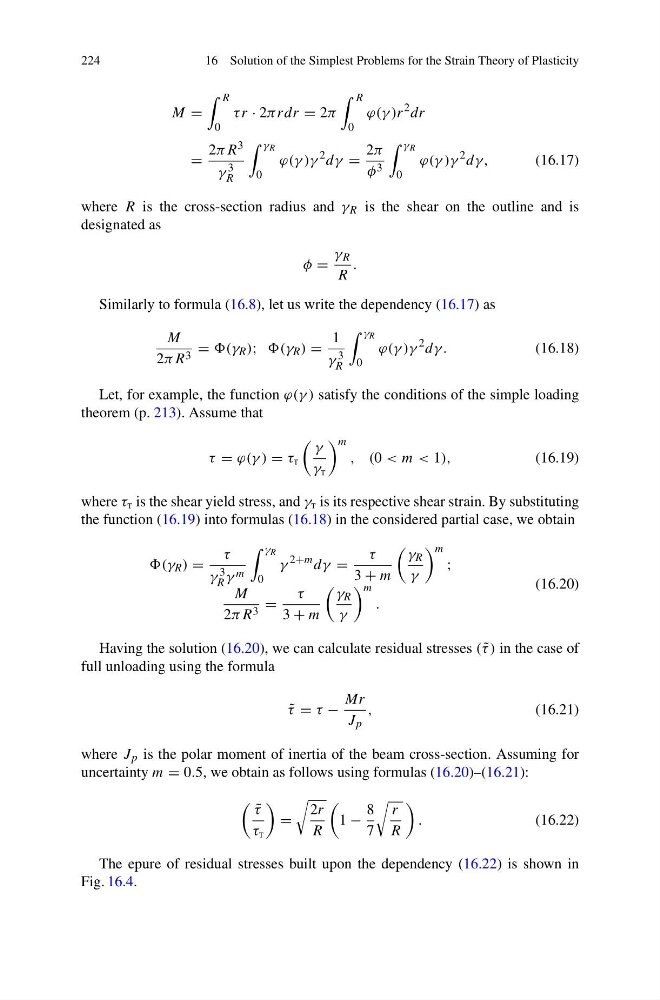
The epure of residual stresses built upon the dependency (16.22) is shown in
Fig. 16.4.
16 Solution of the Simplest Problems for the Strain Theory of Plasticity
M =
R
0
τ r · 2πrdr = 2π
R
0
ϕ(γ )r
2 dr
=
2πR 3
γ 3
R
γ R
0
ϕ(γ )γ
2 dγ =
2π
φ 3
γ R
0
ϕ(γ )γ
2 dγ,
(16.17)
where R is the cross-section radius and γ R is the shear on the outline and is
designated as
φ =
γ R
R
.
Similarly to formula (16.8), let us write the dependency (16.17) as
M
2πR 3 = R ); (γ R ) =
1
γ 3
R
γ R
0
ϕ(γ )γ
2 dγ.
(16.18)
Let, for example, the function ϕ(γ ) satisfy the conditions of the simple loading
theorem (p. 213). Assume that
τ = ϕ(γ ) = τ T
γ
γ T
m
, (0 < m < 1),
(16.19)
where τ T is the shear yield stress, and γ T is its respective shear strain. By substituting
the function (16.19) into formulas (16.18) in the considered partial case, we obtain
(γ R ) =
τ
γ 3
R γ m
γ R
0
γ
2+m dγ =
τ
3 + m
γ R
γ
m
;
M
2πR 3 =
τ
3 + m
γ R
γ
m
.
(16.20)
Having the solution (16.20), we can calculate residual stresses ( ˜
τ ) in the case of
full unloading using the formula
˜
τ = τ −
Mr
J p
,
(16.21)
where J p is the polar moment of inertia of the beam cross-section. Assuming for
uncertainty m = 0.5, we obtain as follows using formulas (16.20)–(16.21):
˜
τ
τ T
=
2r
R
1 −
8
7
r
R
.
(16.22)
The epure of residual stresses built upon the dependency (16.22) is shown in
Fig. 16.4.