

204
15 Plasticity Theory of Henky–Nadai–Ilyushin
δ
W = σ
x δε
x + . . . + τ zx δγ zx + 3σ 0 δε 0 .
(15.24)
Let us now express the stresses in formula (15.24) through strains using the strain
theory ratios
σ 0 = KK; σ
x = σ x − σ 0 =
2σ i
3ε i
(ε x − ε 0 ) =
2σ i
3ε i
ε
x .
(15.25)
We obtain
δ
W =
2σ i
3ε i
(ε
x δε
x + . . . + 2ε
xy δε
xy + . . .) + KKδδ.
(15.26)
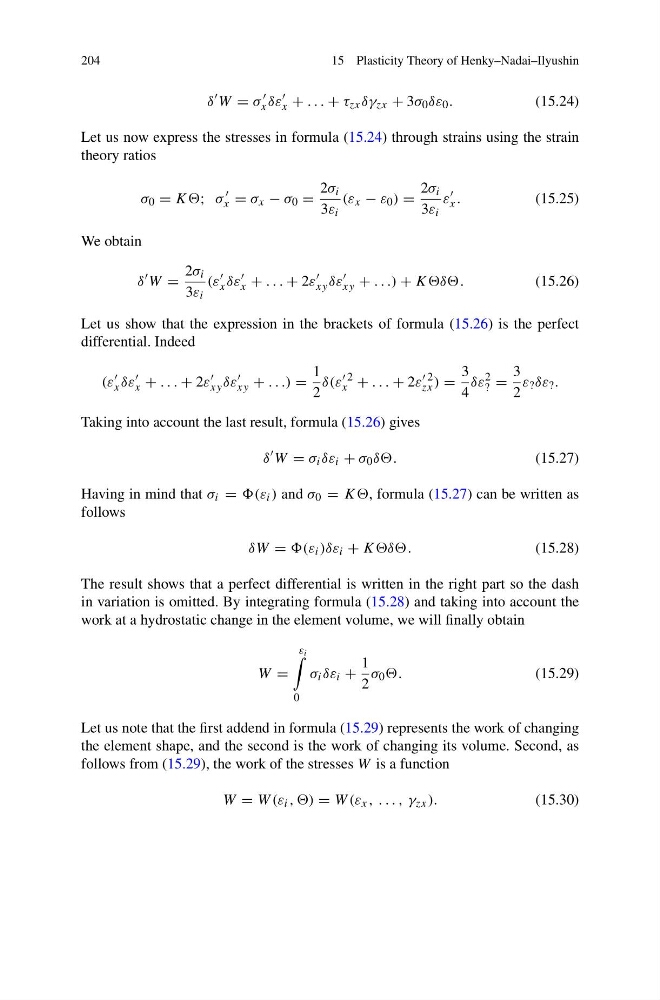
Let us show that the expression in the brackets of formula (15.26) is the perfect
differential. Indeed
(ε
x δε
x + . . . + 2ε
xy δε
xy + . . .) =
1
2
δ(ε
2
x + . . . + 2ε
2
zx ) =
3
4
δε
2
? =
3
2
ε ? δε ? .
Taking into account the last result, formula (15.26) gives
δ
W = σ i δε i + σ 0 δδ.
(15.27)
Having in mind that σ i = i ) and σ 0 = KK, formula (15.27) can be written as
follows
δW = i )δε i + KKδδ.
(15.28)
The result shows that a perfect differential is written in the right part so the dash
in variation is omitted. By integrating formula (15.28) and taking into account the
work at a hydrostatic change in the element volume, we will finally obtain
W =
ε i
0
σ i δε i +
1
2
σ 0 .
(15.29)
Let us note that the first addend in formula (15.29) represents the work of changing
the element shape, and the second is the work of changing its volume. Second, as
follows from (15.29), the work of the stresses W is a function
W = W (ε i , ,) = W (ε x , . . . , γ zx ).
(15.30)
15 Plasticity Theory of Henky–Nadai–Ilyushin
δ
W = σ
x δε
x + . . . + τ zx δγ zx + 3σ 0 δε 0 .
(15.24)
Let us now express the stresses in formula (15.24) through strains using the strain
theory ratios
σ 0 = KK; σ
x = σ x − σ 0 =
2σ i
3ε i
(ε x − ε 0 ) =
2σ i
3ε i
ε
x .
(15.25)
We obtain
δ
W =
2σ i
3ε i
(ε
x δε
x + . . . + 2ε
xy δε
xy + . . .) + KKδδ.
(15.26)
Let us show that the expression in the brackets of formula (15.26) is the perfect
differential. Indeed
(ε
x δε
x + . . . + 2ε
xy δε
xy + . . .) =
1
2
δ(ε
2
x + . . . + 2ε
2
zx ) =
3
4
δε
2
? =
3
2
ε ? δε ? .
Taking into account the last result, formula (15.26) gives
δ
W = σ i δε i + σ 0 δδ.
(15.27)
Having in mind that σ i = i ) and σ 0 = KK, formula (15.27) can be written as
follows
δW = i )δε i + KKδδ.
(15.28)
The result shows that a perfect differential is written in the right part so the dash
in variation is omitted. By integrating formula (15.28) and taking into account the
work at a hydrostatic change in the element volume, we will finally obtain
W =
ε i
0
σ i δε i +
1
2
σ 0 .
(15.29)
Let us note that the first addend in formula (15.29) represents the work of changing
the element shape, and the second is the work of changing its volume. Second, as
follows from (15.29), the work of the stresses W is a function
W = W (ε i , ,) = W (ε x , . . . , γ zx ).
(15.30)