

15.6 Work of Stresses, Potential Energy, and Potentials
205
15.6.1 Stress Potential
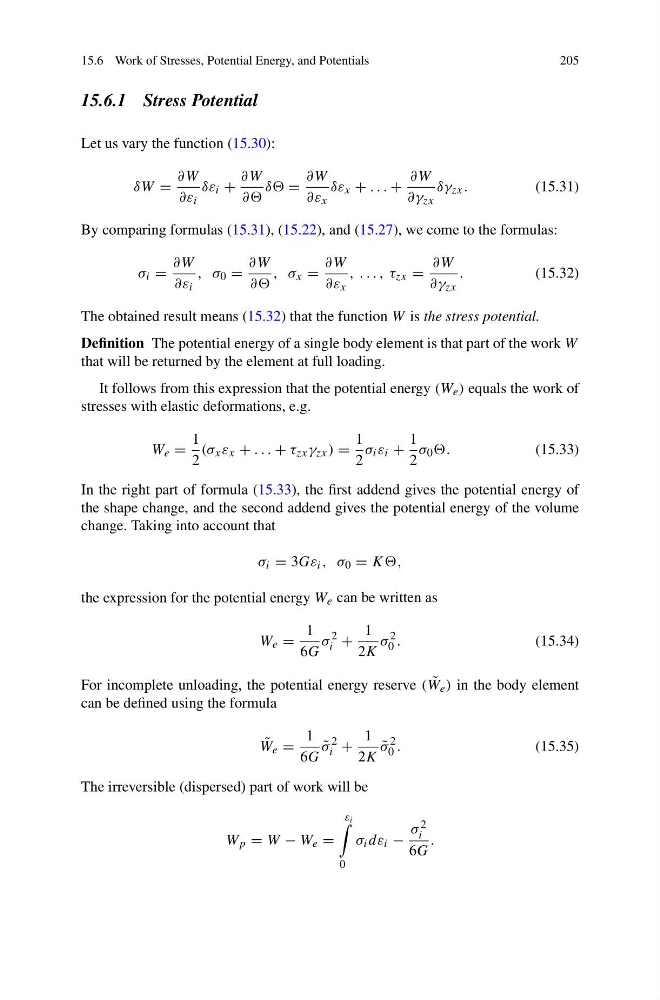
Let us vary the function (15.30):
δW =
∂W
∂ε i
δε i +
∂W
∂∂
δδ =
∂W
∂ε x
δε x + . . . +
∂W
∂γ zx
δγ zx .
(15.31)
By comparing formulas (15.31), (15.22), and (15.27), we come to the formulas:
σ i =
∂W
∂ε i
, σ 0 =
∂W
∂∂
, σ x =
∂W
∂ε x
, . . . , τ zx =
∂W
∂γ zx
.
(15.32)
The obtained result means (15.32) that the function W is the stress potential.
Definition The potential energy of a single body element is that part of the work W
that will be returned by the element at full loading.
It follows from this expression that the potential energy (W e ) equals the work of
stresses with elastic deformations, e.g.
W e =
1
2
(σ x ε x + . . . + τ zx γ zx ) =
1
2
σ i ε i +
1
2
σ 0 .
(15.33)
In the right part of formula (15.33), the first addend gives the potential energy of
the shape change, and the second addend gives the potential energy of the volume
change. Taking into account that
σ i = 3Gε i , σ 0 = KK,
the expression for the potential energy W e can be written as
W e =
1
6G
σ
2
i +
1
2K
σ
2
0 .
(15.34)
For incomplete unloading, the potential energy reserve ( ˜
W e ) in the body element
can be defined using the formula
˜
W e =
1
6G
˜
σ
2
i +
1
2K
˜
σ
2
0 .
(15.35)
The irreversible (dispersed) part of work will be
W p = W − W e =
ε i
0
σ i dε i −
σ 2
i
6G
.
205
15.6.1 Stress Potential
Let us vary the function (15.30):
δW =
∂W
∂ε i
δε i +
∂W
∂∂
δδ =
∂W
∂ε x
δε x + . . . +
∂W
∂γ zx
δγ zx .
(15.31)
By comparing formulas (15.31), (15.22), and (15.27), we come to the formulas:
σ i =
∂W
∂ε i
, σ 0 =
∂W
∂∂
, σ x =
∂W
∂ε x
, . . . , τ zx =
∂W
∂γ zx
.
(15.32)
The obtained result means (15.32) that the function W is the stress potential.
Definition The potential energy of a single body element is that part of the work W
that will be returned by the element at full loading.
It follows from this expression that the potential energy (W e ) equals the work of
stresses with elastic deformations, e.g.
W e =
1
2
(σ x ε x + . . . + τ zx γ zx ) =
1
2
σ i ε i +
1
2
σ 0 .
(15.33)
In the right part of formula (15.33), the first addend gives the potential energy of
the shape change, and the second addend gives the potential energy of the volume
change. Taking into account that
σ i = 3Gε i , σ 0 = KK,
the expression for the potential energy W e can be written as
W e =
1
6G
σ
2
i +
1
2K
σ
2
0 .
(15.34)
For incomplete unloading, the potential energy reserve ( ˜
W e ) in the body element
can be defined using the formula
˜
W e =
1
6G
˜
σ
2
i +
1
2K
˜
σ
2
0 .
(15.35)
The irreversible (dispersed) part of work will be
W p = W − W e =
ε i
0
σ i dε i −
σ 2
i
6G
.