

15.6 Work of Stresses, Potential Energy, and Potentials
203
Ratios (15.17)–(15.19) fully define the link between stresses and strains in the case
of unloading. In the coordinate form, these ratios can be written as follows:
σ x − ˜
σ x = λ(( − ˜
) + 2G(ε x − ˜
ε x ),
. . . . . . . . . . . . . . . . . . . . . . . . . . . ,
. . . . . . . . . . . . . . . . . . . . . . . . . . . ,
τ xy − ˜
τ xy = G(γ xy − ˜
γ xy ).
(15.20)
If we assume ˜
σ x = ˜
σ y = . . . = ˜
τ zx = 0 in formulas (15.20), the components
˜
ε x = ε
p
x , . . . will define residual plastic strains in the case of full unloading.
15.6 Work of Stresses, Potential Energy, and Potentials
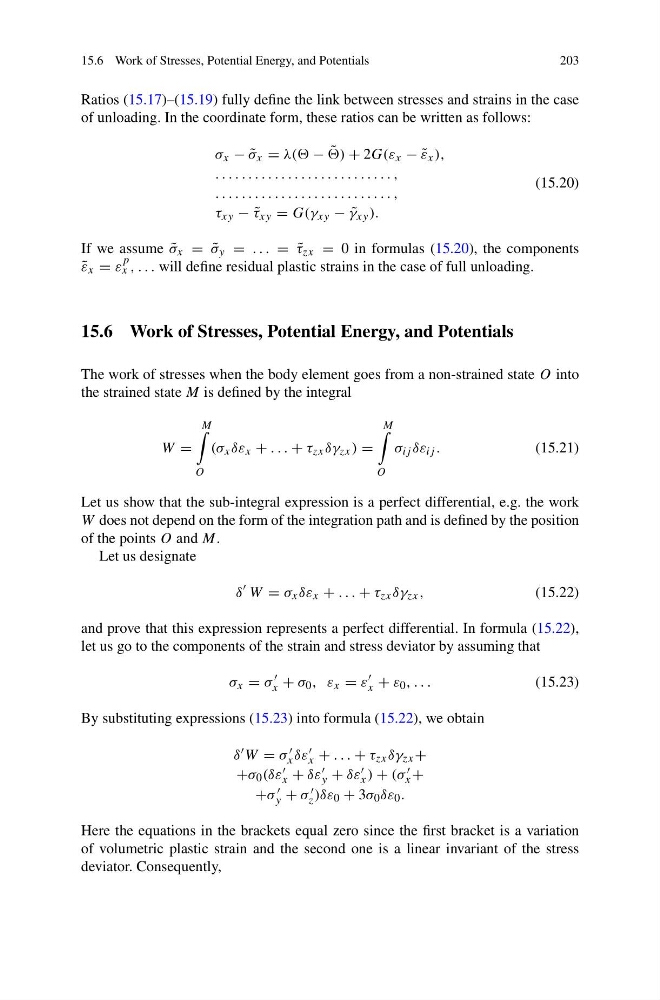
The work of stresses when the body element goes from a non-strained state O into
the strained state M is defined by the integral
W =
M
O
(σ x δε x + . . . + τ zx δγ zx ) =
M
O
σ ij δε ij .
(15.21)
Let us show that the sub-integral expression is a perfect differential, e.g. the work
W does not depend on the form of the integration path and is defined by the position
of the points O and M.
Let us designate
δ
W = σ x δε x + . . . + τ zx δγ zx ,
(15.22)
and prove that this expression represents a perfect differential. In formula (15.22),
let us go to the components of the strain and stress deviator by assuming that
σ x = σ
x + σ 0 , ε x = ε
x + ε 0 , . . .
(15.23)
By substituting expressions (15.23) into formula (15.22), we obtain
δ W = σ
x δε
x + . . . + τ zx δγ zx +
+σ 0 (δε
x + δε
y + δε
x ) + (σ
x +
+σ
y + σ
z )δε 0 + 3σ 0 δε 0 .
Here the equations in the brackets equal zero since the first bracket is a variation
of volumetric plastic strain and the second one is a linear invariant of the stress
deviator. Consequently,
203
Ratios (15.17)–(15.19) fully define the link between stresses and strains in the case
of unloading. In the coordinate form, these ratios can be written as follows:
σ x − ˜
σ x = λ(( − ˜
) + 2G(ε x − ˜
ε x ),
. . . . . . . . . . . . . . . . . . . . . . . . . . . ,
. . . . . . . . . . . . . . . . . . . . . . . . . . . ,
τ xy − ˜
τ xy = G(γ xy − ˜
γ xy ).
(15.20)
If we assume ˜
σ x = ˜
σ y = . . . = ˜
τ zx = 0 in formulas (15.20), the components
˜
ε x = ε
p
x , . . . will define residual plastic strains in the case of full unloading.
15.6 Work of Stresses, Potential Energy, and Potentials
The work of stresses when the body element goes from a non-strained state O into
the strained state M is defined by the integral
W =
M
O
(σ x δε x + . . . + τ zx δγ zx ) =
M
O
σ ij δε ij .
(15.21)
Let us show that the sub-integral expression is a perfect differential, e.g. the work
W does not depend on the form of the integration path and is defined by the position
of the points O and M.
Let us designate
δ
W = σ x δε x + . . . + τ zx δγ zx ,
(15.22)
and prove that this expression represents a perfect differential. In formula (15.22),
let us go to the components of the strain and stress deviator by assuming that
σ x = σ
x + σ 0 , ε x = ε
x + ε 0 , . . .
(15.23)
By substituting expressions (15.23) into formula (15.22), we obtain
δ W = σ
x δε
x + . . . + τ zx δγ zx +
+σ 0 (δε
x + δε
y + δε
x ) + (σ
x +
+σ
y + σ
z )δε 0 + 3σ 0 δε 0 .
Here the equations in the brackets equal zero since the first bracket is a variation
of volumetric plastic strain and the second one is a linear invariant of the stress
deviator. Consequently,