

200
15 Plasticity Theory of Henky–Nadai–Ilyushin
1 ω + ε i
dω
dε i
ω 0.
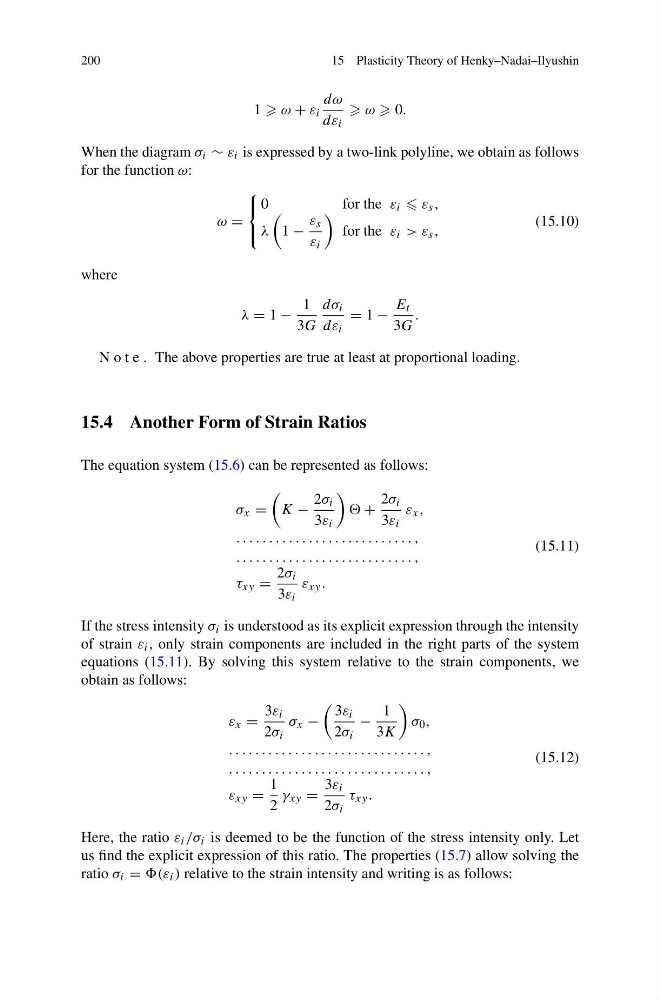
When the diagram σ i ∼ ε i is expressed by a two-link polyline, we obtain as follows
for the function ω:
ω =
⎧
⎨
⎩
0
f o rt h eε i ε s ,
λ
1 −
ε s
ε i
for the ε i > ε s ,
(15.10)
where
λ = 1 −
1
3G
dσ i
dε i
= 1 −
E t
3G
.
N o t e . The above properties are true at least at proportional loading.
15.4 Another Form of Strain Ratios
The equation system (15.6) can be represented as follows:
σ x =
K −
2σ i
3ε i
+
2σ i
3ε i
ε x ,
. . . . . . . . . . . . . . . . . . . . . . . . . . . ,
. . . . . . . . . . . . . . . . . . . . . . . . . . . ,
τ xy =
2σ i
3ε i
ε xy .
(15.11)
If the stress intensity σ i is understood as its explicit expression through the intensity
of strain ε i , only strain components are included in the right parts of the system
equations (15.11). By solving this system relative to the strain components, we
obtain as follows:
ε x =
3ε i
2σ i
σ x −
3ε i
2σ i
−
1
3K
σ 0 ,
. . . . . . . . . . . . . . . . . . . . . . . . . . . . . . ,
. . . . . . . . . . . . . . . . . . . . . . . . . . . . . . ,
ε xy =
1
2
γ xy =
3ε i
2σ i
τ xy .
(15.12)
Here, the ratio ε i /σ i is deemed to be the function of the stress intensity only. Let
us find the explicit expression of this ratio. The properties (15.7) allow solving the
ratio σ i = i ) relative to the strain intensity and writing is as follows:
15 Plasticity Theory of Henky–Nadai–Ilyushin
1 ω + ε i
dω
dε i
ω 0.
When the diagram σ i ∼ ε i is expressed by a two-link polyline, we obtain as follows
for the function ω:
ω =
⎧
⎨
⎩
0
f o rt h eε i ε s ,
λ
1 −
ε s
ε i
for the ε i > ε s ,
(15.10)
where
λ = 1 −
1
3G
dσ i
dε i
= 1 −
E t
3G
.
N o t e . The above properties are true at least at proportional loading.
15.4 Another Form of Strain Ratios
The equation system (15.6) can be represented as follows:
σ x =
K −
2σ i
3ε i
+
2σ i
3ε i
ε x ,
. . . . . . . . . . . . . . . . . . . . . . . . . . . ,
. . . . . . . . . . . . . . . . . . . . . . . . . . . ,
τ xy =
2σ i
3ε i
ε xy .
(15.11)
If the stress intensity σ i is understood as its explicit expression through the intensity
of strain ε i , only strain components are included in the right parts of the system
equations (15.11). By solving this system relative to the strain components, we
obtain as follows:
ε x =
3ε i
2σ i
σ x −
3ε i
2σ i
−
1
3K
σ 0 ,
. . . . . . . . . . . . . . . . . . . . . . . . . . . . . . ,
. . . . . . . . . . . . . . . . . . . . . . . . . . . . . . ,
ε xy =
1
2
γ xy =
3ε i
2σ i
τ xy .
(15.12)
Here, the ratio ε i /σ i is deemed to be the function of the stress intensity only. Let
us find the explicit expression of this ratio. The properties (15.7) allow solving the
ratio σ i = i ) relative to the strain intensity and writing is as follows: