

15.4 Another Form of Strain Ratios
201
ε i =
− (σ i ).
In this manner,
ε i
σ i
=
− (σ i )
σ i
.
(15.13)
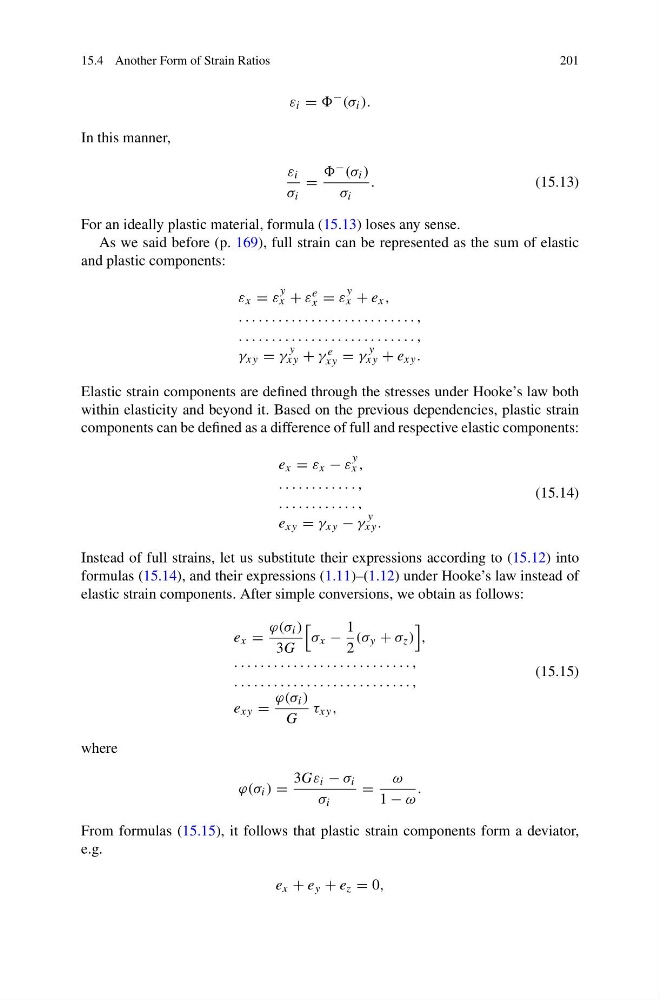
For an ideally plastic material, formula (15.13) loses any sense.
As we said before (p. 169), full strain can be represented as the sum of elastic
and plastic components:
ε x = ε
y
x + ε e
x = ε
y
x + e x ,
. . . . . . . . . . . . . . . . . . . . . . . . . . . ,
. . . . . . . . . . . . . . . . . . . . . . . . . . . ,
γ xy = γ
y
xy + γ e
xy = γ
y
xy + e xy .
Elastic strain components are defined through the stresses under Hooke’s law both
within elasticity and beyond it. Based on the previous dependencies, plastic strain
components can be defined as a difference of full and respective elastic components:
e x = ε x − ε
y
x ,
. . . . . . . . . . . . ,
. . . . . . . . . . . . ,
e xy = γ xy − γ
y
xy .
(15.14)
Instead of full strains, let us substitute their expressions according to (15.12) into
formulas (15.14), and their expressions (1.11)–(1.12) under Hooke’s law instead of
elastic strain components. After simple conversions, we obtain as follows:
e x =
ϕ(σ i )
3G
σ x −
1
2
(σ y + σ z )
,
. . . . . . . . . . . . . . . . . . . . . . . . . . . ,
. . . . . . . . . . . . . . . . . . . . . . . . . . . ,
e xy =
ϕ(σ i )
G
τ xy ,
(15.15)
where
ϕ(σ i ) =
3Gε i − σ i
σ i
=
ω
1 − ω
.
From formulas (15.15), it follows that plastic strain components form a deviator,
e.g.
e x + e y + e z = 0,
201
ε i =
− (σ i ).
In this manner,
ε i
σ i
=
− (σ i )
σ i
.
(15.13)
For an ideally plastic material, formula (15.13) loses any sense.
As we said before (p. 169), full strain can be represented as the sum of elastic
and plastic components:
ε x = ε
y
x + ε e
x = ε
y
x + e x ,
. . . . . . . . . . . . . . . . . . . . . . . . . . . ,
. . . . . . . . . . . . . . . . . . . . . . . . . . . ,
γ xy = γ
y
xy + γ e
xy = γ
y
xy + e xy .
Elastic strain components are defined through the stresses under Hooke’s law both
within elasticity and beyond it. Based on the previous dependencies, plastic strain
components can be defined as a difference of full and respective elastic components:
e x = ε x − ε
y
x ,
. . . . . . . . . . . . ,
. . . . . . . . . . . . ,
e xy = γ xy − γ
y
xy .
(15.14)
Instead of full strains, let us substitute their expressions according to (15.12) into
formulas (15.14), and their expressions (1.11)–(1.12) under Hooke’s law instead of
elastic strain components. After simple conversions, we obtain as follows:
e x =
ϕ(σ i )
3G
σ x −
1
2
(σ y + σ z )
,
. . . . . . . . . . . . . . . . . . . . . . . . . . . ,
. . . . . . . . . . . . . . . . . . . . . . . . . . . ,
e xy =
ϕ(σ i )
G
τ xy ,
(15.15)
where
ϕ(σ i ) =
3Gε i − σ i
σ i
=
ω
1 − ω
.
From formulas (15.15), it follows that plastic strain components form a deviator,
e.g.
e x + e y + e z = 0,