

15.3 Some Properties of the Hardening Function
199
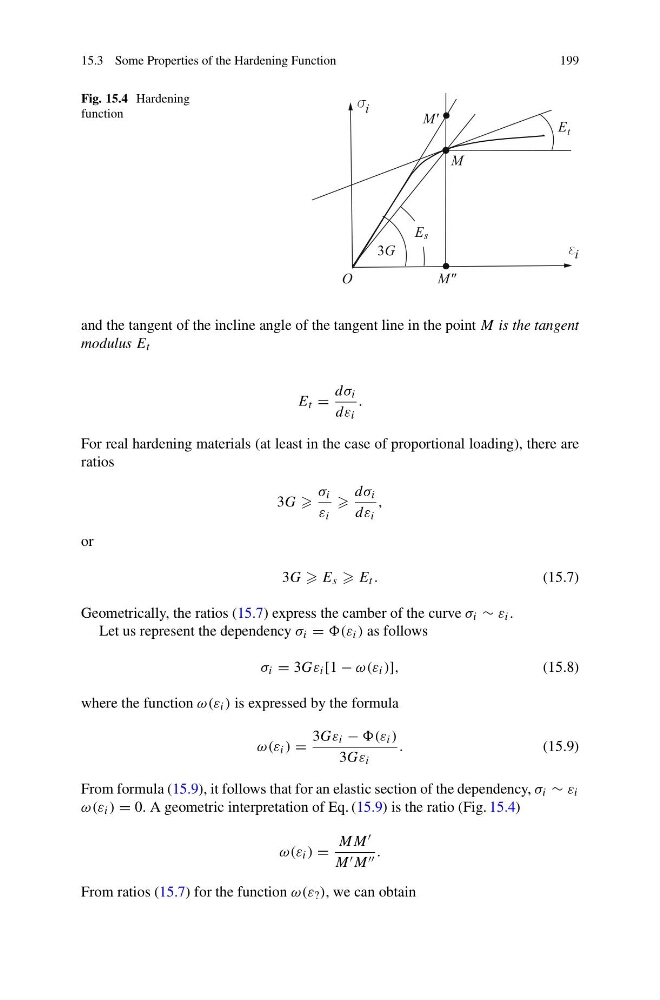
Fig. 15.4 Hardening
function
and the tangent of the incline angle of the tangent line in the point M is the tangent
modulus E t
E t =
dσ i
dε i
.
For real hardening materials (at least in the case of proportional loading), there are
ratios
3G
σ i
ε i
dσ i
dε i
,
or
3G E s E t .
(15.7)
Geometrically, the ratios (15.7) express the camber of the curve σ i ∼ ε i .
Let us represent the dependency σ i = i ) as follows
σ i = 3Gε i [1 − ω(ε i )],
(15.8)
where the function ω(ε i ) is expressed by the formula
ω(ε i ) =
3Gε i − i )
3Gε i
.
(15.9)
From formula (15.9), it follows that for an elastic section of the dependency, σ i ∼ ε i
ω(ε i ) = 0. A geometric interpretation of Eq. (15.9) is the ratio (Fig. 15.4)
ω(ε i ) =
MM
M M .
From ratios (15.7) for the function ω(ε ? ), we can obtain
199
Fig. 15.4 Hardening
function
and the tangent of the incline angle of the tangent line in the point M is the tangent
modulus E t
E t =
dσ i
dε i
.
For real hardening materials (at least in the case of proportional loading), there are
ratios
3G
σ i
ε i
dσ i
dε i
,
or
3G E s E t .
(15.7)
Geometrically, the ratios (15.7) express the camber of the curve σ i ∼ ε i .
Let us represent the dependency σ i = i ) as follows
σ i = 3Gε i [1 − ω(ε i )],
(15.8)
where the function ω(ε i ) is expressed by the formula
ω(ε i ) =
3Gε i − i )
3Gε i
.
(15.9)
From formula (15.9), it follows that for an elastic section of the dependency, σ i ∼ ε i
ω(ε i ) = 0. A geometric interpretation of Eq. (15.9) is the ratio (Fig. 15.4)
ω(ε i ) =
MM
M M .
From ratios (15.7) for the function ω(ε ? ), we can obtain