

14.4 Huber–Mises Plasticity Condition
185
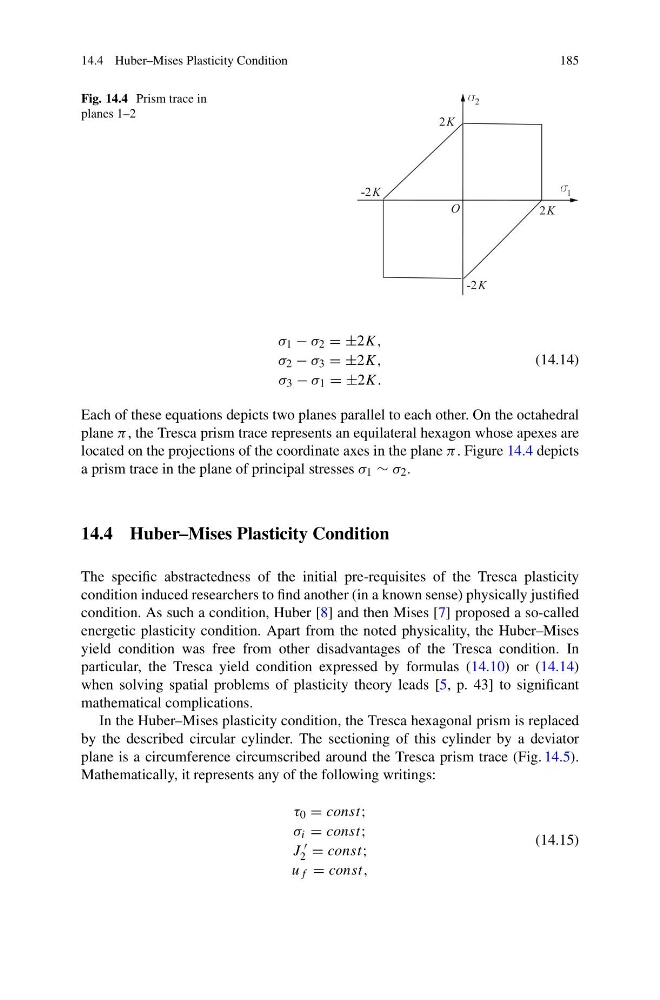
Fig. 14.4 Prism trace in
planes 1–2
σ 1 − σ 2 = ±2K,
σ 2 − σ 3 = ±2K,
σ 3 − σ 1 = ±2K.
(14.14)
Each of these equations depicts two planes parallel to each other. On the octahedral
plane π , the Tresca prism trace represents an equilateral hexagon whose apexes are
located on the projections of the coordinate axes in the plane π . Figure 14.4 depicts
a prism trace in the plane of principal stresses σ 1 ∼ σ 2 .
14.4 Huber–Mises Plasticity Condition
The specific abstractedness of the initial pre-requisites of the Tresca plasticity
condition induced researchers to find another (in a known sense) physically justified
condition. As such a condition, Huber [8] and then Mises [7] proposed a so-called
energetic plasticity condition. Apart from the noted physicality, the Huber–Mises
yield condition was free from other disadvantages of the Tresca condition. In
particular, the Tresca yield condition expressed by formulas (14.10) or (14.14)
when solving spatial problems of plasticity theory leads [5, p. 43] to significant
mathematical complications.
In the Huber–Mises plasticity condition, the Tresca hexagonal prism is replaced
by the described circular cylinder. The sectioning of this cylinder by a deviator
plane is a circumference circumscribed around the Tresca prism trace (Fig. 14.5).
Mathematically, it represents any of the following writings:
τ 0 = const;
σ i = const;
J
2 = const;
u f = const,
(14.15)
185
Fig. 14.4 Prism trace in
planes 1–2
σ 1 − σ 2 = ±2K,
σ 2 − σ 3 = ±2K,
σ 3 − σ 1 = ±2K.
(14.14)
Each of these equations depicts two planes parallel to each other. On the octahedral
plane π , the Tresca prism trace represents an equilateral hexagon whose apexes are
located on the projections of the coordinate axes in the plane π . Figure 14.4 depicts
a prism trace in the plane of principal stresses σ 1 ∼ σ 2 .
14.4 Huber–Mises Plasticity Condition
The specific abstractedness of the initial pre-requisites of the Tresca plasticity
condition induced researchers to find another (in a known sense) physically justified
condition. As such a condition, Huber [8] and then Mises [7] proposed a so-called
energetic plasticity condition. Apart from the noted physicality, the Huber–Mises
yield condition was free from other disadvantages of the Tresca condition. In
particular, the Tresca yield condition expressed by formulas (14.10) or (14.14)
when solving spatial problems of plasticity theory leads [5, p. 43] to significant
mathematical complications.
In the Huber–Mises plasticity condition, the Tresca hexagonal prism is replaced
by the described circular cylinder. The sectioning of this cylinder by a deviator
plane is a circumference circumscribed around the Tresca prism trace (Fig. 14.5).
Mathematically, it represents any of the following writings:
τ 0 = const;
σ i = const;
J
2 = const;
u f = const,
(14.15)